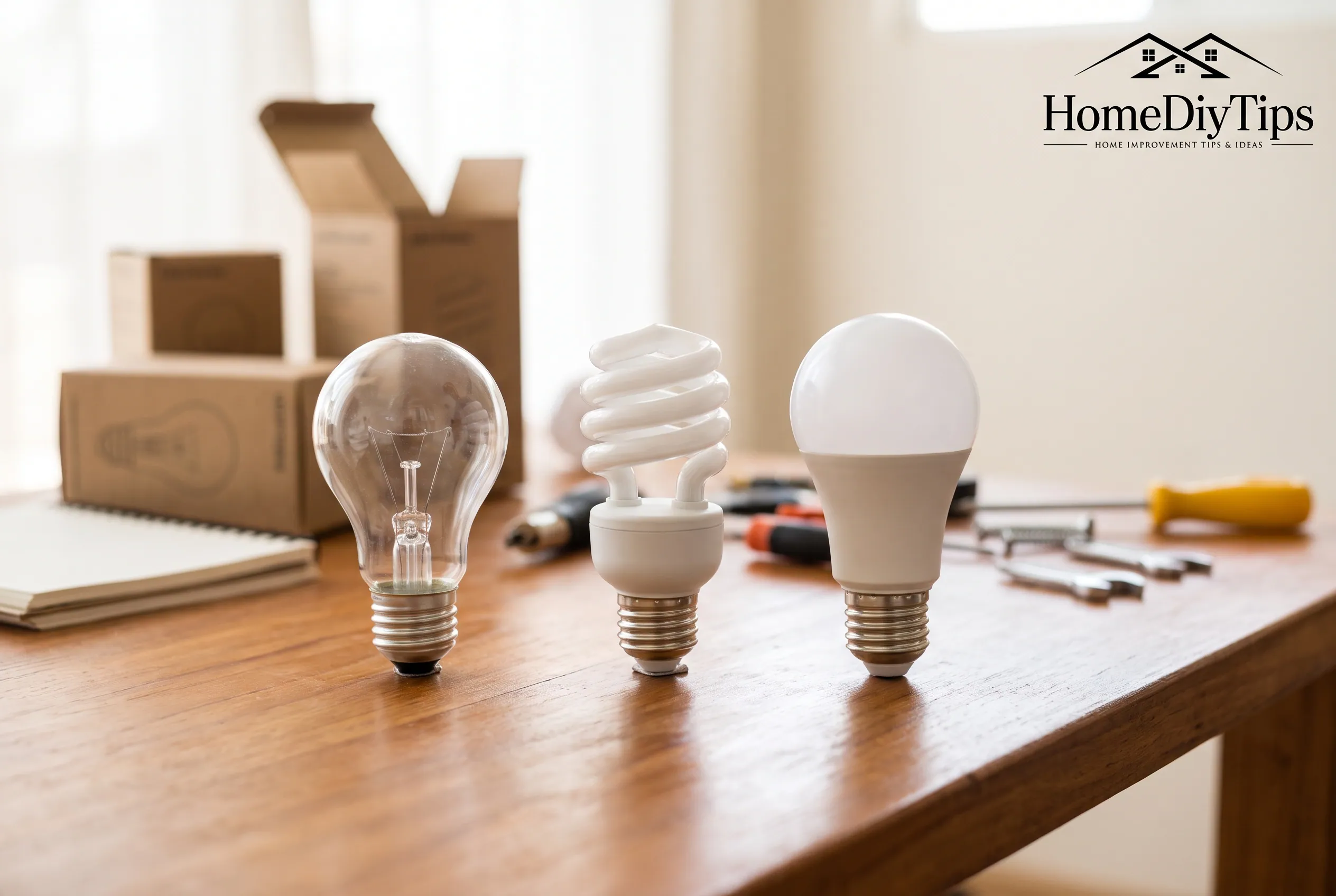
The three most common types of light bulbs used in homes are LED, CFL, and incandescent bulbs. They all produce light, but they differ in how they work, how much electricity they use, how long they last, and the kind of light they provide.
For most everyday home lighting, LED bulbs are a practical first choice because they use less energy than traditional incandescent bulbs and generally last much longer. CFL bulbs are another energy-efficient option, although they contain a small amount of mercury. Incandescent bulbs provide a familiar warm glow but use more electricity and produce more heat.
Understanding these differences can help you choose the right bulb for your living room, bedroom, kitchen, bathroom, or outdoor fixture. You should also consider brightness, light color, bulb base, and whether the bulb works with your fixture or dimmer switch.
Short Definition
The three common household light bulb types are LED, CFL, and incandescent. They differ in energy use, lifespan, and light quality, with LEDs generally offering the best efficiency for everyday home lighting.
Experience
Before buying a replacement bulb, check its lumens for brightness, color temperature for the look of the light, and base type for a proper fit. Also confirm that the bulb is compatible with your fixture and dimmer, if applicable.
What Are the 3 Types of Light Bulbs?
The three main types commonly compared for household lighting are:
- LED (light-emitting diode): An energy-efficient bulb that produces light using electronic components.
- CFL (compact fluorescent lamp): An energy-saving bulb that uses fluorescent technology.
- Incandescent: A traditional bulb that produces light by heating a thin wire filament.
These are the three main categories people usually mean when asking about light bulb types. They are not the only options. Halogen bulbs, fluorescent tubes, specialty bulbs, and different types of LED lighting are also available.
Each type has advantages and disadvantages. The best choice depends on how often you use the light, how much brightness you need, your preferred light color, and the requirements of your fixture.
1. LED Bulbs: Energy-Efficient and Long-Lasting
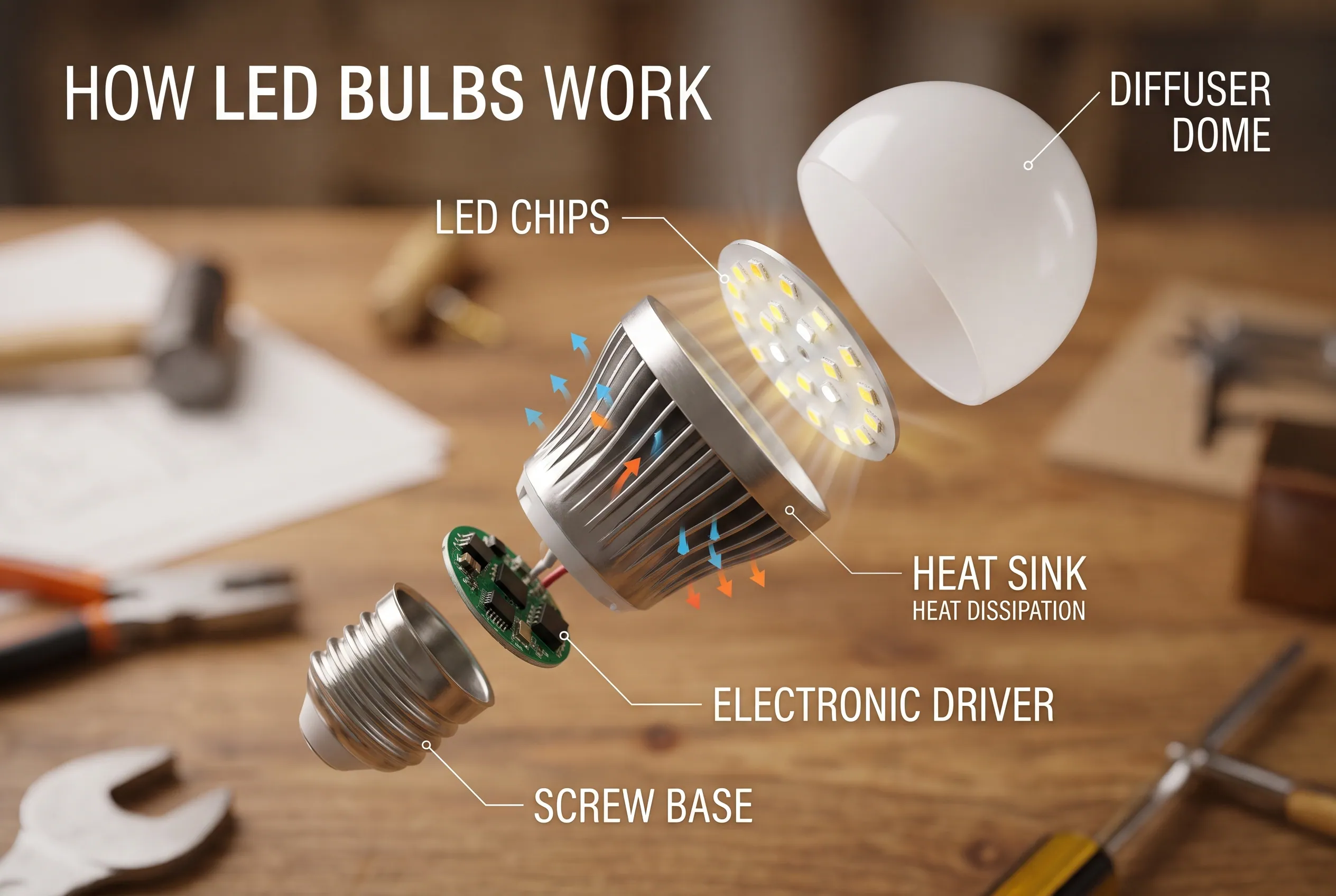
LED stands for light-emitting diode. Unlike an incandescent bulb, an LED does not need to heat a wire until it glows. Instead, electronic components inside the bulb produce light when electricity passes through them.
LED bulbs are widely used in homes because they combine low energy use with a long rated lifespan.
Benefits of LED bulbs
They use less electricity. An LED can provide similar brightness to a traditional incandescent bulb while consuming substantially less power. This can help reduce the electricity used for lighting, especially in rooms where lights stay on for several hours a day.
They generally last longer. Many household LED bulbs have rated lifespans measured in tens of thousands of hours, although the actual lifespan depends on the product, operating conditions, and fixture.
They offer different light colors. You can find LEDs that produce warm white light for relaxing spaces, neutral or cool white light for work areas, and daylight-style light for tasks that need a crisp appearance.
They come in many designs. Standard screw-in bulbs, decorative filament-style LEDs, recessed-light bulbs, floodlights, smart bulbs, and integrated LED fixtures are all available.
What should you know before buying LEDs?
LED bulbs often cost more upfront than basic incandescent bulbs, although their lower energy use and longer lifespan can make them economical over time.
They also produce heat around their electronic components, even though they generally release much less heat into the room than incandescent bulbs. Some LEDs need specific ventilation or fixture conditions to operate reliably.
Check the packaging before installing an LED in an enclosed fixture, a dimmer-controlled light, or an outdoor fitting. The bulb must be rated for the conditions in which you plan to use it.
Where are LED bulbs best used?
LEDs are suitable for most everyday home lighting, including:
- Living rooms and bedrooms
- Kitchens and dining areas
- Hallways and staircases
- Porch lights and outdoor fixtures
- Desk lamps and reading lights
- Smart lighting systems
For a typical homeowner replacing frequently used bulbs, an LED is usually the best place to start.
2. CFL Bulbs: Compact Fluorescent Lighting
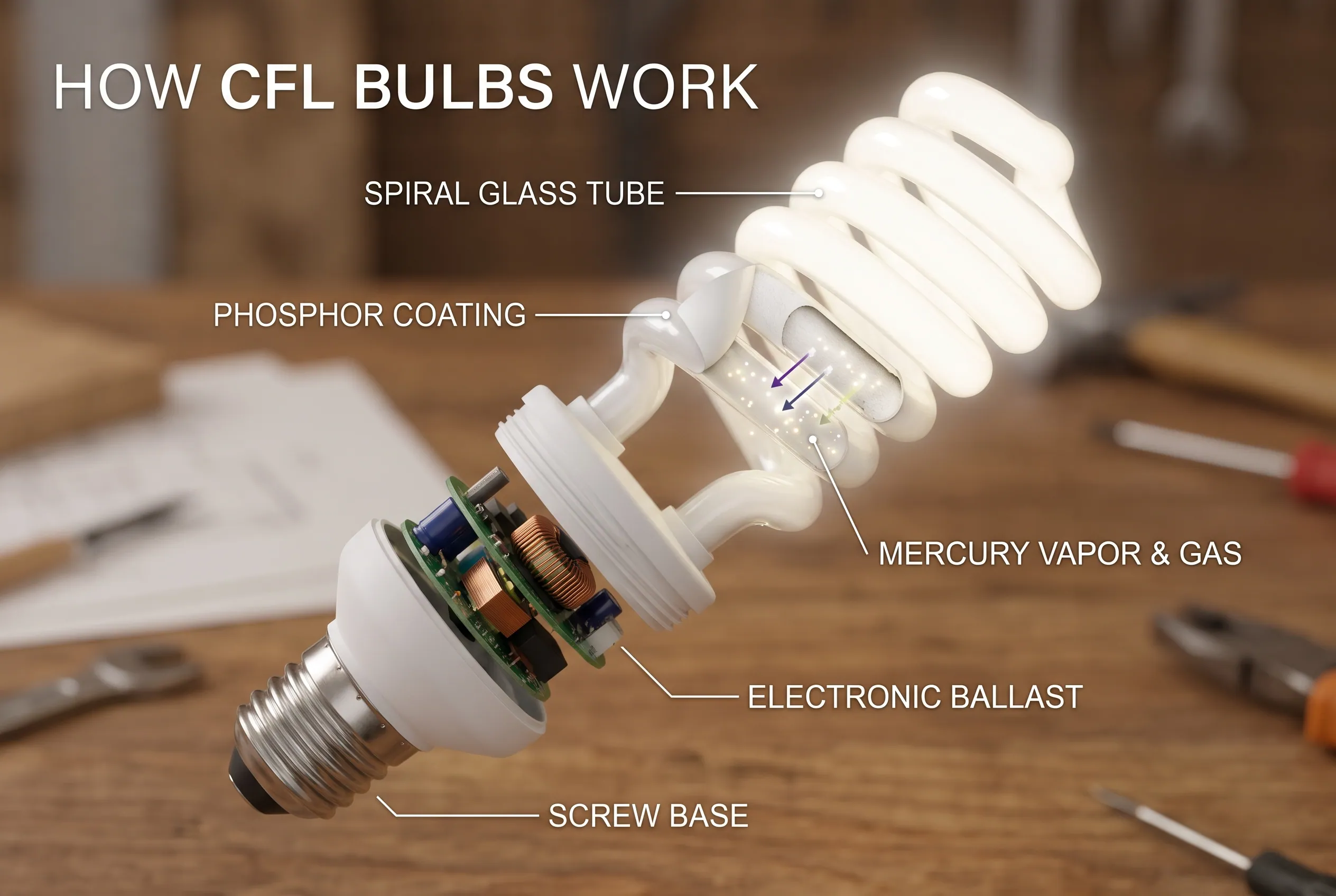
CFL stands for compact fluorescent lamp. These bulbs use fluorescent technology in a compact tube that may be curled into a spiral or folded into another shape.
Inside a CFL, electricity excites mercury vapor, producing ultraviolet energy. A coating inside the tube converts that energy into visible light.
CFLs became popular as an energy-saving alternative to incandescent bulbs because they generally use less electricity and last longer.
Benefits of CFL bulbs
They are more energy-efficient than incandescent bulbs. CFLs can provide comparable light output while consuming less power.
They have a longer rated lifespan than traditional incandescent bulbs. This can mean fewer bulb replacements, depending on how frequently the light is switched on and off and the conditions in which it operates.
They come in different brightness levels and colors. Many CFLs are available in warm white or cooler light colors, making them suitable for a range of household spaces.
What are the disadvantages of CFL bulbs?
One drawback is that some CFLs take time to reach full brightness, particularly in colder conditions. This can make them less convenient in places where you need immediate light.
Not every CFL works with a dimmer switch. If you want dimmable lighting, check the product label and make sure the dimmer is compatible.
The most important safety consideration is that CFLs contain a small amount of mercury. An intact bulb can be used normally, but a broken bulb requires careful cleanup. Used CFLs should be recycled or disposed of according to local requirements rather than automatically placed in ordinary household trash.
Where are CFL bulbs best used?
CFLs may be reasonable choices if you already have compatible fixtures and functioning bulbs. They can work well in general-purpose lighting where the light remains on long enough to make their efficiency useful.
However, when replacing an older bulb today, compare it with an LED that offers the same brightness and appropriate compatibility. LEDs generally avoid the mercury-disposal concern and offer a longer rated lifespan.
3. Incandescent Bulbs: Traditional Filament Lighting
Incandescent bulbs are the traditional light bulbs many people recognize. They produce light by passing electricity through a thin tungsten filament until it becomes hot enough to glow.
This straightforward design creates a familiar warm appearance, but it also uses a significant amount of energy to produce heat rather than visible light.
Benefits of incandescent bulbs
They provide a familiar warm glow. Their light is often associated with traditional household lighting and a comfortable atmosphere.
They reach full brightness immediately. Unlike some older CFLs, incandescent bulbs do not need a warm-up period.
Their light output is easy to dim when paired with a compatible dimmer. However, the fixture and dimmer still need to be suitable for the bulb being used.
Their technology is simple. Traditional incandescent bulbs do not contain the mercury found in CFLs.
What are the disadvantages of incandescent bulbs?
The main disadvantage is energy consumption. An incandescent bulb typically needs considerably more electricity than an LED to produce a similar amount of light.
Incandescent bulbs also release much of their energy as heat. This can make the bulb and nearby surfaces hot, so care is needed around shades, fabrics, and other materials.
Their rated lifespan is usually much shorter than that of LED bulbs, which means more frequent replacements.
Traditional incandescent bulbs are also less common in many markets as energy-efficiency standards and product availability have changed. Some specialty incandescent bulbs may still be sold, depending on the product and local rules.
Where are incandescent bulbs best used?
You might encounter incandescent bulbs in older fixtures, specialty applications, or settings where a particular traditional light effect is desired.
For everyday household lighting, however, an LED with a similar warm color is often a more energy-efficient alternative.
If you like the appearance of an incandescent bulb, look for a warm-white LED or an LED designed to resemble a traditional filament bulb.
LED vs. CFL vs. Incandescent: Quick Comparison
The following table summarizes the main differences between the three common household bulb types.
| Feature | LED | CFL | Incandescent |
| How it works | Electronic light-emitting components | Fluorescent tube technology | Heated tungsten filament |
| Energy use for similar brightness | Generally lowest | Lower than incandescent | Generally highest |
| Rated lifespan | Usually longest | Usually longer than incandescent | Usually shortest |
| Immediate brightness | Usually yes | Some models take time to warm up | Yes |
| Light colors available | Many options | Many options, depending on model | Typically warm light |
| Heat produced | Less room heat than incandescent, but electronics still generate heat | Generally less than incandescent | High |
| Mercury | No | Yes, a small amount | No |
| Dimming | Depends on bulb and dimmer compatibility | Only compatible models | Usually straightforward with a compatible dimmer |
| Common household use | Most general lighting | Existing compatible fixtures | Traditional or specialty lighting |
These are general comparisons, not guarantees for every product. Actual energy consumption, lifespan, brightness, and dimming performance vary by model.
For a fair comparison, choose bulbs that produce a similar amount of light rather than comparing their wattage alone. A low-wattage LED and a higher-wattage incandescent bulb may produce similar brightness.
Which Type of Light Bulb Is Best for Each Room?
Choosing a bulb becomes easier when you consider what you do in each room. A relaxing bedroom needs different lighting from a kitchen counter or outdoor entrance.
Living room
For most living rooms, choose an LED that provides warm white light. This color creates a comfortable atmosphere for relaxing, watching television, or spending time with family.
If you have several lamps, consider using bulbs with similar color temperatures so the room does not look unevenly lit. Dimmable LEDs can also help you adjust the lighting for different activities.
Bedroom
Warm-white LEDs are a practical option for bedside lamps and general bedroom lighting. Choose a brightness that lets you read or move around comfortably without making the room feel overly bright.
For bedside reading, a focused lamp may be more useful than a single bright ceiling bulb.
Kitchen
Kitchens often need brighter, clearer lighting for food preparation, cleaning, and reading labels. LEDs are a practical choice for ceiling fixtures and task lighting.
Consider using separate lighting for the overall room and work surfaces. A well-positioned under-cabinet light, for example, can illuminate a countertop without requiring the entire kitchen to be extremely bright.
Bathroom
LED bulbs are commonly used in bathroom ceiling lights, vanity fixtures, and mirror lighting.
Look for a suitable color temperature that helps you see details clearly. Also, check the fixture’s requirements for moisture exposure, enclosed spaces, and bulb compatibility. A bulb that works in a dry bedroom lamp may not be suitable for every bathroom fixture.
Outdoor areas
For porches, entrances, and other outdoor spaces, choose an LED bulb specifically rated for the fixture and environmental conditions.
If the bulb will be exposed to rain or dampness, the fixture and bulb must have the appropriate ratings. An enclosed outdoor lantern may also require a bulb approved for enclosed fixtures.
Motion-sensor LEDs can be useful for entrances and paths where lights do not need to remain on continuously.
Rental homes
Renters can often improve lighting by replacing removable bulbs without changing the fixture. Choose the correct base, brightness, color, and shape for the existing fitting.
Before replacing a fixed light fixture, altering wiring, or installing a new switch, check your lease and obtain any required permission. Simple bulb replacement is different from electrical modification.
How to Choose the Right Brightness and Light Color
Even an energy-efficient bulb can disappoint if it is too dim, too bright, or the wrong color. Two details on the packaging are especially useful: lumens and color temperature.
Lumens vs. watts
Lumens measure how much visible light a bulb produces. Watts measure how much electrical power it uses.
For choosing brightness, start with lumens rather than watts.
For example, if you are replacing a traditional 60-watt incandescent bulb, look for an LED labeled as a suitable 60-watt replacement. Check the actual lumen rating on the package to confirm the brightness.
Do not assume that two bulbs with the same wattage produce the same amount of light. Different technologies can use different amounts of electricity to provide comparable brightness.
The best brightness also depends on the fixture, room size, wall colors, shade material, and task. A bulb inside a dark lampshade may appear less bright than the same bulb in an open fixture.
Warm white, cool white, and daylight
Light color is commonly described by its color temperature, measured in kelvins (K). This tells you whether the light looks warmer and more yellow or cooler and more bluish.
| Light color | Typical appearance | Common uses |
| Warm white | Soft, yellowish-white | Bedrooms, living rooms, relaxing areas |
| Neutral or cool white | Cleaner, less yellow | Kitchens, bathrooms, utility spaces |
| Daylight | Crisp, often bluish-white | Task lighting, workshops, detailed work |
Exact color-temperature ranges vary by manufacturer, so use the Kelvin number and the description on the package when comparing bulbs.
Is daylight brighter than warm white? Not necessarily. Brightness is measured in lumens, while color temperature describes the appearance of the light. A warm-white bulb and a daylight bulb can produce the same number of lumens but look very different.
If you prefer a comfortable atmosphere, start with warm white. If you need clearer-looking light for detailed tasks, consider neutral white or daylight, depending on your preference.
Matching brightness to the task
Think about the activity before selecting a bulb.
- For relaxing, choose comfortable ambient lighting rather than the brightest bulb available.
- For reading, use a lamp that directs enough light onto the page.
- For cooking, make sure counters and food-preparation areas are properly illuminated.
- For stairs and hallways, provide enough light to see changes in floor level and avoid dark spots.
- For outdoor entrances, consider both useful visibility and whether the light creates glare.
When possible, compare the lumen ratings of different bulbs and choose the color that suits the space.
Bulb Bases, Shapes, and Fixture Compatibility
Brightness and color are important, but a bulb must also fit your fixture. A bulb that has the wrong base, shape, voltage, or rating may not work safely or properly.
Understand the bulb base
The base is the part that connects the bulb to the socket. In the United States, common household options include:
- E26: The standard medium screw base used in many household lamps and fixtures.
- E12: A smaller screw base commonly used in chandeliers and decorative fixtures.
- Pin bases: Used by certain fluorescent, CFL, and specialty bulbs, depending on the design.
Do not choose a bulb based only on its appearance. Two bulbs may look similar but have different bases.
If you are uncertain, check the existing bulb’s markings, the fixture label, or the manufacturer’s instructions. A reference such as the Bulbs.com light bulb base chart can help you identify common base types.
Check the bulb shape and size
Bulb shapes are often identified by letters and numbers. For example, an A-shaped bulb is a common general-purpose design, while globe bulbs and reflector bulbs are used for other applications.
The right shape depends on the fixture. A bulb may have the correct base but still be too large for a decorative shade or recessed housing.
Before buying a replacement, check the available space and make sure the bulb will not touch the shade or other components.
Check dimmers and enclosed fixtures
Not every LED or CFL works with every dimmer. A mismatch can cause flickering, buzzing, poor dimming, or failure to switch on properly.
Look for a bulb labeled as dimmable if you use a dimmer, and check the dimmer manufacturer’s compatibility information when needed.
Some fixtures also require bulbs rated for enclosed housings or outdoor conditions. Follow the fixture label rather than assuming every LED is suitable.
Finally, remember that some lights have integrated LEDs. In these fixtures, the LED components are built into the fitting, so you may need to replace a module or the entire fixture instead of changing a conventional bulb.
Common Light Bulb Buying Mistakes to Avoid
A few simple checks can help you avoid buying the wrong bulb.
- Choosing by watts alone. Watts measure power use, not brightness. Compare lumens and use the replacement-equivalence information on the package.
- Ignoring the base. Check whether your fixture needs an E26 screw base, an E12 base, or a different connection.
- Assuming every LED is dimmable. Look for an explicit dimmable label and confirm compatibility with your dimmer.
- Confusing light color with brightness. Daylight may look crisper than warm white, but that does not automatically mean it produces more light. Compare lumens.
- Using an unsuitable bulb in an enclosed or outdoor fixture. Check the manufacturer’s ratings and instructions for the fixture and bulb.
- Throwing CFLs away without checking local rules. CFLs contain mercury. Follow local recycling and disposal guidance, and use the EPA’s instructions if a bulb breaks.
- Treating rated lifespan as a guarantee. Lifespan ratings are based on specified test conditions. Actual performance can be affected by heat, frequent switching, electrical conditions, and fixture compatibility.
Frequently Asked Questions
1. Which bulb is brighter, warm white or daylight?
Neither is automatically brighter. Warm white and daylight describe the appearance of the light, while lumens indicate light output. If two bulbs have the same lumen rating, they may produce similar amounts of light even though their colors look different.
2. What are seven different types of light bulbs?
Seven types you may encounter include:
- LED bulbs
- CFL bulbs
- Incandescent bulbs
- Halogen bulbs
- Linear fluorescent tubes
- Specialty reflector or floodlight bulbs
- Smart LED bulbs
These categories are not all mutually exclusive. For example, a smart bulb is usually an LED bulb with additional control features, and reflector bulbs describe a shape or light-distribution design rather than one single lighting technology.
3. What are the types of LED light bulbs?
LED bulbs come in several forms, including standard A-shaped bulbs, candle-shaped bulbs, globe bulbs, reflector or floodlight bulbs, tube-style replacements, smart bulbs, and decorative filament-style LEDs.
Some LEDs are designed for specific applications, such as recessed fixtures or outdoor lighting. Choose the type that fits your fixture and check its ratings, base, brightness, and color temperature.
4. What is a non-LED bulb called?
A non-LED bulb may be called an incandescent bulb, CFL, fluorescent bulb, or halogen bulb, depending on how it produces light. The term traditional bulb often refers to an incandescent bulb, but it does not describe every non-LED option.
5. How do I know which bulb fits my light fixture?
Check the fixture label or manual for the required base, voltage, maximum wattage where applicable, and any restrictions on bulb size or type. Then check the replacement bulb’s packaging for its base, dimensions, dimming compatibility, and suitability for enclosed or outdoor fixtures.
If a fixture is damaged, wiring is exposed, or a replacement causes persistent overheating or other unusual behavior, stop using it and seek help from a qualified electrician.
Choose a Bulb That Fits Your Home
For most household lighting, an LED is a sensible starting point because it typically uses less electricity and lasts longer than a traditional incandescent bulb. CFLs can still be useful in compatible fixtures, while incandescent bulbs offer a familiar warm appearance but consume more energy.
Before buying, check four things: brightness in lumens, light color, base compatibility, and fixture requirements. Consider how the room is used, whether you need dimming, and whether the bulb will be exposed to moisture or enclosed inside a fitting.
With those details in mind, you can choose lighting that suits your home, supports your daily activities, and avoids unnecessary replacements.
Disclaimer
Lighting needs vary by room, fixture, budget, and personal preference. Always follow the bulb and fixture manufacturers’ instructions, and consult a qualified electrician if you encounter damaged wiring, unsafe fixtures, or electrical problems.