A digital controller is an electronic device or processor-based system that controls how another device or process operates. It uses digital information, programmed instructions, or sensor readings to decide what action to take. In a home, a digital controller might regulate a heater, manage ventilation, schedule garden watering, or control a water pump.
The right controller depends on what you need to control. A smart thermostat manages a compatible heating and cooling system, while a plug-in temperature controller can regulate certain compatible appliances. An irrigation controller follows a watering schedule, and a pump pressure controller helps manage water flow. Before buying one, check the device’s purpose, compatibility, operating limits, and installation requirements.
Direct Answer
A digital controller is an electronic device or processor-based system that uses digital information, programmed rules, or sensor readings to manage a device or process, such as heating, ventilation, irrigation, or a water pump.
Experience
Practical Home Tip: Before buying a controller, identify the device you want to control and check the manufacturer’s sensor, voltage, current, and output requirements. A digital display alone does not guarantee accuracy or compatibility, and fixed wiring or pump installation may require qualified help.
What Is a Digital Controller?
A digital controller processes information and uses it to control a device or process. Depending on its design, it might respond to temperature, pressure, humidity, movement, or a programmed schedule.
For example, imagine a greenhouse where plants need a reasonably stable temperature. A suitable temperature controller can read a sensor, compare the measured temperature with the selected target, and switch a compatible heater on or off when needed.
The selected target is called a setpoint. If you set a controller to maintain a particular temperature, that setpoint gives the system a target to work toward.
Digital controllers are used in homes, factories, vehicles, appliances, and many other systems. In home improvement, their main benefit is that they can automate a specific task instead of requiring someone to adjust the equipment manually every time.
Is a digital controller the same as a digital display?
No. A digital display shows information using numbers or symbols. A digital controller uses information to manage an output or control action.
For instance, a digital thermometer might display a room temperature without controlling anything. A temperature controller can use a sensor reading to operate compatible heating equipment.
Some products combine both functions. They show the measured value, display the desired setting, and control connected equipment.
A digital controller also does not automatically mean a smart or Wi-Fi-enabled device. Some models have simple buttons and a screen, while others offer schedules, alarms, remote access, or app controls.
The basic principle of digital control is described in the IEEE overview of digital control, which explains how a processor can use measured values to calculate and issue control commands.
How Does a Digital Controller Work?
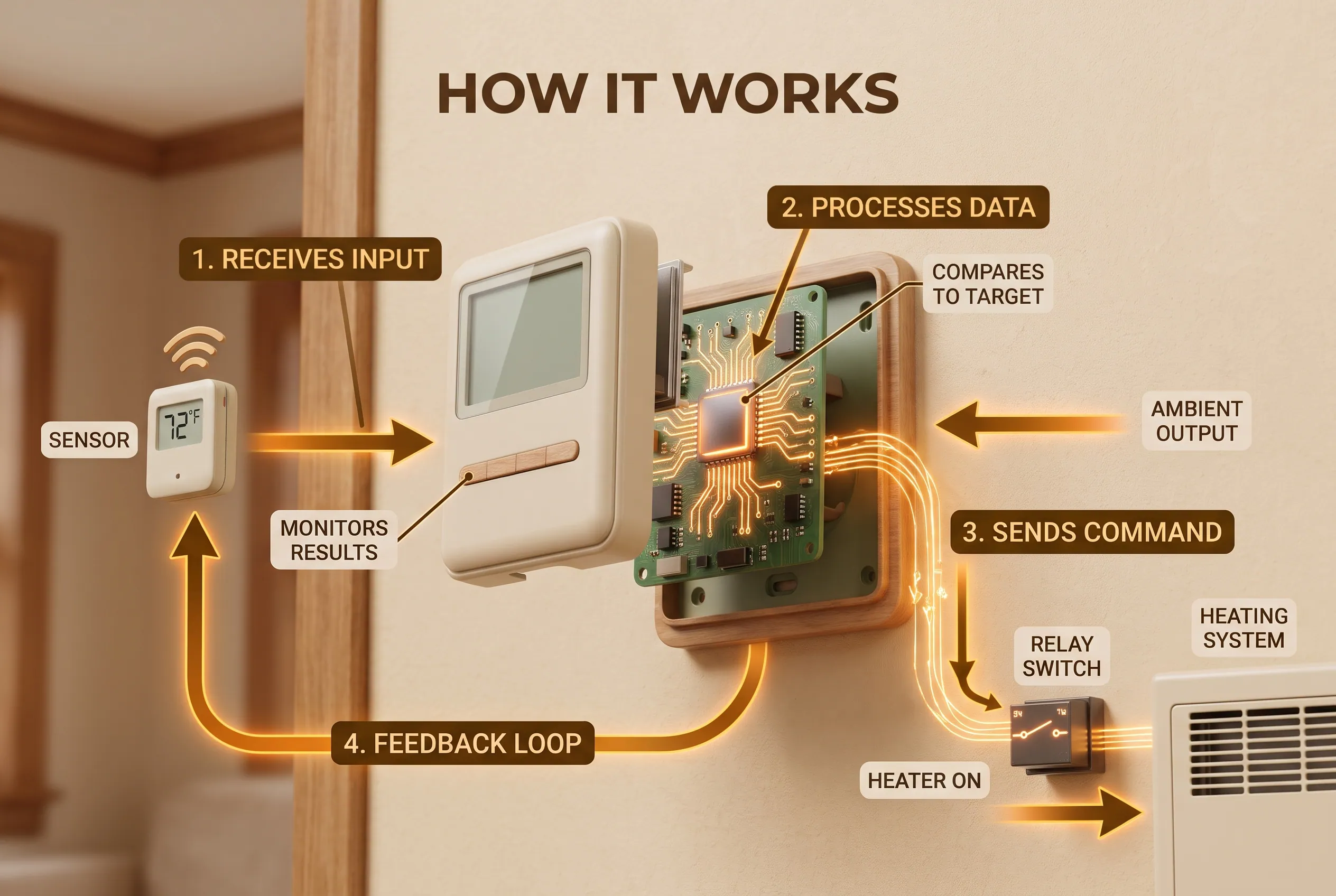
A digital controller follows programmed rules to manage an output. The exact process depends on its design, but a system using sensor feedback generally follows four steps.
1. It receives information
A sensor measures a condition such as temperature, pressure, or humidity. It sends information about that condition to the controller.
For example, a greenhouse temperature sensor measures the surrounding air. Its reading helps the controller determine whether the temperature is below or above the selected target.
Not every digital controller needs a sensor. A basic irrigation timer, for example, might simply follow a watering schedule.
2. It processes the information
The controller processes the incoming information and compares it with its programmed rules.
Suppose a temperature controller has a setpoint of 70°F. If the measured temperature falls below the chosen control threshold, the controller may call for heat. When the temperature reaches the appropriate switching point, it may turn the heater off.
The exact switching behavior depends on the model and its settings. Some controllers also use a temperature difference, delay, or other rule to avoid switching equipment too frequently.
3. It sends a command
The controller sends an output command to compatible equipment. Depending on the system, this might switch a relay, adjust a fan’s speed, or signal another control device.
A relay is an electrically operated switch. It allows a controller to switch a compatible circuit on or off within the relay’s specified limits.
Some controllers offer only simple on/off control. Others can adjust output levels or follow more advanced programs.
4. It checks the result, when feedback is available
In a feedback control system, the controller measures the result and adjusts its actions as needed. This creates a feedback loop.
For example, a temperature controller may switch heating equipment on when the temperature falls, then switch it off when the required condition is reached. It continues monitoring the temperature as the room or greenhouse changes.
Not all controllers use continuous feedback. A basic timer may simply run equipment at scheduled times without checking whether the intended result has occurred.
What is PID control?
PID stands for Proportional-Integral-Derivative. It is a control method that uses the difference between a target and a measured result, along with information about how that difference changes over time.
A PID controller can adjust an output to help maintain a stable condition. Some temperature-control projects use this method, especially when simple on/off switching is not suitable.
However, PID control is not necessary for every home project. A basic thermostat or timer may be more affordable and easier to set up. Choose the control method that suits the equipment and the level of control you actually need.
Common Types of Digital Controllers for Home Use
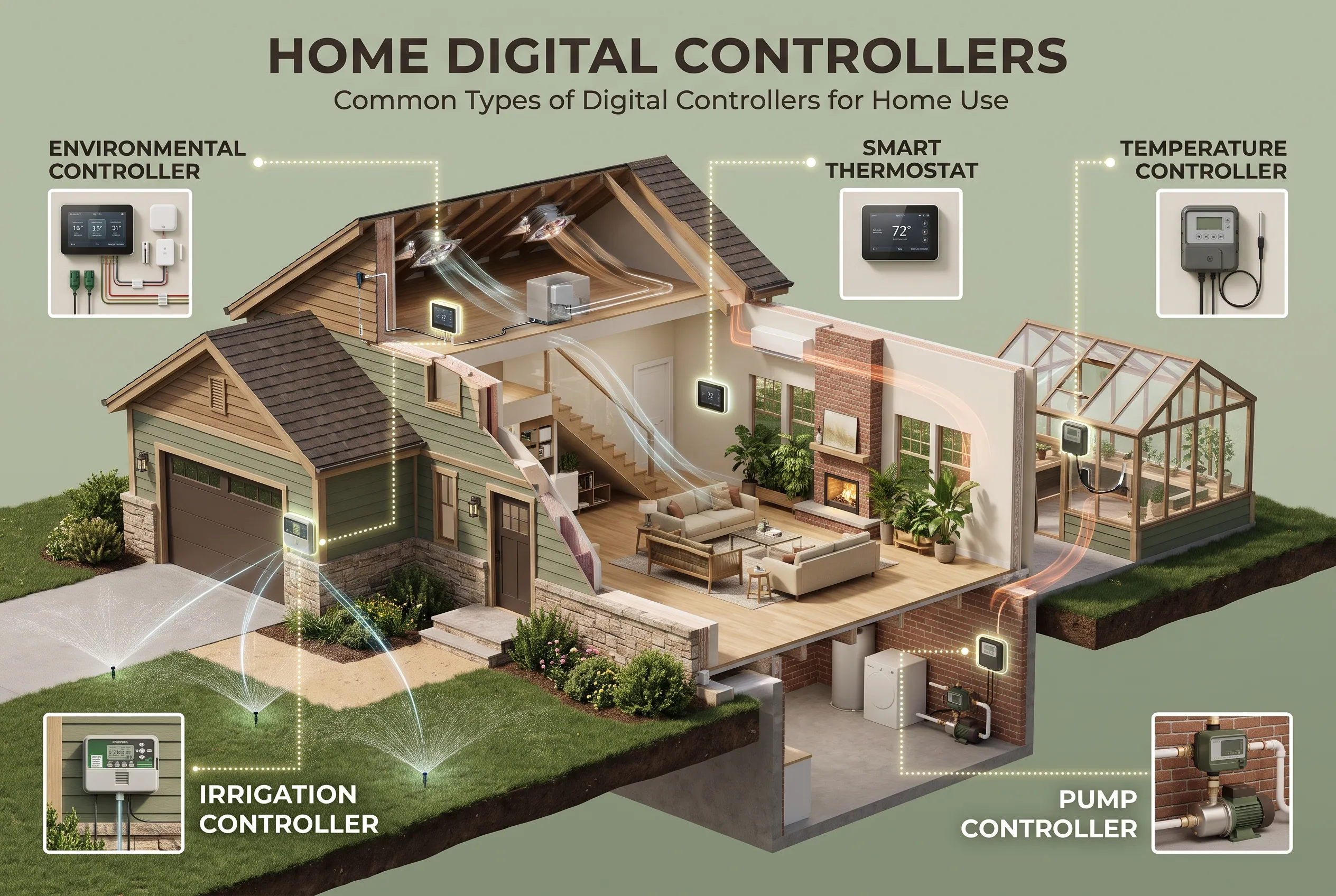
Digital controllers come in several forms. Their names often describe the job they perform rather than one standard design.
Digital temperature controllers
A digital temperature controller monitors temperature and operates compatible heating or cooling equipment according to programmed rules.
Common applications include:
- Greenhouse temperature management.
- Certain aquarium and terrarium heating setups.
- Temperature-controlled hobby projects.
- Compatible heating equipment used in other controlled environments.
Many models have a temperature probe, a display, and one or more controlled outlets. Some offer high-temperature alarms or sensor-fault warnings.
Features differ considerably between models. For example, the INKBIRD ITC-306T temperature controller is a heating-focused product series. It should not be treated as a universal controller for both heating and cooling.
Before buying a temperature controller, check the sensor type, temperature range, electrical rating, and whether the model supports your intended equipment. Also check whether the probe, controller body, and outlet have different moisture protection limits.
Digital and smart thermostats
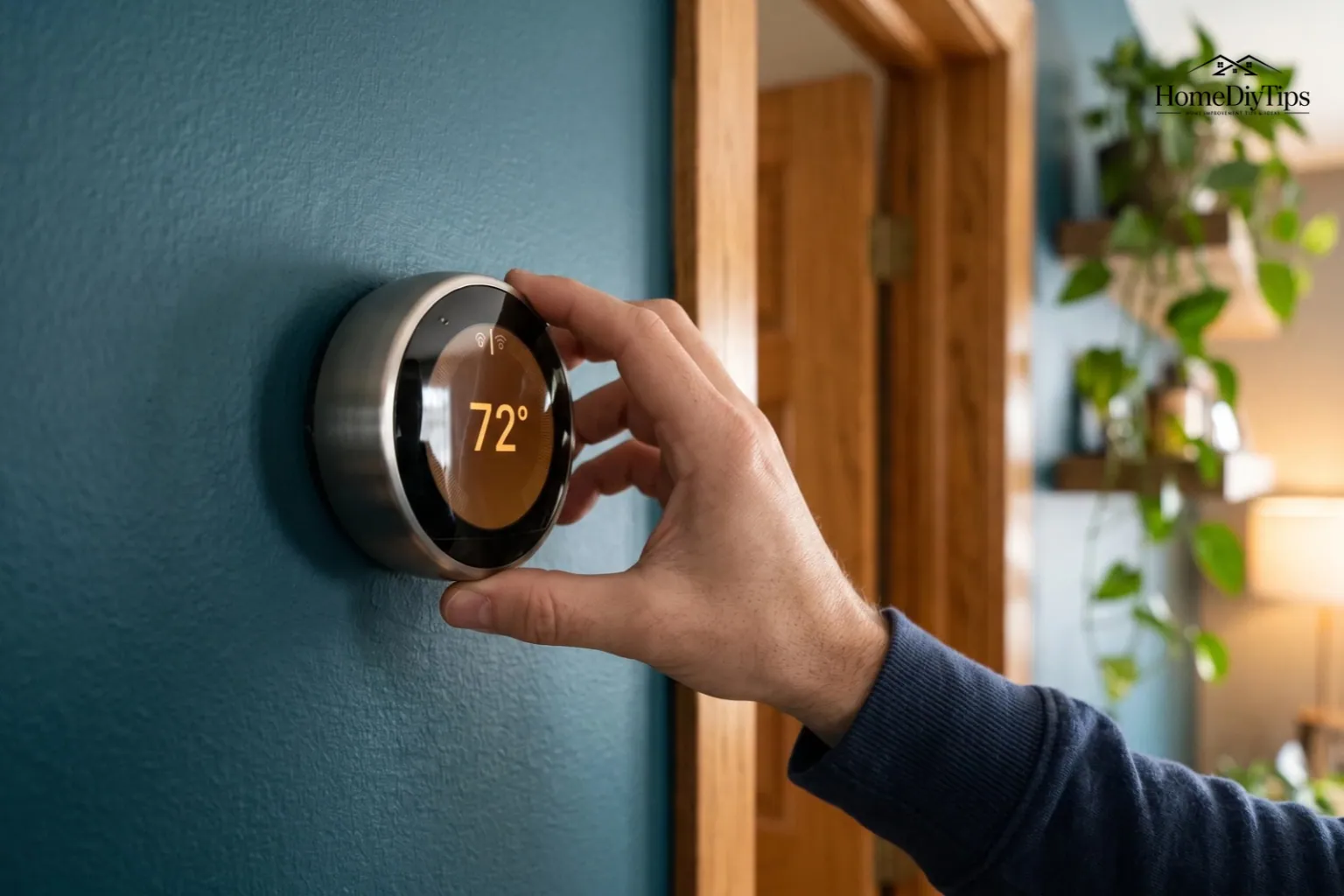
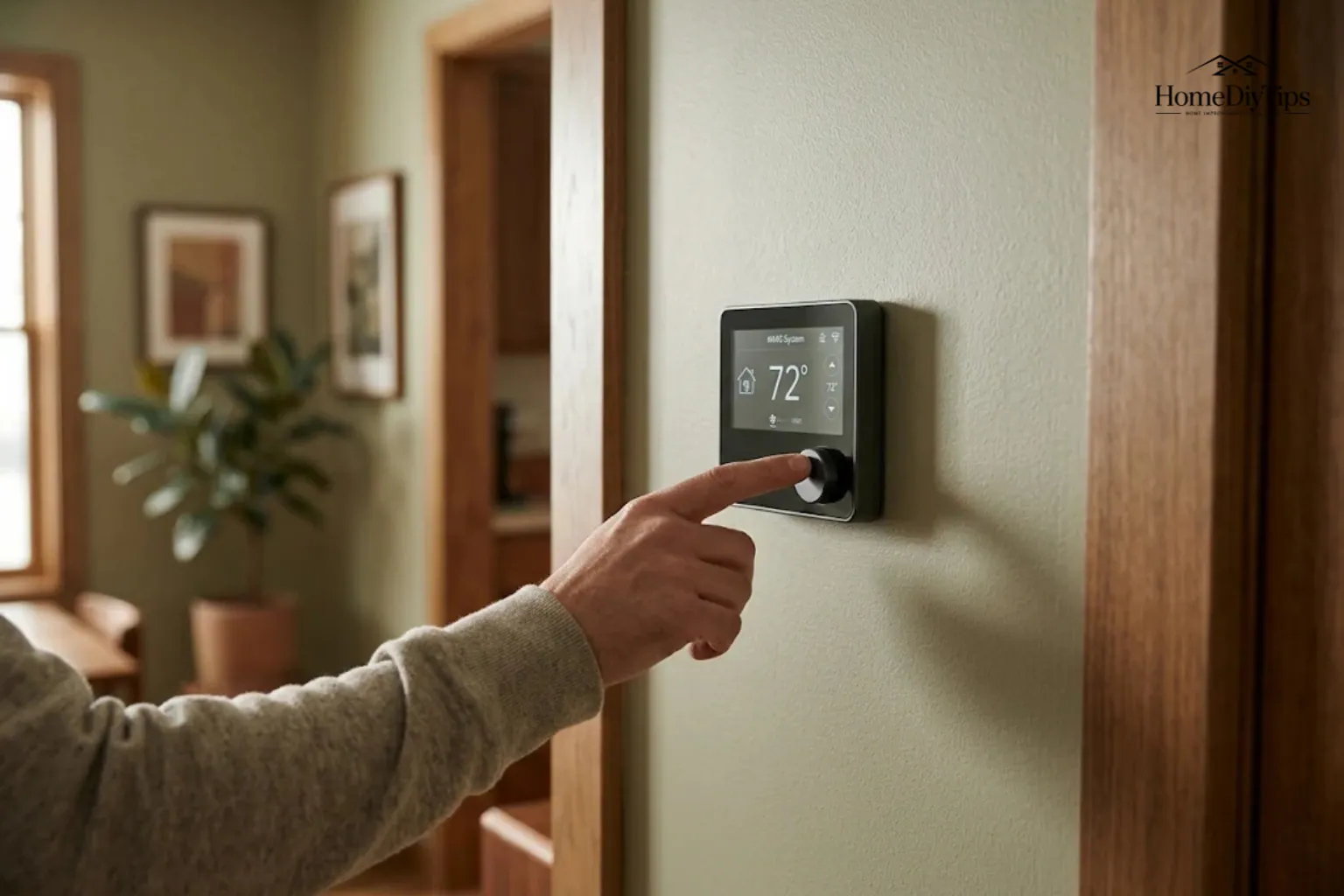
A thermostat is a controller that helps regulate temperature. Many modern thermostats use digital electronics, but a smart thermostat adds connected features such as remote access, automatic scheduling, or learning functions.
A compatible smart thermostat can help manage a home’s heating and cooling system. Depending on the model, you might adjust the target temperature from your phone, set different schedules for weekdays and weekends, or monitor certain aspects of HVAC operation.
These features can be useful when your household follows a regular routine. However, a smart thermostat is not automatically compatible with every heating system.
According to ENERGY STAR’s smart thermostat guidance, buyers should check their HVAC system type, wiring, and desired features before choosing a model. Some systems may require an adapter or professional installation.
If you rent, check your lease and obtain the necessary permission before replacing a fixed thermostat.
Digital ventilation and environmental controllers
Ventilation controllers manage fans or other compatible equipment. Environmental controllers may also use temperature and humidity readings to adjust how connected devices operate.
For example, a greenhouse might need ventilation when temperatures rise. A suitable controller can monitor the temperature and increase fan operation when the programmed threshold is reached.
Some systems manage several compatible devices independently. Others are designed for a specific manufacturer’s equipment ecosystem.
The AC Infinity Controller 69 Pro is one example of a digital environmental controller designed for compatible equipment. Its features include temperature and humidity monitoring, schedules, and control of supported devices.
This type of controller is useful when several environmental conditions affect a project. It may be unnecessary for a simple room that needs only a basic thermostat.
Digital irrigation controllers
An irrigation controller automates when a sprinkler or irrigation system runs. It can follow a schedule and, depending on the model, manage separate watering zones.
For example, a homeowner might schedule lawn irrigation for one set of times and garden beds for another. A connected model may offer app-based changes or other smart features.
The main advantage is consistent scheduling without manually operating each watering cycle. More advanced systems may support weather information or additional sensors, but these features are not available on every model.
Before buying one, check the number of zones, compatibility with your irrigation valves, indoor or outdoor installation requirements, and the type of control you need.
Rain Bird’s timer and controller range provides examples of residential irrigation options.
A scheduled watering system also needs sensible programming. More automation does not mean plants should receive water when the soil is already wet or local conditions make watering unnecessary.
Digital pump and pressure controllers
Pump controllers manage when a compatible pump starts, stops, or operates under certain conditions. A pressure controller may start a pump when water pressure falls to a preset point.
For example, a domestic water-supply system may use a pressure manager to help maintain water service when taps are opened. The controller responds according to its design and the requirements of the pump system.
Grundfos explains its PM START and PM PLUS pressure managers. These controllers can start compatible pumps at a preset pressure and keep them running while sufficient water flow is present. Some models also include dry-running protection.
Pump controllers must match the pump and water system. Check pressure limits, flow requirements, electrical ratings, and required protection features. Because pumps involve electricity and water, incorrect installation can cause equipment damage or create a safety risk. Use a qualified installer when the work involves unfamiliar wiring or plumbing.
Digital Controller vs. Analog Controller
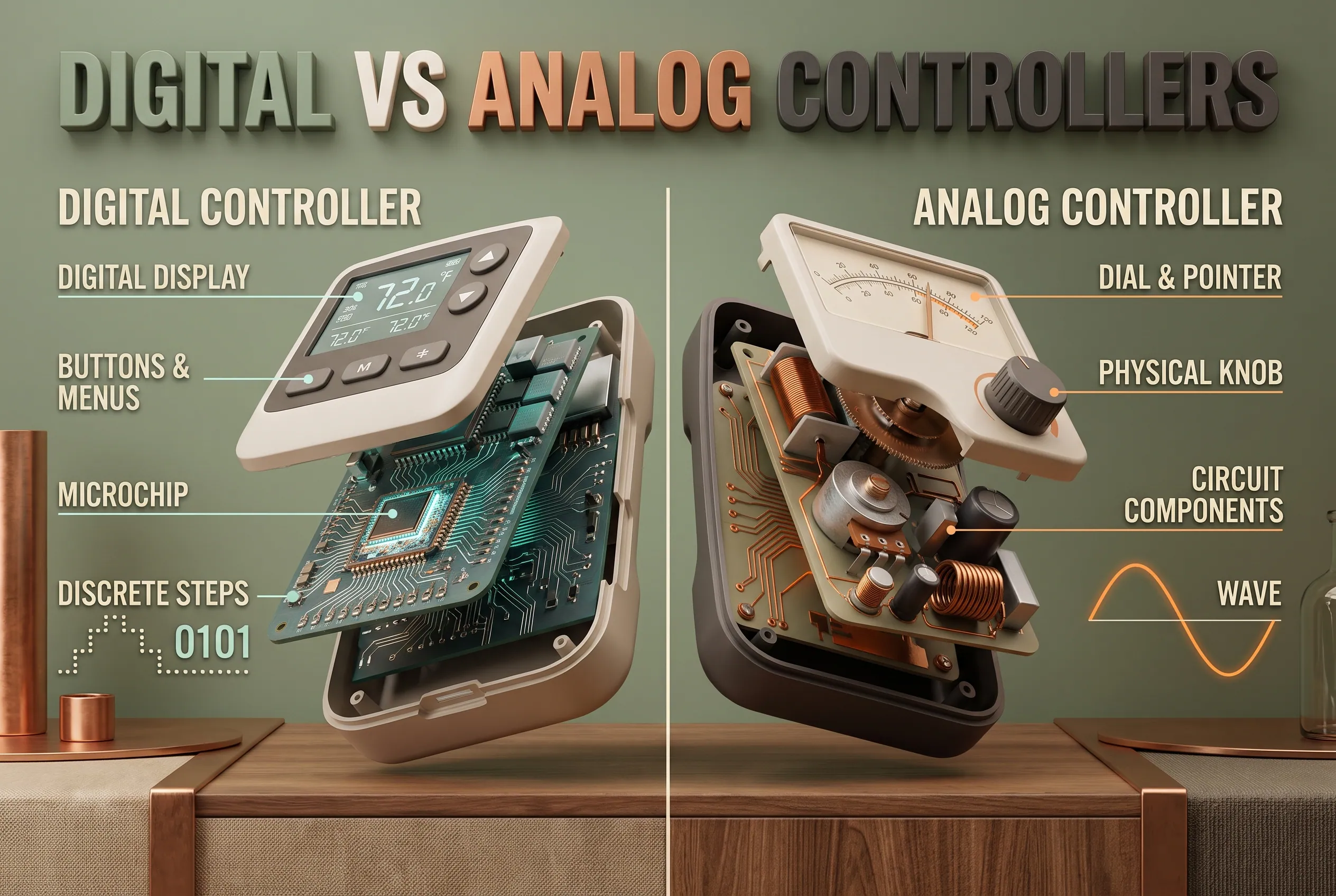
Both digital and analog controllers can regulate a process. The main difference is how they represent and process information.
A digital controller works with numerical values and discrete processing steps. An analog controller works with continuously changing signals or electrical properties.
| Feature | Digital controller | Analog controller |
| How it processes information | Uses digital values and programmed logic | Uses continuously varying signals or electronic behavior |
| Settings | May offer buttons, menus, presets, or software | May use physical knobs or fixed circuit settings |
| Programmable functions | Often supports flexible rules, schedules, or alarms | Depends on the circuit and design |
| Monitoring | May display numerical readings and stored information | May use a pointer, scale, or separate display |
| Complexity | Can be simple or highly advanced | Can be simple or highly advanced |
| Accuracy | Depends on the sensor, design, calibration, and control method | Also depends on component quality, calibration, and system design |
Digital controllers can make settings easier to repeat and can support complex rules without redesigning the entire circuit. Those advantages can be useful when a project needs scheduling, monitoring, or several operating modes.
However, digital does not automatically mean more accurate or more reliable. A digital controller can give incorrect readings if its sensor is faulty or poorly placed. It can also fail if its power supply, output circuit, or connected equipment has a problem.
An analog controller may be a reasonable choice for a straightforward task that needs only a simple adjustment. For some projects, the extra features of a digital model add cost without providing much practical value.
Choose according to the control job, not just the display.
How to Choose the Right Digital Controller
The simplest way to choose a controller is to begin with the device you want to manage. Then check compatibility, useful features, cost, and installation needs.
Start with the device you need to control
Write down the equipment you want to operate and the condition you want to manage.
For example:
- For a greenhouse heater, look for a compatible temperature controller with suitable sensor and electrical ratings.
- For a home’s central heating and cooling, look for a thermostat compatible with the specific HVAC system.
- For a ventilation fan, check whether you need simple on/off switching or variable speed control.
- For a garden sprinkler system, check the required number of zones and watering schedules.
- For a water pump, check whether the application needs pressure control, automatic start/stop operation, or additional protection.
This first step prevents a common buying mistake: comparing products that do entirely different jobs.
Check compatibility and ratings
Compatibility matters more than the number of features.
Check the manufacturer’s specifications for the following:
Sensor compatibility: Confirm the controller supports the required sensor type. A sensor designed for one model may not work with another.
Operating range: Make sure the controller can measure and control the conditions your project requires.
Voltage and current: Confirm that the controller’s input, relay, and output ratings suit the connected equipment. A product’s maximum rated capacity must not be treated as a recommendation to operate continuously at that limit under every condition.
Control type: Determine whether the controller uses an on/off relay, variable output, or another method. The connected device must support that control method.
Environmental rating: A device designed for indoor use may not be suitable for outdoor exposure, condensation, or wet environments.
Manufacturer instructions: Check whether installation requires particular wiring, a separate power supply, an adapter, or compatible accessories.
If you are replacing a smart thermostat, check the HVAC system and wiring requirements before removing the existing unit. ENERGY STAR notes that systems with specialized configurations may need a compatible thermostat or professional installation.
Decide which features matter
A long feature list can make a controller look attractive, but not every feature solves a real problem.
- Simple display: Useful when you want to read a setting or measurement directly from the unit.
- Programmable schedules: Helpful when equipment should follow different routines at different times.
- Alarms: Useful when an unusual reading or sensor fault needs attention.
- Wi-Fi or app access: Convenient when you need to change settings remotely.
- Multiple outputs: Useful when separate devices need different control rules.
- Data history: Helpful when you want to review how conditions change over time.
For a small project, a basic controller may be easier to understand and maintain. A more advanced model makes sense when its additional functions solve a specific problem.
Compare product price with total project cost
The controller’s purchase price may be only one part of the project. You might also need a compatible sensor, adapter, mounting hardware, wiring, or installation service.
Representative US prices checked on October 23, 2026, illustrate the differences between product categories:
| Product or category | Displayed price | What it represents |
| DEWENWILS plug-in temperature controller | $22.99 | A particular plug-in controller listed by The Home Depot |
| INKBIRD ITC-306T temperature controller series | From $29.99 | A heating-focused temperature-control product series |
| Smart thermostats | About 50–300 | ENERGY STAR’s broad price range for smart thermostats |
These are product-price examples, not a like-for-like comparison. Prices and availability can change, and models within the same series may have different features or prices. The figures do not include installation, extra equipment, or other project costs.
For a fixed HVAC system, a suitable smart thermostat may cost more than a basic plug-in controller but offer functions that the plug-in device cannot provide. For a small temperature-control project, the simpler product may be more appropriate.
Compare the complete setup rather than choosing only by the lowest price.
Consider your home and living situation
The installation location can affect which controller is suitable.
For renters, a plug-in controller may be easier to use than changing fixed wiring, provided the connected appliance and outlet are compatible. A permanent thermostat replacement may need the landlord’s permission.
For outdoor applications, check that the controller, sensor, and any connections are rated for the actual environment. A water-resistant probe does not automatically make the entire controller waterproof.
For a greenhouse or hobby setup, consider whether the display is easy to read, the controls are understandable, and alarms are useful for the conditions you need to monitor.
If the project involves mains wiring, pump connections, or changes to a fixed HVAC system, include qualified installation in your budget where needed.
Common Digital Controller Mistakes to Avoid
Choosing a suitable controller is only part of the process. These common mistakes can make a compatible-looking product unsuitable for your project.
Choosing based on the display alone
A clear digital screen helps you read settings, but it does not prove the controller is accurate or appropriate. Check the specifications, sensor, and operating limits.
Using the wrong sensor
A controller and sensor must work together. A sensor with the wrong type or measurement range may give unsuitable readings or prevent the controller from working correctly.
Follow the manufacturer’s instructions for sensor placement and installation. Avoid assuming that every probe can be used in water, outdoors, or near a heater.
Ignoring electrical ratings
A controller must be rated for the connected load and intended use. Do not assume a plug-in controller can safely operate any heater or appliance simply because its plug fits.
Check the applicable voltage, current, power, and operating conditions. Do not exceed any manufacturer’s limits or protection requirements.
Assuming every controller can heat and cool
Some temperature controllers support heating only, while others can switch heating and cooling equipment independently. The distinction matters when you need a particular temperature range.
The INKBIRD ITC-306T, for example, is a heating-focused model. A product that looks similar may offer different functions, so confirm the exact model before purchasing.
Replacing a thermostat without checking compatibility
A smart thermostat may require particular wiring or support for a specific HVAC configuration. Some line-voltage heating systems are not compatible with thermostats designed for low-voltage control.
Read the manufacturer’s compatibility information before buying. Seek qualified help when the wiring or system requirements are unclear.
Expecting Wi-Fi to fix a control problem
Remote access is convenient, but it cannot correct a faulty sensor, poor placement, incorrect settings, or unsuitable equipment. Check the basic setup before relying on smart features.
How to Check Whether a Digital Controller Is Working Properly
You can start with simple checks that do not require opening electrical equipment or changing fixed wiring.
1. Check the settings
Confirm that the controller is in the correct operating mode and that the setpoint or schedule matches your intention.
For example, a heater will not necessarily run when you expect if the controller is set to cooling mode or a schedule prevents operation.
2. Review the displayed reading
Compare the displayed value with what you expect from the environment. If a temperature reading seems unusual, check the sensor position and consult the manufacturer’s troubleshooting instructions.
For a temperature controller, a suitable separate thermometer may help you investigate a suspected reading problem. Differences can occur because instruments have different accuracy limits or measure different locations.
3. Check the sensor and connections visually
Look for an obviously displaced probe, a damaged sensor cable, or a display warning. Do not open the controller or handle exposed wiring while investigating.
Follow the manual for any safe external checks. Stop using the equipment if you notice damaged wiring, overheating, a burning smell, or another sign of a possible electrical fault.
4. Confirm the expected response
Under the conditions described in its manual, check whether the connected device responds as expected. A heater might switch on at the appropriate threshold, while an irrigation controller might start the programmed zone at the scheduled time.
If the device does not respond, check the settings and manual before attempting more complex troubleshooting. The problem may involve the controller, sensor, power supply, or connected equipment.
Leave wiring repairs, internal electrical work, and complex pump or HVAC faults to a qualified professional.
Frequently Asked Questions
What is a digital controller?
A digital controller is an electronic device or processor-based system that uses digital information and programmed rules to control a device or process. Depending on its design, it can manage temperature, pressure, ventilation, irrigation, or other functions.
How does digital control work?
A digital control system processes information and sends commands according to programmed rules. In a feedback system, sensors measure conditions and help the controller adjust its output toward a selected target. Other controllers follow timers or schedules without measuring the result.
What is the difference between a digital and analog controller?
A digital controller processes numerical information in discrete steps, while an analog controller uses continuously changing signals. Digital models often make programmable settings and monitoring easier, but both types can work well when matched to the application.
Which digital temperature controller should you choose?
Choose a controller that supports your required temperature range, sensor, heating or cooling function, and connected equipment. Check the electrical ratings and environmental limits before buying. A simple plug-in model may suit a small project, while a compatible thermostat is usually the relevant choice for a home’s HVAC system.
Choose a Controller That Matches Your Task
Start by deciding exactly what you need to control. Then compare the relevant controller types, verify compatibility and electrical ratings, and choose only the features that help with your project.
A basic controller may be enough for a simple task. A smart or programmable model can make sense when you need schedules, remote access, or more detailed environmental control. The best choice is the one that matches your equipment, fits your budget, and can be used safely according to its manufacturer’s instructions.
Disclaimer
Home conditions, budgets, equipment, and installation requirements vary. Always follow the manufacturer’s instructions and verify compatibility before use. Consult a qualified professional for electrical wiring, HVAC changes, pump installation, or other work that requires specialized knowledge.