
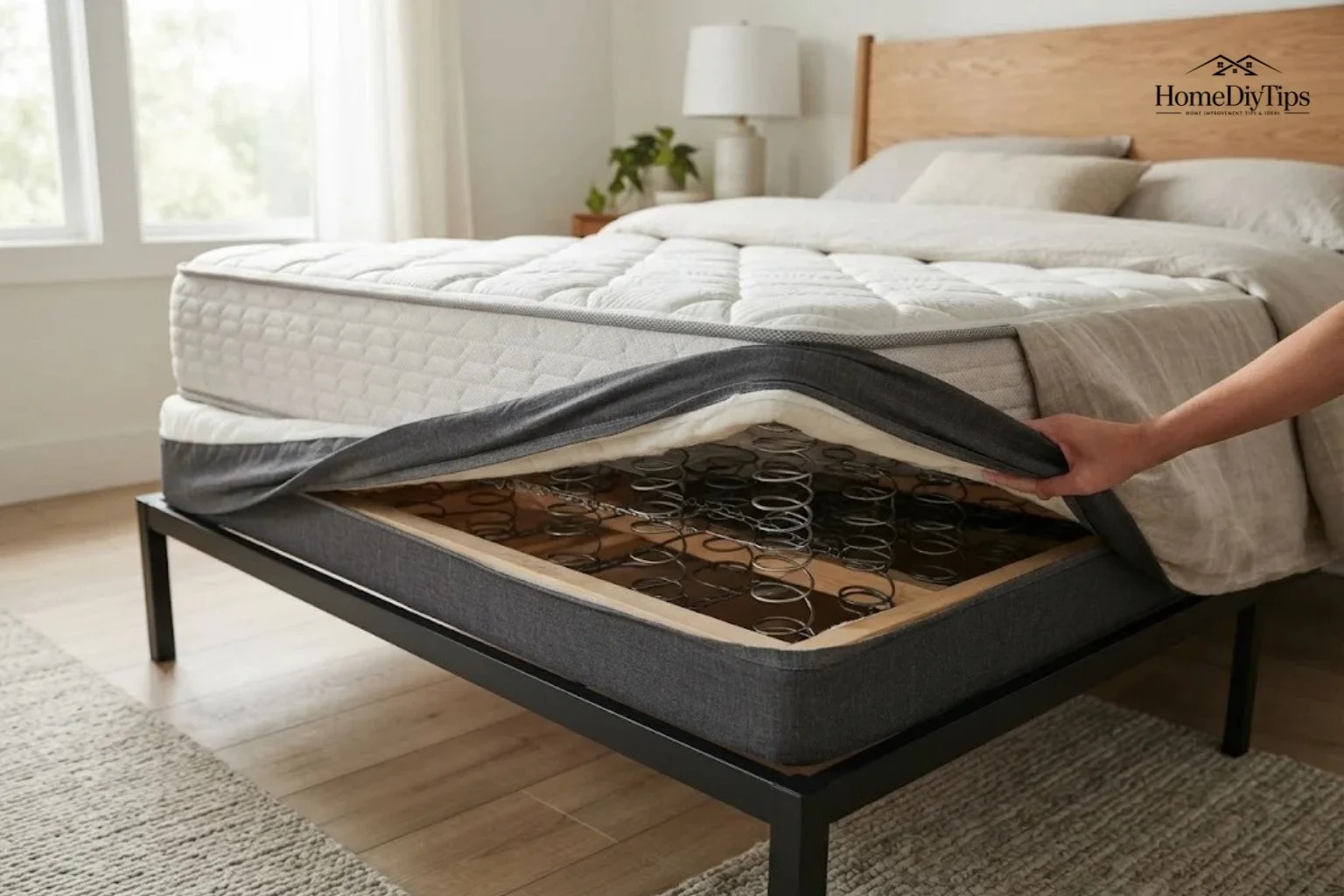
A box spring is a supportive base that sits underneath a mattress and above a bed frame. It helps support the mattress, raises the sleeping surface, and, in traditional designs, adds a little cushioning through its internal springs. It can be useful with certain innerspring mattresses and bed frames that do not provide enough support on their own.
However, not every mattress needs a box spring. Many modern mattresses work better with a firm foundation, a platform bed, or a properly designed slatted frame. The right choice depends on your mattress, bed frame, and the support requirements listed by the manufacturer.
Before buying one, it is worth understanding what a box spring does, how it differs from other mattress foundations, and when you can safely use an alternative. This guide explains these points so you can choose the right setup without spending money on something your bed does not need.
Short Definition
A box spring is a base placed beneath a mattress to provide support and extra height. Traditional models also contain springs that add some cushioning, but not every mattress needs one.
Experience
Before buying a box spring, check your mattress manufacturer’s support instructions and inspect your bed frame. A platform bed or suitable slatted frame may already provide the support you need.
What Is a Box Spring Used For?
A box spring is designed to support a mattress from underneath. It usually has a rectangular wooden or metal frame, an internal support structure, and a fabric covering. Traditional models contain metal coils, while some products sold as box springs today use a more rigid construction.
It sits between the mattress and the bed frame. This arrangement creates a complete sleeping setup in which the mattress rests on a suitable support surface instead of directly on a basic frame.
A box spring has four main purposes:
- Supporting the mattress: It provides a base that helps distribute the weight of the mattress and sleepers.
- Raising the bed: It adds height, which can make getting into and out of bed easier.
- Absorbing some movement: Traditional spring designs provide a little flexibility beneath the mattress.
- Completing certain bed setups: Some metal bed frames are designed to hold a box spring and mattress rather than a mattress alone.
For example, imagine you have a traditional metal bed frame with a perimeter rail but no built-in platform or closely spaced slats. The frame may not provide enough support for your mattress by itself. A compatible box spring or rigid foundation can provide the missing support surface.
The important point is that a box spring is one type of mattress support. It is not a necessary part of every modern bed.
What Is a Box Spring Made Of?
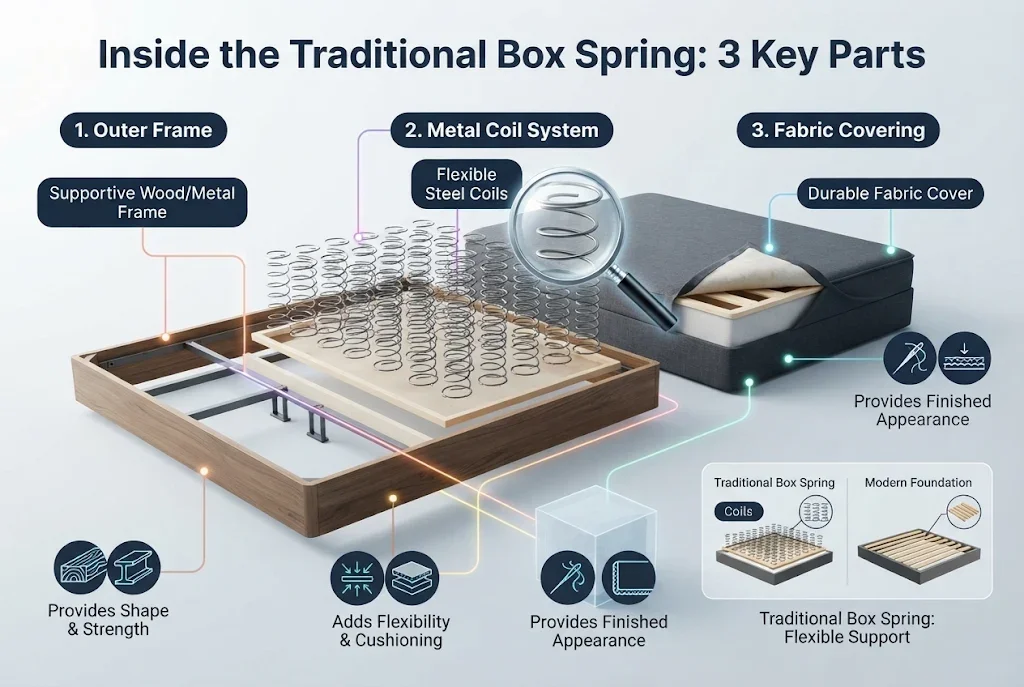
Traditional box springs have a fairly simple construction. Their internal parts work together to create a supportive base for a mattress.
Most traditional models contain three main parts.
1. Wooden or Metal Frame
The outer frame gives the box spring its rectangular shape. It is usually made from wood or metal and is designed to support the internal structure.
The frame also helps the box spring maintain its shape when it carries the weight of the mattress and sleepers.
2. Metal Springs or Coils
The defining feature of a traditional box spring is its internal spring system.
These metal coils provide some flexibility when pressure is applied. When someone lies down or moves on the mattress, the springs can compress slightly and return toward their original position.
This creates a little cushioning beneath the mattress. It is different from the firm, mostly solid support offered by many modern foundations.
3. Fabric Covering
The outside is usually covered with fabric. This gives the box spring a finished appearance and helps cover its internal components.
Some covers are simple and designed to match the mattress. Others are more decorative.
Traditional Box Springs vs. Modern Foundations
The words box spring and foundation are sometimes used as if they mean the same thing. However, they do not always describe the same construction.
A traditional box spring contains springs or coils. A modern mattress foundation may use a solid surface, wooden slats, or a rigid internal structure instead.
Both products can sit beneath a mattress, but they may provide different types of support. This difference matters because some mattresses need a firm, stable base rather than a flexible one.
Sleep Foundation+1
When shopping, check the product description instead of relying only on its name. A product advertised as a box spring may actually be a rigid foundation.
How Does a Box Spring Work?
A box spring works by creating a support layer between the mattress and the bed frame.
When you lie down, your weight presses against the mattress. The mattress transfers that pressure to the base underneath it. The box spring then carries the load to the bed frame.
In a traditional design, the internal springs compress slightly under pressure. This gives the base some flexibility while supporting the mattress.
Here are the main ways it works.
It Helps Distribute Weight
A suitable box spring provides a stable support structure beneath the mattress. This helps spread the load across the supporting frame instead of allowing the mattress to rest on a few unsupported areas.
However, the box spring must be in good condition and designed for the mattress being used. A damaged or unsuitable base cannot provide proper support simply because it is called a box spring.
It Absorbs Some Movement
Traditional spring systems can compress when pressure is applied. This allows the base to absorb some impact from normal movement.
For example, when someone gets into bed, the mattress and its support system experience pressure. The springs in a traditional box spring can provide a small amount of additional flexibility.
This does not mean a box spring will eliminate movement or stop one person from feeling another person’s movements. That depends mainly on the mattress and its construction.
It Raises the Sleeping Surface
A box spring adds height beneath the mattress. This can be useful if your bed frame is low or if you prefer a taller sleeping surface.
The additional height may make sitting down and standing up more comfortable for some people.
It Can Allow Airflow
Traditional box springs contain spaces around their internal springs. Some modern open or slatted foundations also allow air to move beneath a mattress.
However, airflow depends on the complete bed design. A box spring does not guarantee that a mattress will stay dry or prevent mold. Room humidity, ventilation, bedding, and the mattress itself also matter.
What Are the Main Benefits of a Box Spring?
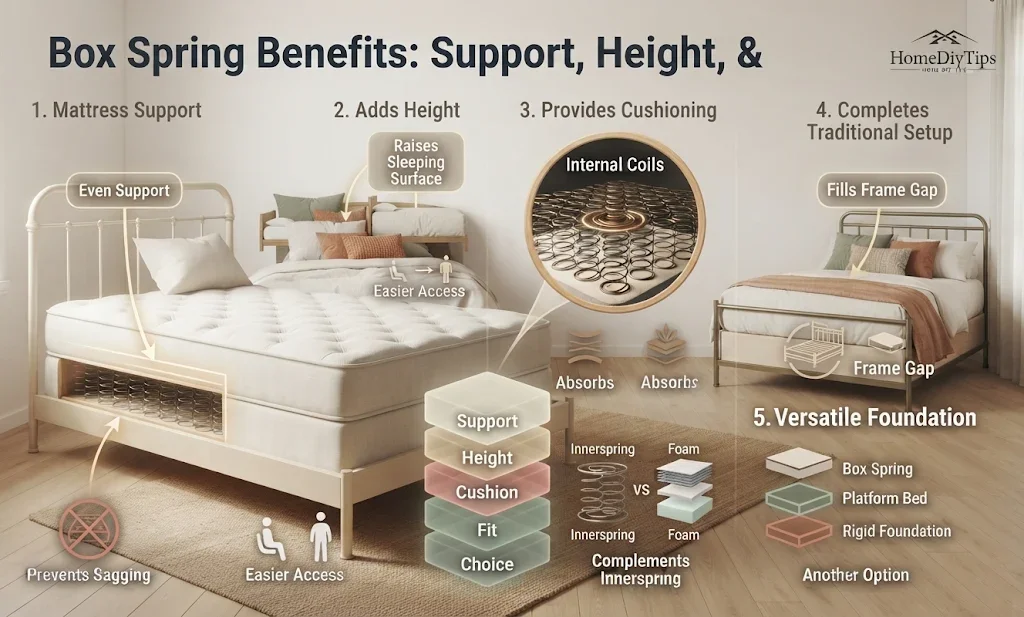
A box spring can be useful when it matches the mattress and bed frame. Its benefits are practical rather than universal.
1. Provides Mattress Support
The main reason to use a box spring is to give a compatible mattress the support it needs.
A mattress placed on an unsuitable frame may bend, sag, or develop uneven support over time. A suitable box spring can provide a more complete base.
This is especially relevant when using a traditional bed frame that does not have its own supporting platform.
2. Adds Height to Your Bed
Some people prefer a higher bed because it is easier to sit on or stand up from.
A box spring can raise the mattress without requiring you to replace the entire bed frame.
You can also find low-profile box springs if you want some additional support without making the bed too tall.
3. Provides Some Cushioning
Traditional box springs contain internal coils that give them a little flexibility.
This can complement compatible innerspring mattresses. However, it does not mean every mattress will feel better on a spring base. Foam and other mattress types may require firmer support.
4. Completes a Traditional Bed Setup
Many older metal bed frames were designed to hold a box spring and mattress together.
In these setups, the box spring fills the space between the frame rails and the mattress. It provides the supporting surface that the frame itself may lack.
5. Offers Another Foundation Choice
A box spring gives you an additional option when planning your bedroom furniture.
If you already have a compatible mattress and frame, you may be able to use a box spring instead of purchasing a different bed system.
Still, compare the cost and support requirements before buying. A platform bed or rigid foundation may be a better choice for some mattresses.
Do You Actually Need a Box Spring?
No, you do not always need a box spring.
Whether you need one depends on three things:
- The type of mattress you own.
- The support provided by your bed frame.
- The foundation requirements set by the mattress manufacturer.
Some traditional innerspring mattresses are designed to work with box springs. Many modern foam mattresses, on the other hand, need a firm and stable foundation.
When You May Need a Box Spring
A box spring may be suitable when:
- Your mattress manufacturer recommends or requires one.
- You have a compatible traditional innerspring mattress.
- Your metal bed frame does not have built-in mattress support.
- You want to raise a low bed frame.
- Your existing bed setup was designed to use a box spring.
For example, if your bed frame has only side rails and a center support bar, it may need a separate foundation to support the mattress properly.
A compatible box spring could provide that support.
When You May Not Need a Box Spring
You may not need one when:
- Your platform bed already provides suitable mattress support.
- Your bed frame has a properly designed slatted base.
- You use a compatible adjustable bed base.
- Your mattress manufacturer recommends a rigid foundation instead.
- Your existing foundation already provides the required support.
A platform bed with a solid or suitable slatted surface can support many mattresses directly. In that situation, adding another box spring may be unnecessary.
The best way to decide is to check your mattress instructions and warranty. Do not assume that every mattress needs the same foundation.
Which Mattresses Work With Box Springs?
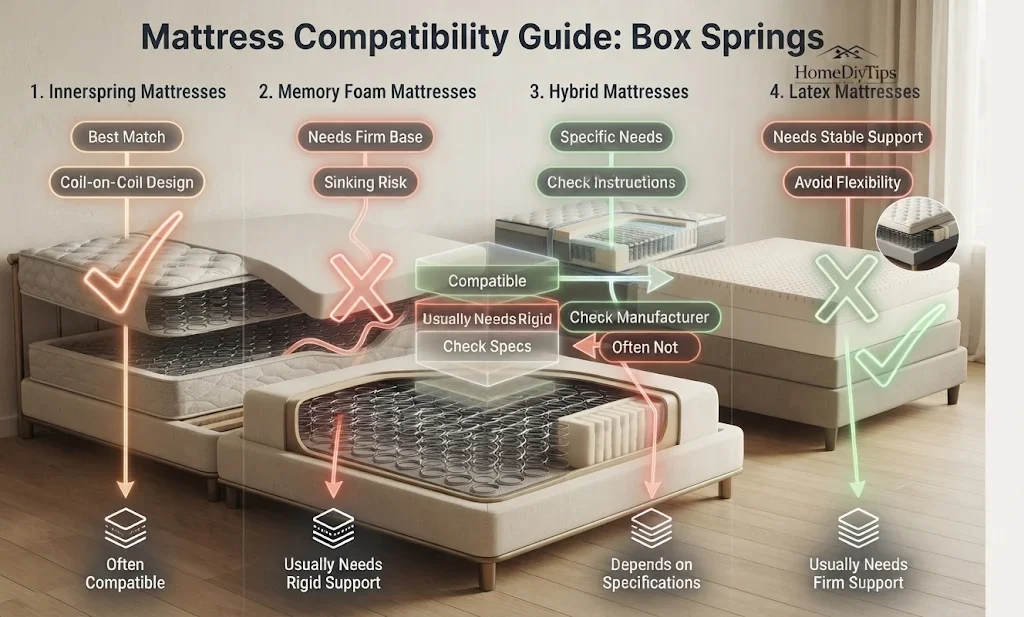
Different mattresses have different support requirements. Choosing the wrong foundation can affect how a mattress feels and performs.
Here is a general guide.
Innerspring Mattresses
Traditional innerspring mattresses are often the best match for traditional box springs.
Both products use spring-based construction, and some older mattress systems were designed to work together.
However, not every innerspring mattress requires a box spring. Some modern models are designed for rigid foundations or platform beds.
Check the manufacturer’s instructions before using one.
Memory Foam Mattresses
Memory foam mattresses generally need a firm, stable support surface.
A traditional box spring with flexible coils may not provide the support required by a foam mattress. The mattress may sink or flex in areas where it needs a more consistent base.
For this reason, a rigid foundation or compatible platform bed is often a better choice.
Use a traditional box spring only if the mattress manufacturer specifically approves it.
Hybrid Mattresses
Hybrid mattresses combine foam layers with an innerspring support system.
Although they contain coils, that does not automatically mean they are compatible with traditional box springs. Many hybrid mattresses require a firm foundation or a specific type of slatted support.
Always check the mattress specifications.
Latex Mattresses
Latex mattresses usually need a stable foundation that supports their weight evenly.
Some can work with suitable slatted frames, while others require a solid or specially designed base.
A traditional box spring may not be appropriate if it has too much flexibility or does not meet the manufacturer’s support requirements.
Quick Mattress Compatibility Guide
| Mattress type | General support recommendation |
| Traditional innerspring | Often compatible with a box spring |
| Memory foam | Usually needs rigid support |
| Hybrid | Depends on manufacturer requirements |
| Latex | Usually needs firm, even support |
These are general guidelines, not universal rules. The mattress manufacturer’s instructions should always take priority.
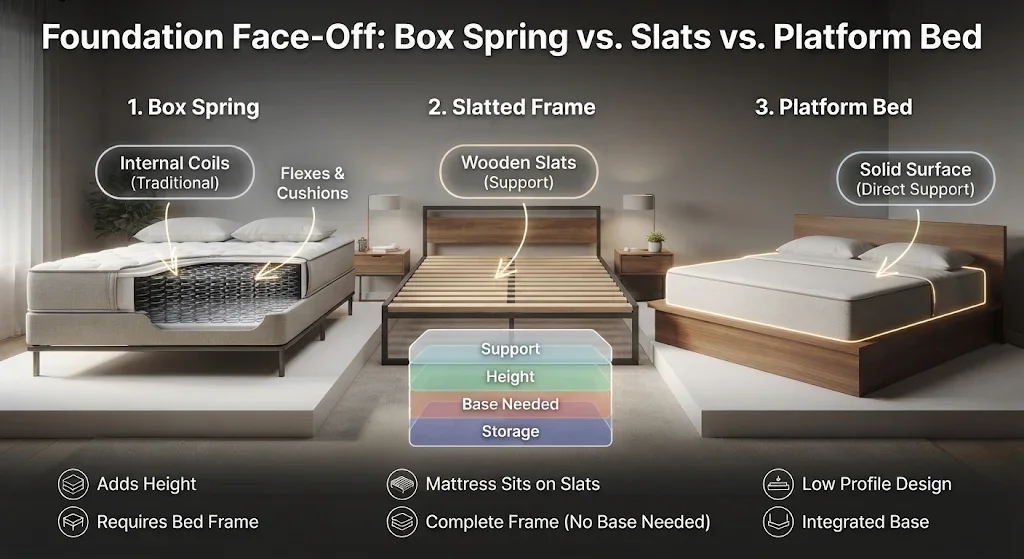
Box Spring vs. Slats vs. Platform Bed: What Is the Difference?
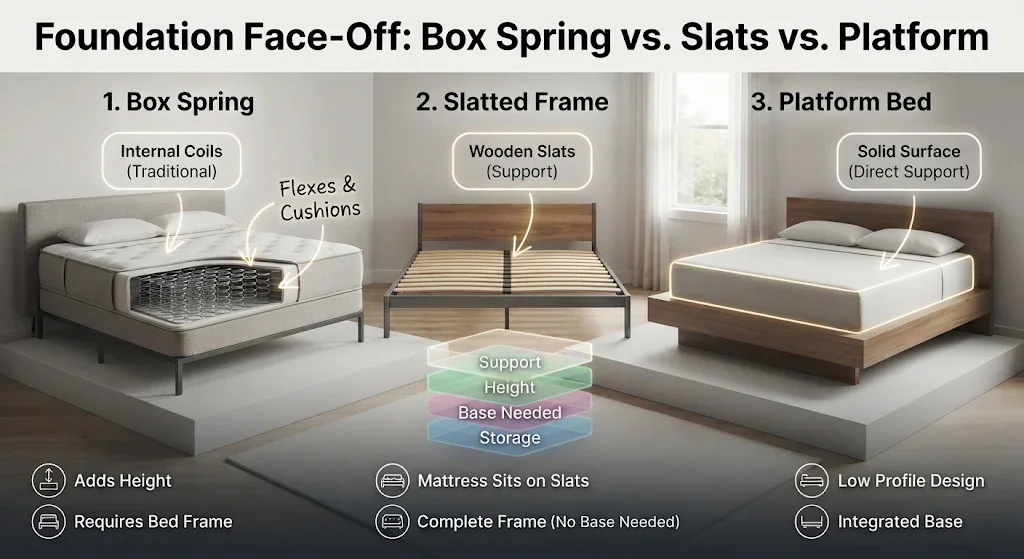
A box spring is only one way to support a mattress. Slatted frames and platform beds are two common alternatives.
Understanding the differences can help you avoid buying an unnecessary foundation.
Box Spring
A traditional box spring is a fabric-covered frame with internal springs.
Advantages:
- Can work well with compatible innerspring mattresses.
- Adds height to the bed.
- Provides some cushioning.
- Fits many traditional metal bed frames.
Disadvantages:
- Not suitable for every modern mattress.
- Adds extra height and cost.
- Can wear out or become damaged.
- May need replacement if the mattress or foundation requirements change.
Slatted Bed Frame
A slatted bed frame uses horizontal wooden or metal supports across the bed frame.
The mattress rests directly on these slats.
Advantages:
- Often provides a simple and practical support system.
- Can allow airflow beneath the mattress.
- May cost less than buying a separate box spring.
- Some designs provide useful storage space underneath.
Disadvantages:
- Wide gaps may not support certain mattresses.
- Loose or damaged slats can create uneven support.
- Some mattresses need closer spacing or an additional support board.
There is no single slat-spacing measurement that works for every mattress. Follow the manufacturer’s requirements. For example, Saatva gives specific platform-bed spacing instructions for its own mattresses, which should not be treated as a universal rule for other brands.
Sleep Foundation+1
Platform Bed
A platform bed is designed to support a mattress directly.
It may have a solid surface or a built-in slatted system. Since the support is already part of the bed, a separate box spring is often unnecessary.
Advantages:
- Does not usually require a separate foundation.
- Can create a clean, modern appearance.
- Comes in different heights and styles.
- Some designs include drawers or under-bed storage.
Disadvantages:
- Some models may be too low for your preference.
- Slatted versions must meet mattress support requirements.
- A damaged platform may need repair or replacement.
Comparison Table
| Feature | Box spring | Slatted frame | Platform bed |
| Main purpose | Supports and raises mattress | Supports mattress on slats | Supports mattress directly |
| Internal springs | Traditional models | No | Usually no |
| Adds height | Usually | Depends on frame | Depends on design |
| Separate base needed | Often used with a frame | No, if frame is complete | Usually no |
| Mattress compatibility | Must be checked | Must be checked | Must be checked |
| Storage options | Limited | Depends on frame | Available on some models |
Box Spring vs. Bed Frame
These two products are not the same thing.
A bed frame is the structure that holds the bed setup. It may have side rails, legs, a headboard, a footboard, or built-in support.
A box spring is a separate foundation that can sit on top of certain bed frames.
Some bed frames need a box spring or rigid foundation. Others, such as complete platform beds, already have the support needed for the mattress.
Before buying a box spring, identify which type of bed frame you own.
What Happens If You Don’t Use a Box Spring?
Nothing bad happens simply because you do not use a box spring.
The important question is whether your mattress still has the support it needs.
If your mattress is designed for a platform bed or rigid foundation, you can use that support system without adding a traditional box spring.
Problems may arise when you remove a box spring but do not replace the support it was providing.
1. The Mattress May Not Have Enough Support
If your bed frame has only perimeter rails and no suitable center support or platform, the mattress may not have a stable surface beneath it.
This can cause uneven pressure and poor support.
2. The Mattress May Sag
A mattress placed on an unsuitable foundation may develop unsupported areas.
Over time, this can contribute to sagging or uneven wear. However, mattress sagging can also result from normal wear, damaged internal components, or other factors.
3. The Bed May Feel Different
Removing a traditional box spring changes the height and possibly the feel of the bed.
If the box spring provided cushioning, the mattress may feel firmer when placed on a rigid surface.
Whether that change is comfortable depends on the mattress and the person using it.
4. The Mattress Warranty May Be Affected
Some mattress warranties specify the type of foundation or bed frame that must be used.
If you use an unsupported setup, you may risk losing warranty coverage for certain problems.
Read the warranty before changing your foundation. Requirements can differ between mattress brands and models.
Sleep Foundation+1
How to Check Whether Your Bed Needs a Box Spring
Use this simple checklist:
- Read the mattress label and manufacturer’s support instructions.
- Identify whether your bed frame has a solid platform, slats, or only perimeter rails.
- Check whether the frame has adequate center support.
- Inspect existing slats and joints for damage.
- Confirm that the foundation supports the mattress size and weight.
- Check the warranty for foundation requirements.
If the mattress instructions permit your existing bed frame, you probably do not need to add a box spring.
How to Choose the Right Box Spring Size and Type
If you have confirmed that your mattress needs a box spring, the next step is choosing the correct one.
A suitable box spring should match your mattress dimensions, support requirements, bed frame, and preferred bed height.
1. Choose the Correct Size
Box springs are commonly available in standard mattress sizes.
| Size | Common mattress dimensions |
| Twin | 38 × 75 inches |
| Twin XL | 38 × 80 inches |
| Full | 54 × 75 inches |
| Queen | 60 × 80 inches |
| King | 76 × 80 inches |
| California King | 72 × 84 inches |
These are common US mattress dimensions. Actual product measurements may vary slightly, so check the specifications before purchasing.
What Is a Full Box Spring?
A full box spring is designed for a full-size mattress, which commonly measures 54 inches wide and 75 inches long.
It is often used in smaller bedrooms, guest rooms, and spaces where a larger mattress may not fit comfortably.
Make sure the full box spring matches both the mattress and the bed frame.
What Is a Queen Box Spring?
A queen box spring is designed for a queen mattress, which commonly measures 60 inches wide and 80 inches long.
Queen beds are popular because they provide more sleeping space than full beds without taking up as much room as a king-size setup.
A queen foundation should also provide suitable center support if required by the bed frame or manufacturer.
2. Choose Between Standard and Low-Profile
Box springs are available in different heights.
Standard box spring: A taller option that raises the mattress more.
Low-profile box spring: A thinner option that provides support while adding less height.
Consider your mattress thickness before choosing. A thick mattress combined with a tall box spring may make the bed uncomfortable to climb into.
3. Check the Weight Capacity
The foundation must support the combined weight of the mattress and sleepers.
Check the manufacturer’s weight limit and make sure the box spring is suitable for your mattress size.
Do not assume that a larger-looking foundation can support more weight.
4. Check the Frame and Center Support
Some bed frames need a center support rail or additional legs, especially for larger mattress sizes.
Check the frame instructions to confirm what is required.
A suitable box spring cannot compensate for a weak or damaged bed frame.
5. Inspect Construction Quality
Before buying, check:
- Whether the frame feels sturdy.
- Whether the fabric is securely attached.
- Whether the internal structure is suitable for your mattress.
- Whether the corners and edges are properly finished.
- Whether the product has a clear weight limit and warranty.
Choose based on compatibility and construction rather than appearance alone.
Common Box Spring Mistakes to Avoid
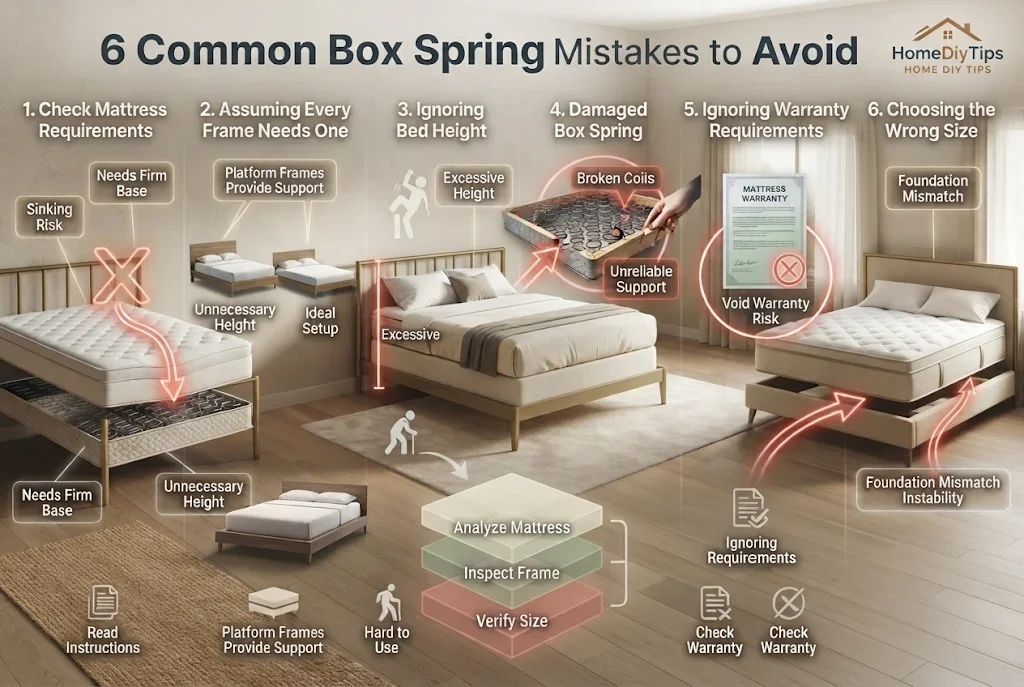
A box spring may look like a simple purchase, but choosing the wrong one can create problems.
Avoid these common mistakes.
1. Buying One Without Checking Mattress Requirements
A traditional box spring may not provide the firm support required by a memory foam or latex mattress.
Check the mattress instructions first.
2. Assuming Every Bed Frame Needs One
Some platform beds and slatted frames already support the mattress.
Adding a box spring may increase the bed height unnecessarily and add extra cost.
3. Ignoring Bed Height
Think about the combined height of the frame, foundation, and mattress.
A bed that is too high may be difficult to use, particularly for children or people who prefer a lower sleeping surface.
4. Using a Damaged Box Spring
A box spring with broken springs, loose joints, or a bent frame may not provide reliable support.
Inspect an old foundation before reusing it with a new mattress.
5. Ignoring Warranty Requirements
A mattress warranty may specify acceptable foundation types or slat spacing.
Keep the warranty information and check its requirements before changing your setup.
6. Choosing the Wrong Size
A box spring should match the mattress and bed frame.
A foundation that is too small or too large can create an unstable setup. Measure the available space and compare it with the product specifications before ordering.
Frequently Asked Questions
1. Why Are People No Longer Using Box Springs?
Many people use platform beds, slatted frames, and rigid foundations instead of traditional box springs.
Modern mattresses also have different support requirements. Foam, latex, and many hybrid models are designed for firm support rather than the flexible structure of a traditional spring box.
Box springs are still useful for compatible mattresses and traditional bed frames, but they are no longer necessary for every bedroom.
2. Why Would I Need a Box Spring?
You may need a box spring if your mattress manufacturer recommends one or if your bed frame requires a separate foundation.
It can also raise the mattress and provide some cushioning when used with a compatible traditional innerspring mattress.
If your bed already has a suitable platform or foundation, you may not need one.
3. What Happens If I Don’t Use a Box Spring?
If your mattress has the correct support from a platform bed, slatted frame, or rigid foundation, nothing bad should happen simply because you do not use a box spring.
However, removing a box spring without providing another suitable support system may lead to an unstable setup, uneven support, or mattress damage.
Always check your mattress requirements.
4. How Do I Know If My Bed Needs a Box Spring?
Start by checking the mattress manufacturer’s instructions.
Then inspect your bed frame. If it has a complete platform or suitable slats, it may support the mattress without an extra foundation.
If it only has perimeter rails, it may need a box spring or another suitable support system.
5. Can You Use a Box Spring With a Memory Foam Mattress?
A traditional box spring is generally not the best choice for a memory foam mattress because its flexible coils may not provide the firm support the mattress needs.
A rigid foundation or compatible platform bed is usually a better option.
However, always follow the specific mattress manufacturer’s instructions. Some products have different support requirements.
Final Thoughts
A box spring is used to support and raise a mattress, and traditional models also provide some cushioning through their internal springs. It can be a useful part of a bedroom setup, especially when paired with a compatible innerspring mattress and a bed frame that needs a separate foundation.
But you do not need to buy one automatically. Many modern mattresses work with platform beds, slatted frames, or rigid foundations instead.
Before purchasing, check your mattress instructions, inspect your bed frame, and consider the height you want. Choosing the right support system is more important than choosing a product simply because it is called a box spring.
Disclaimer
This article provides general information, not advice for every mattress, bed frame, or home. Products, budgets, and individual needs vary, so check manufacturer instructions and seek qualified help when a damaged or structural bed component requires repair.