
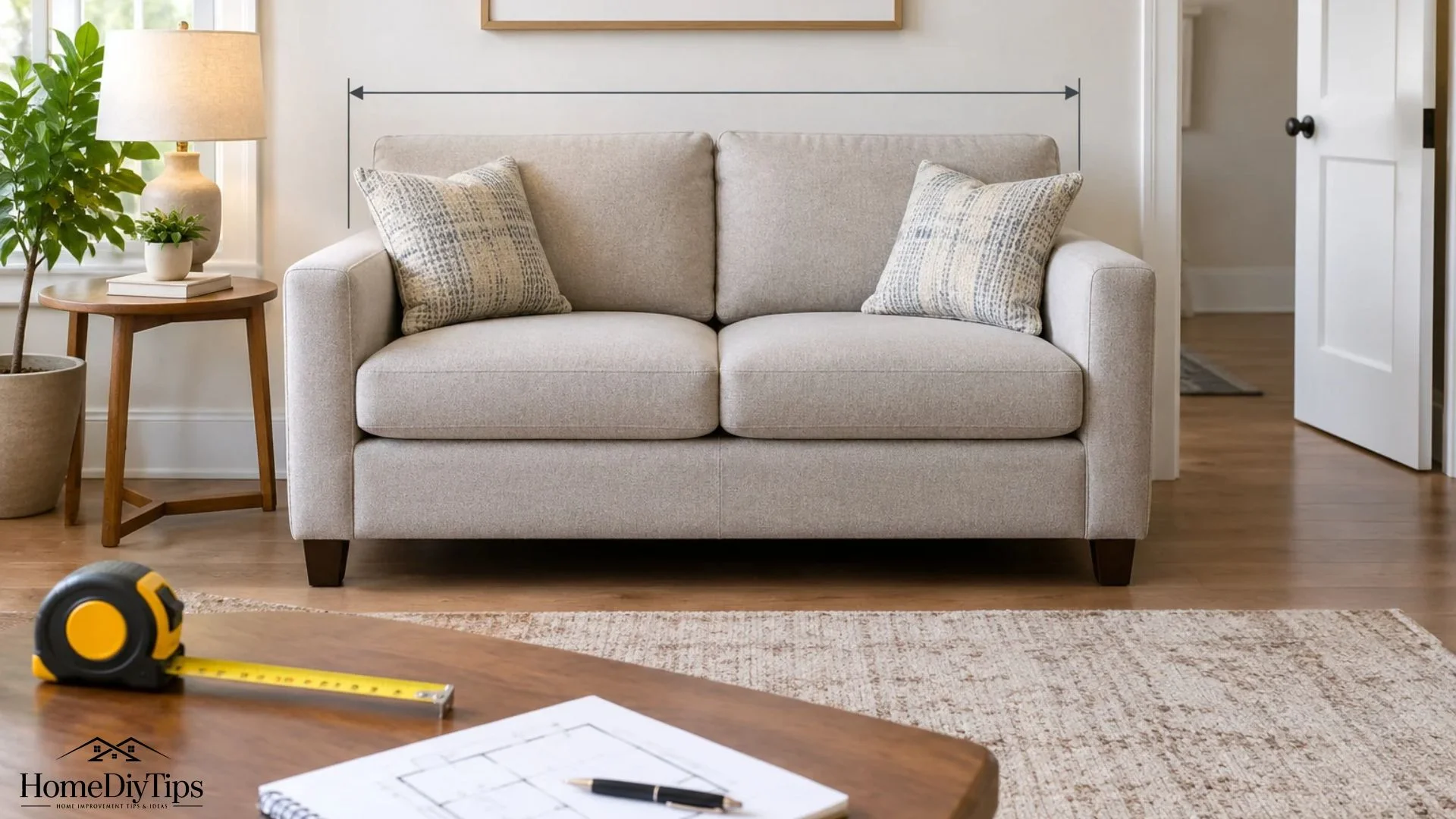
A loveseat is usually 48 to 72 inches long (4 to 6 feet), measured from the outside of one arm to the outside of the other. Many standard models measure around 58 to 64 inches, although the exact size depends on the design, arm width, and manufacturer.
If you’re buying a loveseat for a small living room or apartment, don’t check length alone. Depth, available walking space, and the route from your front door to the room also matter. Measuring these areas before you order can help you avoid a furniture piece that looks right online but doesn’t fit your home.
Direct Answer
A loveseat is usually 48–72 inches long (4–6 feet), measured from the outside of one arm to the other. Exact dimensions vary by design and manufacturer, so check the product specifications before buying.
Practical
Measure the loveseat’s full length and depth, then mark its footprint on your floor with painter’s tape. Before ordering, measure doorways, hallways, and turns along the delivery route to help prevent fit problems.
Mission Statement
Home Topics Mission Statement: Home Topics helps readers make confident home decisions through practical, easy-to-understand guidance on furniture, home improvement, maintenance, decor, and everyday living.
Standard Loveseat Dimensions at a Glance
A loveseat is a small sofa designed mainly for two people. However, loveseats come in different sizes, and their dimensions can vary even when retailers use the same name.
The following ranges are general shopping guidelines, not fixed industry standards.
| Measurement | Common planning range | What it means |
| Overall length | 48–72 inches | Outside arm to outside arm |
| Overall depth | 30–40 inches | Front to back |
| Overall height | 30–40 inches | Floor to top of backrest |
| Seat height | 16–20 inches | Floor to the top of the seat cushion |
| Seat depth | Varies by model | Front of the seat to the back cushion |
These ranges are useful for early planning. Before purchasing, use the exact dimensions listed on the product page or manufacturer’s specification sheet.
Why overall length matters
Overall length tells you how much wall space the loveseat will occupy. It also helps you estimate how much room will remain for a side table, floor lamp, or other furniture.
For example, a 60-inch loveseat needs five feet of horizontal space before you account for nearby furniture or the room’s layout.
Remember that the length of the loveseat is different from its seating width. Thick arms can take up several inches on each side, leaving less room for people to sit.
Why depth matters too
Depth measures how far the loveseat extends into the room. A loveseat that’s 60 inches long and 38 inches deep may take up more floor space than you expect.
This matters in narrow living rooms, small apartments, and rooms with doors that open toward the seating area. Always compare both length and depth before deciding where to place the furniture.
Compact, Standard, and Large Loveseat Sizes
Loveseats are often grouped into three size categories: compact, standard, and large. These labels help you narrow your choices, but they are not official size classes used by every manufacturer.
Compact models work well in small apartments, bedrooms, home offices, and narrow seating areas. Slim arms can preserve more sitting space without increasing the outside length.
Best for: Limited wall space and rooms that need a small two-person seat.
This range is a useful starting point for shoppers who want comfortable seating for two without choosing a full-size sofa. Check the seat width and depth because two models with similar outside dimensions can feel different.
Best for: Everyday seating in many apartments and smaller living rooms.
Larger models may have broad arms, deep cushions, or extra lounging space. They can offer a more generous seat but take up more room than a compact loveseat.
Best for: Larger seating areas or homes where a small sofa would be too large but a compact loveseat would feel cramped.
Ashley Furniture’s loveseat sizing guide describes similar compact, medium, and large categories. Use these ranges to compare options, then confirm the dimensions of the model you want.
Compact loveseats for small rooms
A small loveseat may be a good choice when you want two seats but cannot fit a wider sofa. Look for narrow arms and a simple frame if every inch matters.
However, a shorter loveseat is not automatically the best choice for a small room. A deep model can still occupy too much floor space, and a very narrow seat may not feel comfortable for two adults.
Standard loveseats for everyday seating
A loveseat around 60 inches long is a practical starting point for many buyers. It provides a clear measurement to use when planning a room, even before you choose a particular style.
For example, if you have about seven feet of usable wall space, a 60-inch loveseat may leave room for small side gaps. You must still account for nearby doors, tables, outlets, and walking paths.
Large and oversized loveseats
A 70-inch loveseat is nearly six feet long. It may look more like a small sofa, especially if it has thick arms and a tall back.
Before choosing one, compare it with smaller models and check whether the extra length gives you more usable seating. If most of the added width comes from padded arms, the larger piece may offer less extra seating than expected.
Loveseat Dimensions in Inches, Feet, and Centimeters
Furniture listings in the United States usually use inches. If you measure a room in feet, converting the loveseat dimensions can make planning easier.
| Inches | Feet and inches | Approximate centimeters |
| 48 inches | 4 feet | 122 cm |
| 52 inches | 4 feet 4 inches | 132 cm |
| 58 inches | 4 feet 10 inches | 147 cm |
| 60 inches | 5 feet | 152 cm |
| 64 inches | 5 feet 4 inches | 163 cm |
| 66 inches | 5 feet 6 inches | 168 cm |
| 72 inches | 6 feet | 183 cm |
These are rounded conversions. One inch equals 2.54 centimeters, and 12 inches equal one foot.
When a product page lists a loveseat as 60 inches wide, that usually means the complete outside measurement, including the arms. It does not mean the seat itself is five feet wide.
Practical tip: Keep your measurements in inches when comparing US furniture listings. Convert them only when needed for your room plan. This reduces the chance of mixing feet and inches or comparing measurements that use different units.
Is a 72-Inch Loveseat a Sofa?
A 72-inch loveseat can still be sold as a loveseat. The difference between a loveseat and a sofa is not determined by one universal length limit.
A loveseat is generally designed for two people, while a conventional sofa usually offers three seating positions. However, manufacturers use different product names, and larger loveseats can overlap in size with compact sofas.
Consider these examples:
- A 60-inch loveseat may have two comfortable seats and slim arms.
- A 72-inch loveseat may have wider arms or deeper cushions.
- A compact sofa may be close to the same overall length but have a different seat arrangement.
If you’re comparing two pieces, check three things:
- Overall length: How much wall and floor space does the complete piece need?
- Usable seat width: How much room is available for people to sit?
- Seating design: Is the piece designed for two people, three people, or a different arrangement?
Do not reject a 72-inch loveseat just because it seems close to sofa size. Instead, compare its dimensions with the space available and the number of people you expect to seat.
How to Measure Your Room Before Buying a Loveseat
Measuring your room first helps you choose a loveseat that fits without blocking doors or crowding other furniture. You only need a tape measure, a way to record the numbers, and optionally some painter’s tape.
Follow these steps before ordering.
Measure the section of wall where you plan to place the loveseat. Check for nearby door frames, radiators, built-in shelves, and other features that reduce usable space.
If you have 66 inches available, a 66-inch loveseat may leave almost no room for adjustment. A slightly shorter model may be easier to position.
Measure from the intended wall to the opposite side of the seating area. Then compare the loveseat’s depth with the space needed for a coffee table and a walking path.
For example, a 36-inch-deep loveseat extends three feet into the room. A coffee table and walkway need additional space beyond those three feet.
Allow room to move between the loveseat, coffee table, and other furniture. Around 30 inches is a useful starting point for a main walkway, although the best layout depends on traffic and the room’s shape.
Use painter’s tape to mark the loveseat’s full length and depth on the floor. Add outlines for nearby furniture if possible.
Walk around the marked area and check door swings, access to windows, and the path to other parts of the room. If the layout feels crowded before the loveseat arrives, choose a smaller model or rearrange the furniture.
Example: Will a 60-inch loveseat fit a small living room?
Imagine a room with 78 inches of usable wall space. A 60-inch loveseat leaves 18 inches of total space along that wall, or nine inches on each side if you center it.
That may be enough for a balanced layout, provided the remaining space is not needed for a doorway, radiator, or another fixed feature. The loveseat’s depth and the walking route still need to be checked.
Now imagine the same room has only 64 inches of usable wall space. A 60-inch loveseat may technically fit, but the narrow side gaps could make placement awkward. A compact model around 52 inches long might be easier to position.
These are hypothetical examples. The right fit depends on your room’s actual measurements and layout.
Will the Loveseat Fit Through Your Door?
A loveseat can fit the intended wall perfectly and still fail to reach the room. This is why delivery access deserves its own measurement check.
Before placing your order, measure the route from the building entrance to the final location. Depending on your home, this may include:
- The front or apartment entrance
- Interior door openings
- Hallways and narrow corners
- Staircases and landings
- Elevators and their doors
- Low ceilings or overhead fixtures
Measure the clear opening, not just the door frame. An open door can reduce the space available for carrying furniture through the doorway.
Also check the product’s delivery information. Some loveseats arrive assembled, while others require assembly or have removable legs. If the manufacturer provides package dimensions, compare those with the delivery route as well as the assembled furniture measurements.
A loveseat’s length alone cannot tell you whether it will pass through a doorway. Height, depth, diagonal clearance, and turning space may also matter.
If the route looks tight, ask the retailer or delivery provider to confirm the fit before purchase. Do not assume that tilting the furniture will solve the problem.
How Long Are Reclining and Console Loveseats?
Reclining and console loveseats can fall within the general loveseat length range, but their features change how much space they need.
Reclining loveseats
A reclining loveseat has seats that move backward and footrests that extend forward. Some models also require space behind the frame when the backrest reclines.
Check the manufacturer’s measurements for the closed and fully reclined positions. If the model uses a wall-hugger mechanism, follow its specific placement instructions rather than assuming it can sit directly against every wall.
A reclining loveseat may fit along the wall but still interfere with a coffee table or walkway when opened.
Loveseats with a center console
A console loveseat has a built-in section between the seats, often with cup holders or storage. The console can change the seat arrangement and overall width.
When comparing these models, check the complete outside measurement, the usable width of each seat, and any clearance required for moving parts or storage lids.
There is no single standard length for every console loveseat. The manufacturer’s product specifications are the most reliable guide.
Common Loveseat Buying Mistakes to Avoid
A few simple checks can prevent common sizing problems.
- Measuring only the wall: Check the room’s depth, furniture layout, and walking paths too.
- Ignoring the arms: Overall length includes the arms, which may reduce usable seating space.
- Assuming every loveseat is small: Some models are close to six feet long or more.
- Forgetting delivery access: Measure the complete route, not only the destination room.
- Ignoring reclining clearance: Check the fully opened position before choosing a location.
- Using rounded measurements as exact specifications: General ranges help with planning, but actual product dimensions should guide the purchase.
- Skipping the floor outline: Marking the proposed footprint is an inexpensive way to identify layout problems before delivery.
The goal is not simply to find a loveseat that fits a wall. It is to choose one that provides comfortable seating and leaves enough space to use the room normally.
Frequently Asked Questions About Loveseat Size
What is the typical length of a loveseat?
A loveseat commonly measures 48–72 inches long, or 4–6 feet. Many standard models fall around 58–64 inches, but the exact length depends on the design and manufacturer.
Is a 72-inch loveseat considered a sofa?
Not necessarily. Some manufacturers sell 72-inch pieces as loveseats, while others use similar dimensions for compact sofas. Check the seating arrangement and usable seat width rather than relying on the product name.
Is a loveseat designed for two people?
Yes. A loveseat is generally designed to seat two people. However, comfort depends on the usable seat width, cushion depth, and the size of the people using it.
How many people can sit on a loveseat?
Most loveseats are intended for two people. A larger model may provide more room, but its advertised length does not guarantee comfortable seating for three adults.
How long is a loveseat in feet?
A loveseat is commonly 4–6 feet long. For example, a 60-inch loveseat is 5 feet long, while a 72-inch loveseat is 6 feet long.
How long is a loveseat with a console?
There is no single standard length for a console loveseat. Check the model’s full outside width and the space needed to use its console features.
How long is a loveseat recliner?
Reclining loveseats vary by model. Check both the closed dimensions and the manufacturer’s required clearance when the seats are fully reclined.
Choose a Loveseat That Fits Your Space
For most shoppers, a loveseat around 58–64 inches long is a useful starting point. Compact models may work better in tight rooms, while larger designs can suit more spacious seating areas.
Before buying, confirm the exact length and depth, mark the proposed footprint on the floor, and measure the delivery route. These simple checks help you choose a loveseat that fits your home and works comfortably in everyday use.
Disclaimer
Loveseat dimensions vary by manufacturer, model, and design, so general size ranges should be used for planning rather than as exact specifications. Always confirm the product measurements and delivery requirements before purchasing. For difficult delivery routes or heavy furniture, consult the retailer or delivery provider for safe handling guidance.