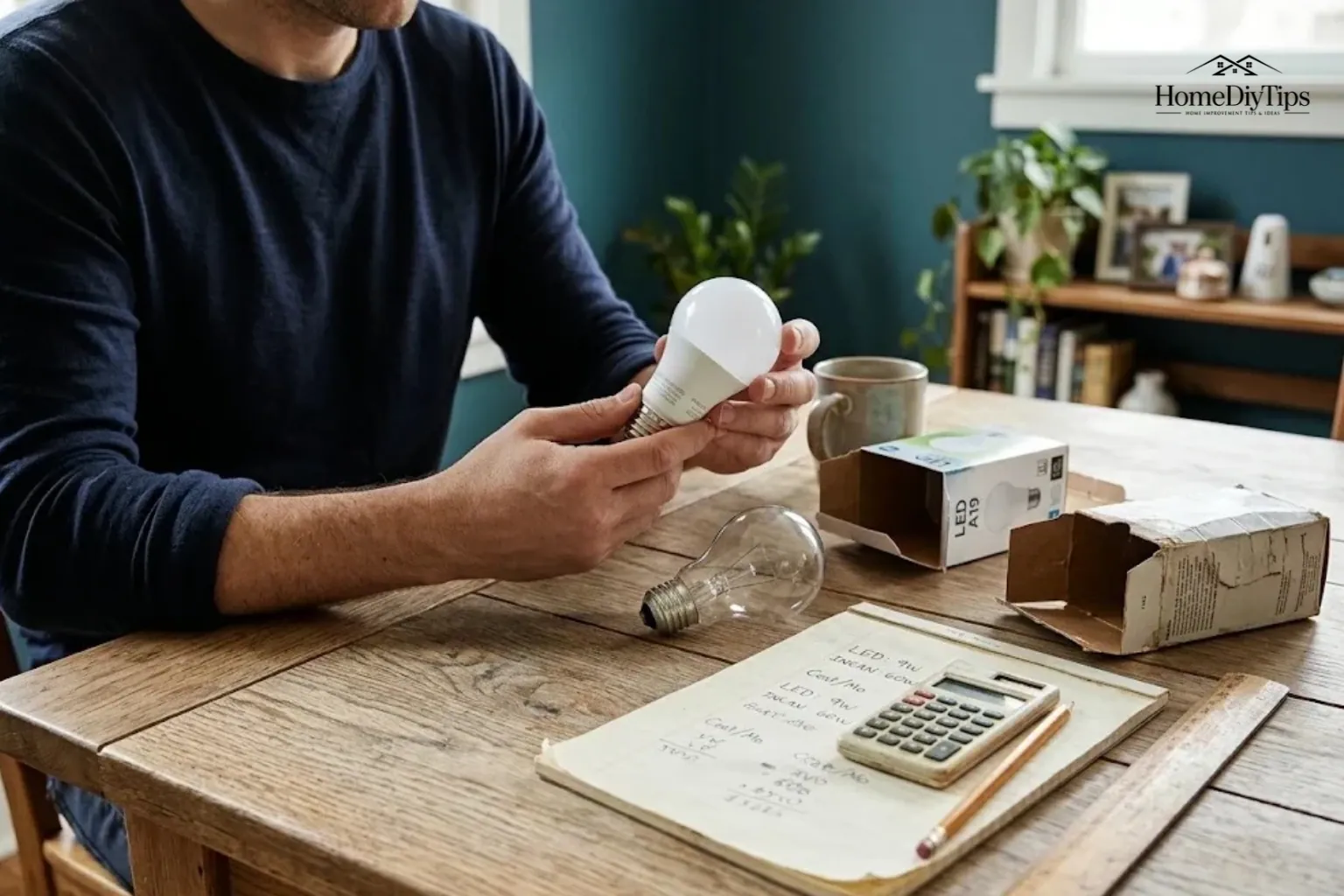
A typical incandescent light bulb uses 40, 60, 75, or 100 watts, while an LED bulb can provide similar brightness using much less power. For example, a traditional 60-watt incandescent bulb produces about 800 lumens of light, while an LED bulb can produce similar brightness using about 9 watts.
The right bulb depends on how much light you need, how long you keep it on, and whether it fits your fixture. Understanding these details helps you choose suitable lighting and estimate how much electricity it will use.
Direct Answer
A light bulb’s wattage shows how much electrical power it uses. Incandescent bulbs commonly use 40–100 watts, while LEDs often provide similar brightness with much less power. Compare lumens and check actual wattage.
Experience
Practical Home Tip
When replacing a bulb, compare lumens for brightness and actual watts for electricity use. A 60W-equivalent LED may use about 9W, but check the product label and fixture instructions because products and fixtures vary.
How Many Watts Does a Light Bulb Use?
A light bulb’s wattage tells you how much electrical power it uses while operating. The amount depends mainly on the bulb’s type and design.
Here are some common examples:
| Bulb type | Typical wattage | Common use |
| Traditional incandescent | 40W | Lower-level general lighting |
| Traditional incandescent | 60W | Everyday room lighting |
| Traditional incandescent | 75W | Brighter general lighting |
| Traditional incandescent | 100W | Higher light output |
| LED replacement for a 40W bulb | About 4.5–7W | Similar brightness with less power |
| LED replacement for a 60W bulb | About 6–10W | Everyday room lighting |
| LED replacement for a 75W bulb | About 10–14W | Brighter general lighting |
| LED replacement for a 100W bulb | About 11–18W | Higher light output |
The LED ranges are drawn from the U.S. Department of Energy’s published light bulb comparison guide. They are reference ranges, not specifications that apply to every bulb on the market. Always check the actual wattage and brightness printed on the product.
The main difference is efficiency. An incandescent bulb uses much of its electrical energy to produce heat, while an LED converts a larger share into light. As a result, an LED can provide similar brightness while using substantially less power.
For most everyday lighting needs, an LED is a practical option when you want to reduce electricity use without sacrificing the amount of light you need.
Watts vs. Lumens vs. Kilowatt-Hours
Before calculating electricity use, it helps to understand three terms: watts, lumens, and kilowatt-hours. Each describes a different part of how lighting works.
What do watts measure?
Watts (W) measure electrical power. The number tells you the rate at which a bulb uses electricity while it is operating.
A 60W bulb uses more power than a 9W bulb under normal operating conditions. However, that does not necessarily mean the 60W bulb produces more useful light.
This distinction matters when shopping for replacement bulbs. Two bulbs can produce similar brightness even when their wattages are very different.
What do lumens measure?
Lumens (lm) measure the amount of visible light a bulb produces. More lumens generally mean more light output, while fewer lumens mean less.
The Federal Trade Commission’s light bulb shopping guide explains that an incandescent bulb using 60 watts produces about 800 lumens. An LED can produce approximately the same 800 lumens using only about 9 watts.
When replacing an old bulb, compare lumens to find similar brightness. Do not rely on wattage alone.
What is a kilowatt-hour?
A kilowatt-hour, written as kWh, measures the amount of electrical energy consumed over time. It is the unit commonly used on US electricity bills.
One kilowatt equals 1,000 watts. If a 1,000W appliance operates for one hour, it uses 1 kWh of electricity.
A 60W light bulb uses much less energy in one hour:
60 watts × 1 hour = 60 watt-hours, or 0.06 kWh.
This explains why the question “How many watts does a light bulb use per hour?” needs a small correction. The bulb has a wattage rating, but its energy consumption over an hour depends on that rating and how long it operates.
LED vs. Incandescent: Wattage and Brightness Compared
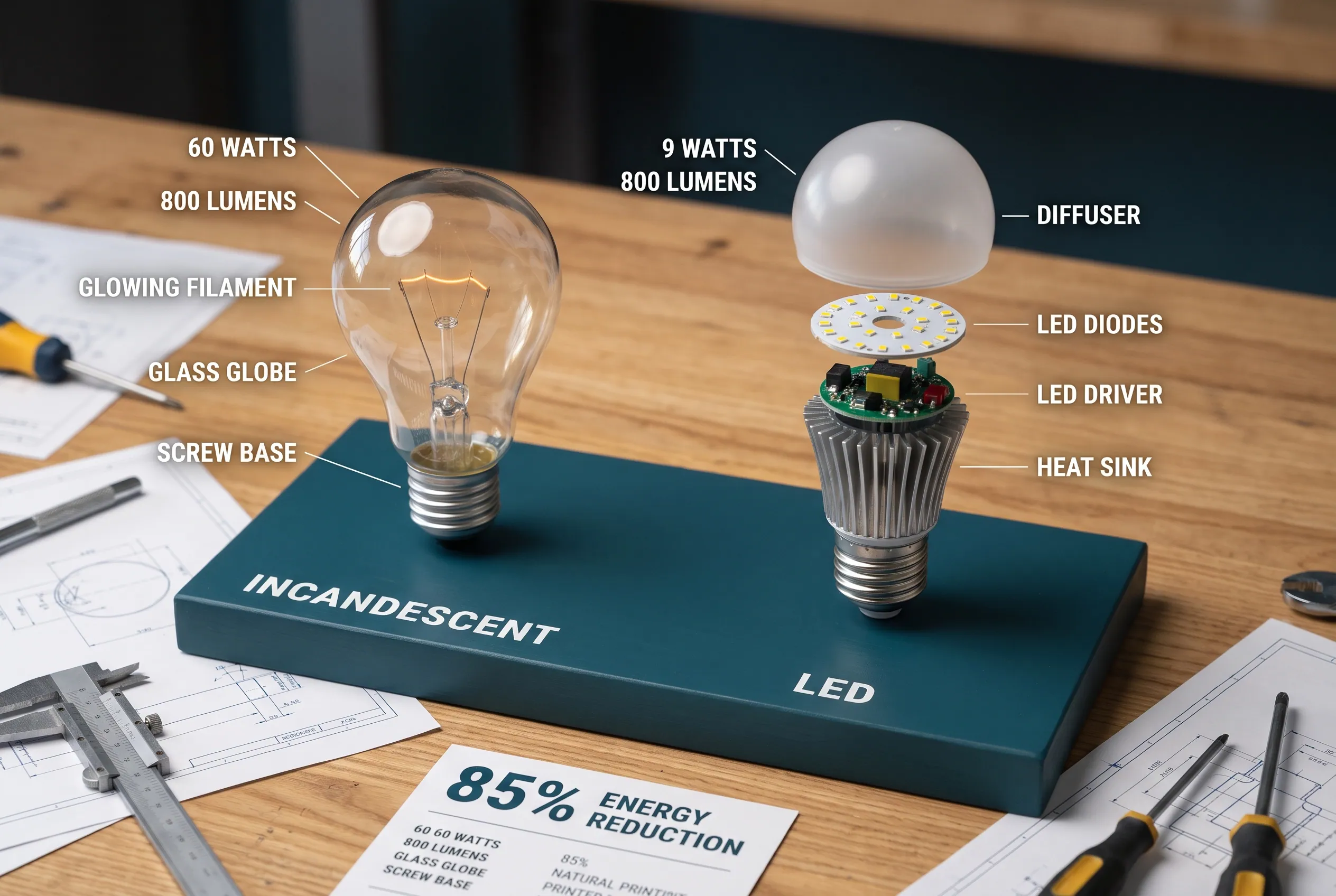
LED and incandescent bulbs can produce similar amounts of light while using different amounts of electricity.
Incandescent bulbs create light by heating a thin wire called a filament until it glows. LED bulbs use light-emitting diodes, which produce light more efficiently.
The following table uses the Department of Energy’s published comparison for certain general-purpose LED replacement lamps. Treat the figures as reference values and use the current product label to choose an actual bulb.
| Approximate brightness | Incandescent wattage | LED wattage range |
| 450 lumens | 40W | 4.5–7W |
| 800 lumens | 60W | 5.9–10.5W |
| 1,100 lumens | 75W | 9.5–14W |
| 1,600 lumens | 100W | 10.5–18W |
These ranges come from the DOE’s published purchasing guidance. They are not a guarantee that every LED within a wattage range will produce exactly the same brightness.
Why does an LED use fewer watts?
LEDs are more efficient at converting electrical power into light than traditional incandescent bulbs. The exact difference depends on each bulb’s design and performance.
Consider two bulbs:
- A 60W incandescent bulb produces about 800 lumens.
- A 9W LED produces about 800 lumens.
The LED uses 51 fewer watts while delivering approximately the same light output.
That is an 85% reduction in power consumption for this comparison. It is not a universal percentage for every bulb pair, but it shows why the actual wattage matters.
Which bulb is the better choice?
An LED is generally a practical choice for everyday household lighting because it uses less electricity for similar brightness and typically lasts longer than an incandescent bulb.
An incandescent bulb may still be present in older fixtures or specialty applications. However, when replacing a standard household bulb, an LED with suitable brightness and compatibility is often the more efficient option.
Look beyond wattage, too. Color appearance, dimming ability, bulb shape, and fixture requirements can affect whether a replacement works well in your home.
How to Calculate a Light Bulb’s Electricity Use
You do not need special equipment to estimate how much electricity a bulb consumes. You need its actual wattage and the number of hours it operates.
Use this formula:
Electricity used (kWh) = Wattage × Hours of use ÷ 1,000
For example, a 60W bulb operating for five hours uses:
60 × 5 ÷ 1,000 = 0.30 kWh.
A 9W LED operating for the same five hours uses:
9 × 5 ÷ 1,000 = 0.045 kWh.
The LED uses less electricity because its actual wattage is lower.
How many watts does a light bulb use per hour?
Wattage does not change simply because an hour has passed. A bulb rated at 60W continues to use approximately 60 watts while operating under its rated conditions.
Over one hour, its energy consumption is:
| Bulb | Power rating | Energy used in one hour |
| Incandescent | 60W | 0.06 kWh |
| LED | 9W | 0.009 kWh |
The 60W bulb uses 60 watt-hours of energy in an hour, while the 9W LED uses 9 watt-hours.
For a quick estimate, divide a bulb’s wattage by 1,000 to find the number of kWh it uses in one hour.
How much electricity does a light bulb use per day?
Daily consumption depends on how long you leave the light on.
Suppose you use one 60W incandescent bulb for two hours each day.
60 × 2 ÷ 1,000 = 0.12 kWh per day.
A 9W LED used for the same two hours consumes:
9 × 2 ÷ 1,000 = 0.018 kWh per day.
Here is how those figures change if each bulb operates continuously for 24 hours.
| Bulb | Two hours per day | Twenty-four hours per day |
| 60W incandescent | 0.12 kWh | 1.44 kWh |
| 9W LED | 0.018 kWh | 0.216 kWh |
Keeping a light on longer increases its total energy consumption. Lower-wattage bulbs reduce consumption when you compare the same operating time.
How much electricity does a light bulb use per month?
To calculate monthly use, multiply daily consumption by the number of days in the month.
Assume you use one bulb for two hours daily over a 30-day month.
| Bulb | Daily use | Monthly use |
| 60W incandescent | 0.12 kWh | 3.6 kWh |
| 9W LED | 0.018 kWh | 0.54 kWh |
The incandescent bulb uses 3.6 kWh per month, while the LED uses 0.54 kWh.
The difference is 3.06 kWh per month for this example.
For a bulb that stays on all day, the monthly totals are much higher. A 60W bulb uses 43.2 kWh over 30 days of continuous operation, compared with 6.48 kWh for a 9W LED.
These calculations assume constant rated power and do not include any other lights or appliances in the home.
How Much Does It Cost to Run a Light Bulb?
The cost of running a light bulb depends on its energy consumption and your electricity price.
Use this formula:
Electricity cost = Energy used (kWh) × Price per kWh
The US Energy Information Administration reported a national average residential electricity price of 18.31 cents per kWh for July 2026 in its latest accessible data during this research. See the EIA electricity price tables.
That figure is a benchmark, not a promise of what you will pay. Your local utility rate, plan, fees, and other bill charges can change your actual cost.
What does it cost to run one bulb for two hours a day?
Using the national average of $0.1831 per kWh, consider the two bulbs used in the previous example.
For the 60W incandescent bulb:
3.6 kWh × $0.1831 = approximately $0.66 per month.
For the 9W LED:
0.54 kWh × $0.1831 = approximately $0.10 per month.
| 30-day use at two hours per day | 60W incandescent | 9W LED |
| Energy consumed | 3.6 kWh | 0.54 kWh |
| Estimated electricity cost | $0.66 | $0.10 |
The difference is about $0.56 per month for one bulb, using these assumptions.
That may seem small on its own. But if ten comparable lights operate on the same schedule, the estimated difference would be about $5.60 per month. Your actual savings depend on the wattage of each bulb, operating hours, and electricity rate.
How much does a light bulb cost to run for 24 hours?
Continuous operation makes the difference easier to see.
Over a 30-day month, a 60W incandescent bulb consumes 43.2 kWh, while a 9W LED consumes 6.48 kWh.
At $0.1831 per kWh, the estimated costs are:
| Bulb | Monthly energy use | Estimated monthly cost |
| 60W incandescent | 43.2 kWh | $7.91 |
| 9W LED | 6.48 kWh | $1.19 |
The difference is about $6.72 per month for this single light operating continuously.
Not every household keeps one bulb on for 24 hours. The example simply shows how longer operating times magnify the effect of wattage.
For your own estimate, replace the example rate with the price shown on your electricity bill. If your rate is 25 cents per kWh, for example, multiply the bulb’s monthly kWh consumption by $0.25.
How to Choose the Right Bulb Brightness for Each Room
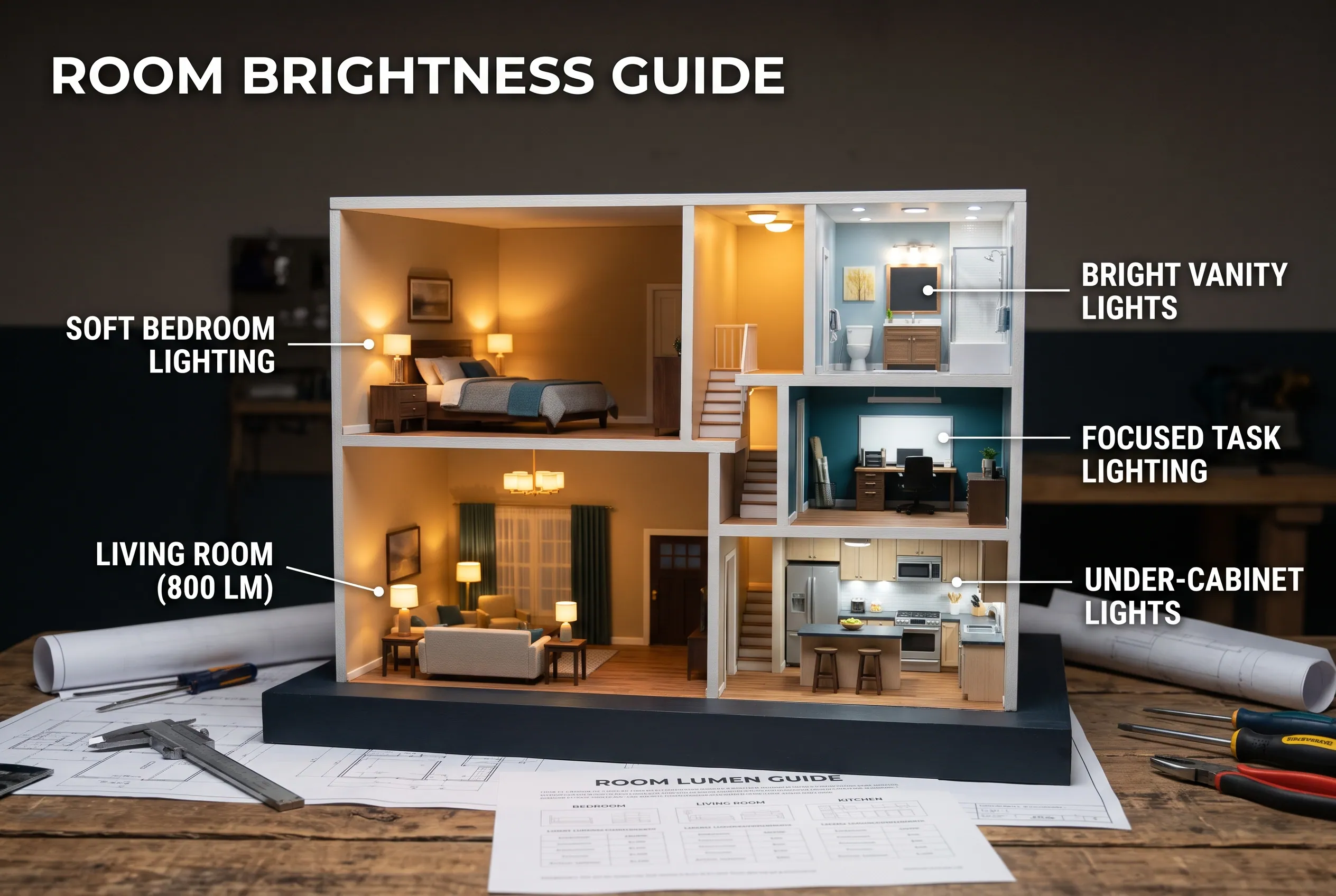
The right bulb is not always the one with the highest wattage. Think about how much light the room needs, what you do there, and how many bulbs share the work.
Living rooms and bedrooms
Living rooms often benefit from comfortable general lighting, with additional lamps for reading or other activities. Bedrooms may need softer lighting near the bed and brighter light in areas used for dressing.
An 800-lumen bulb is a useful reference point because it provides roughly the light output of a traditional 60W incandescent bulb. However, one bulb may not light a large room evenly.
Consider room size, ceiling height, fixture placement, and the total output of all bulbs. You may get better results from several well-placed lights than from one very bright bulb.
Kitchens, bathrooms, and work areas
Cooking, grooming, reading, and working often require more focused light than general room lighting.
In a kitchen, for example, overhead lights may illuminate the room while under-cabinet lights help brighten countertops. In a bathroom, mirror lighting can make grooming easier.
Choose the required brightness in lumens and consider how the light falls on the work area. Also check color appearance, since some people prefer warmer light in living spaces and a more neutral appearance for detailed tasks.
What wattage light bulb should you use in a living room?
There is no single wattage that suits every living room. A small room with several fixtures has different needs from a large room with one central light.
Start by deciding how bright you want the space to be. Then compare lumen ratings, account for the number of bulbs, and check whether your fixtures support the selected bulbs.
For energy efficiency, choose an LED that produces the required light without exceeding the fixture’s limits.
What to Check on the Bulb and Fixture Labels
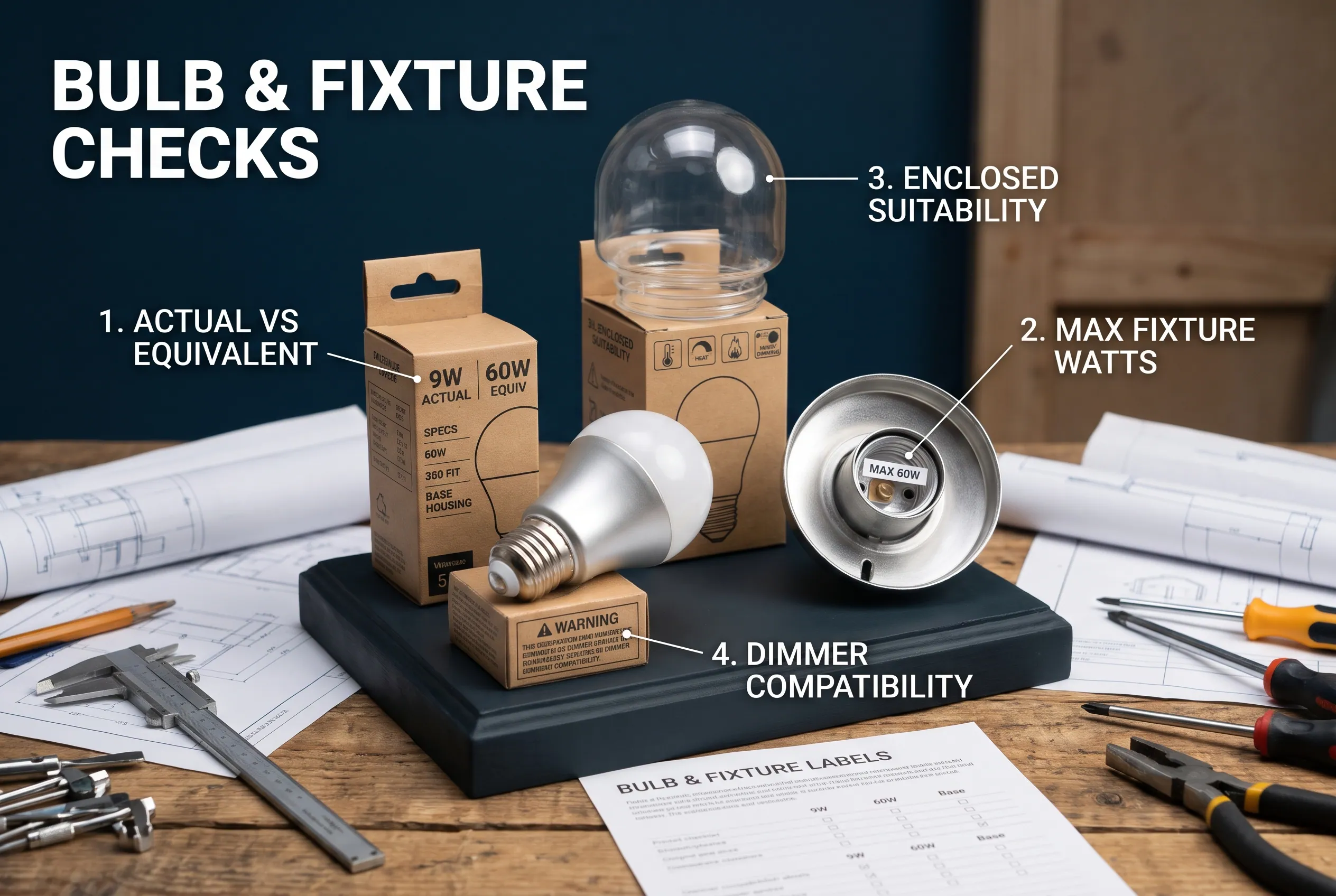
A bulb can provide the right brightness and still be unsuitable for a particular fixture. Before buying a replacement, check these details.
Actual wattage vs. equivalent wattage
An LED package may say “60W equivalent” even though the bulb actually uses only 9W.
The equivalent wattage describes brightness compared with a traditional incandescent bulb. It does not mean the LED consumes 60 watts.
For electricity calculations and fixture checks, use the bulb’s actual wattage and follow the fixture manufacturer’s instructions.
Maximum fixture wattage
Many fixtures list a maximum wattage on a label near the socket or in the manual. Check this limit before installing a replacement.
Do not treat an incandescent-equivalent rating as the bulb’s actual power use. Also, do not assume that a lower-wattage LED can be used in every fixture regardless of its instructions.
If the fixture specifies a particular bulb type, maximum LED wattage, or other restriction, follow those instructions.
Enclosed fixtures and dimmers
A fully enclosed fixture can trap heat, which may affect the performance and expected life of some LEDs. Check the bulb packaging or manufacturer’s specifications for enclosed-fixture suitability.
If your light uses a dimmer, confirm that the LED is dimmable and compatible with that dimmer. A bulb marked dimmable may not work properly with every older dimming system.
Bulb base and shape
Check whether the replacement has the correct base and fits inside the fixture’s shade or housing. LEDs can have different shapes and sizes from the incandescent bulbs they replace.
For outdoor fixtures, check that the product is rated for the intended location and conditions. A bulb suitable for an indoor lamp may not be suitable for an exposed outdoor fitting.
Common Light Bulb Wattage Mistakes
A few misunderstandings can lead to the wrong bulb choice or incorrect electricity estimates.
Mistake 1: Assuming more watts always means more brightness. Watts measure power, not light output. Compare lumens when choosing brightness.
Mistake 2: Treating watts as energy consumed per hour. A 60W bulb running for one hour uses 60 watt-hours, or 0.06 kWh. Its wattage rating remains 60W.
Mistake 3: Confusing equivalent watts with actual watts. A 60W-equivalent LED might use 9W. Use actual wattage for electricity calculations.
Mistake 4: Assuming every LED uses the same amount of power. Different LEDs produce different light outputs and vary in efficiency. Read the label before estimating consumption.
Mistake 5: Ignoring operating time and electricity prices. A bulb used for 30 minutes a day has a different running cost from one kept on all day. Use your actual hours and electricity rate for a useful estimate.
Frequently Asked Questions About Light Bulb Wattage
Does a 60-watt light bulb use 60 watts per hour?
Not exactly. A 60W bulb uses 60 watt-hours of energy during one hour of operation, equal to 0.06 kWh. Watts measure power, while watt-hours and kilowatt-hours measure energy consumed over time.
Is 200 watts a lot for a light?
It depends on the lighting setup and how long it operates. A total of 200W from several lights uses less power than a typical high-wattage household appliance, but its electricity consumption still adds up over long periods. For LED lighting, check the actual combined wattage rather than the equivalent-wattage labels.
How much does it cost to run one light bulb for 24 hours?
Using a 60W incandescent bulb and an example rate of $0.1831 per kWh, one day of continuous operation costs about $0.26. A 9W LED costs about $0.04 per day at the same rate. Actual costs vary with wattage and electricity prices.
How much electricity does an LED light bulb use per month?
A 9W LED used for two hours daily over 30 days consumes 0.54 kWh. If it operates continuously for those 30 days, it consumes 6.48 kWh. Multiply the relevant kWh figure by your electricity price to estimate the cost.
What wattage light bulb should I use in my living room?
Choose the brightness you need in lumens, considering the room’s size, fixture arrangement, and activities. Then select a compatible bulb whose actual wattage stays within the fixture’s stated limits. A 60W-equivalent LED can be a useful starting point for general lighting, but it is not the right choice for every room.
A Simple Rule for Choosing Your Next Light Bulb
When choosing a replacement bulb, focus on three things: brightness, actual wattage, and fixture compatibility.
Compare lumens to get the light output you need. Check the actual wattage to estimate electricity use, and read the fixture and bulb instructions before installing the replacement.
For many everyday household lights, an efficient LED provides similar brightness to an incandescent bulb while using much less power. Calculate the cost using your own operating hours and electricity rate, and you will have a clearer picture of what the bulb costs to run.
Disclaimer
Lighting needs, fixture limits, electricity rates, and household usage vary. Check the bulb and fixture instructions before replacing a light bulb, and consult a qualified electrician if you find damaged wiring, overheating, or an electrical fault.