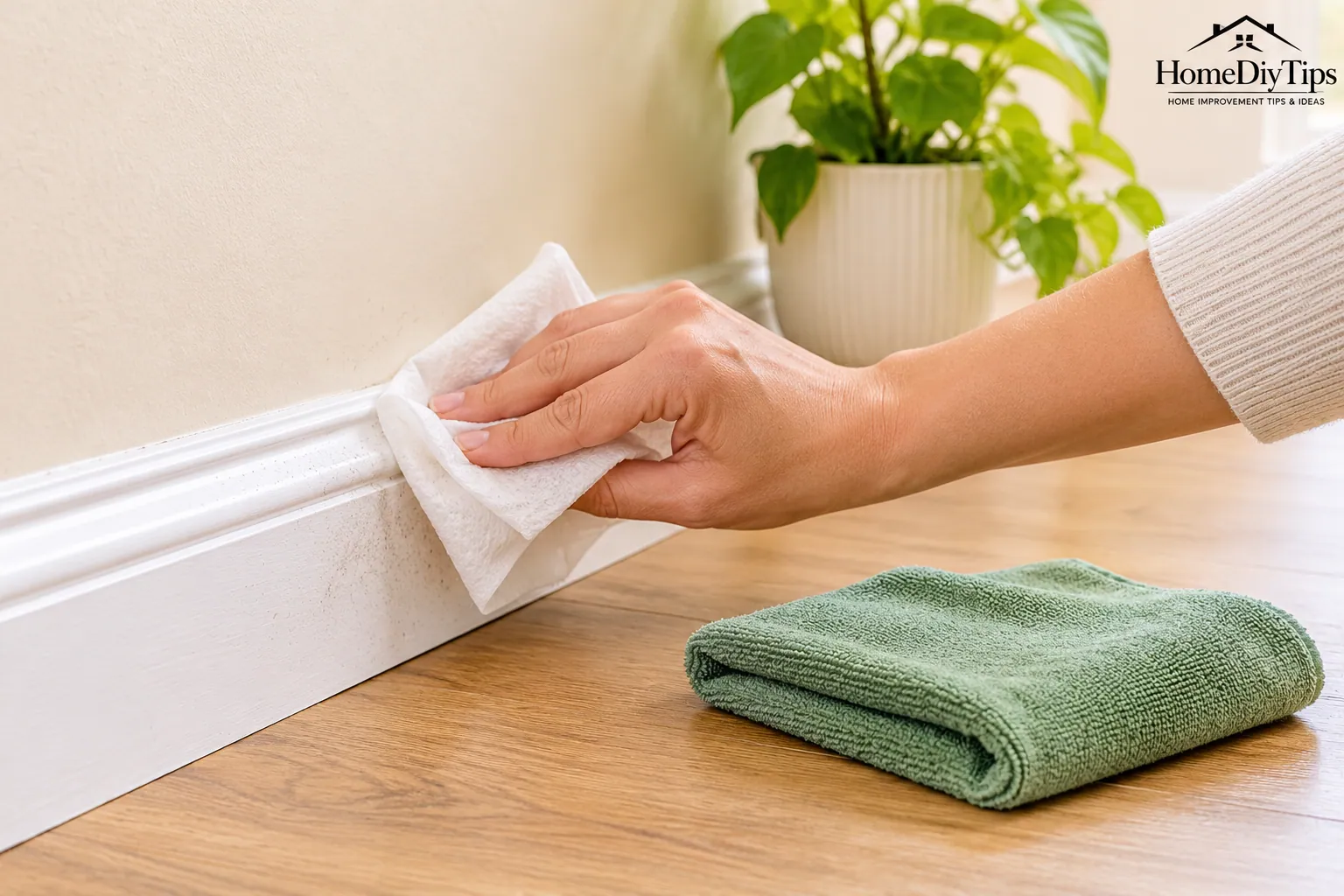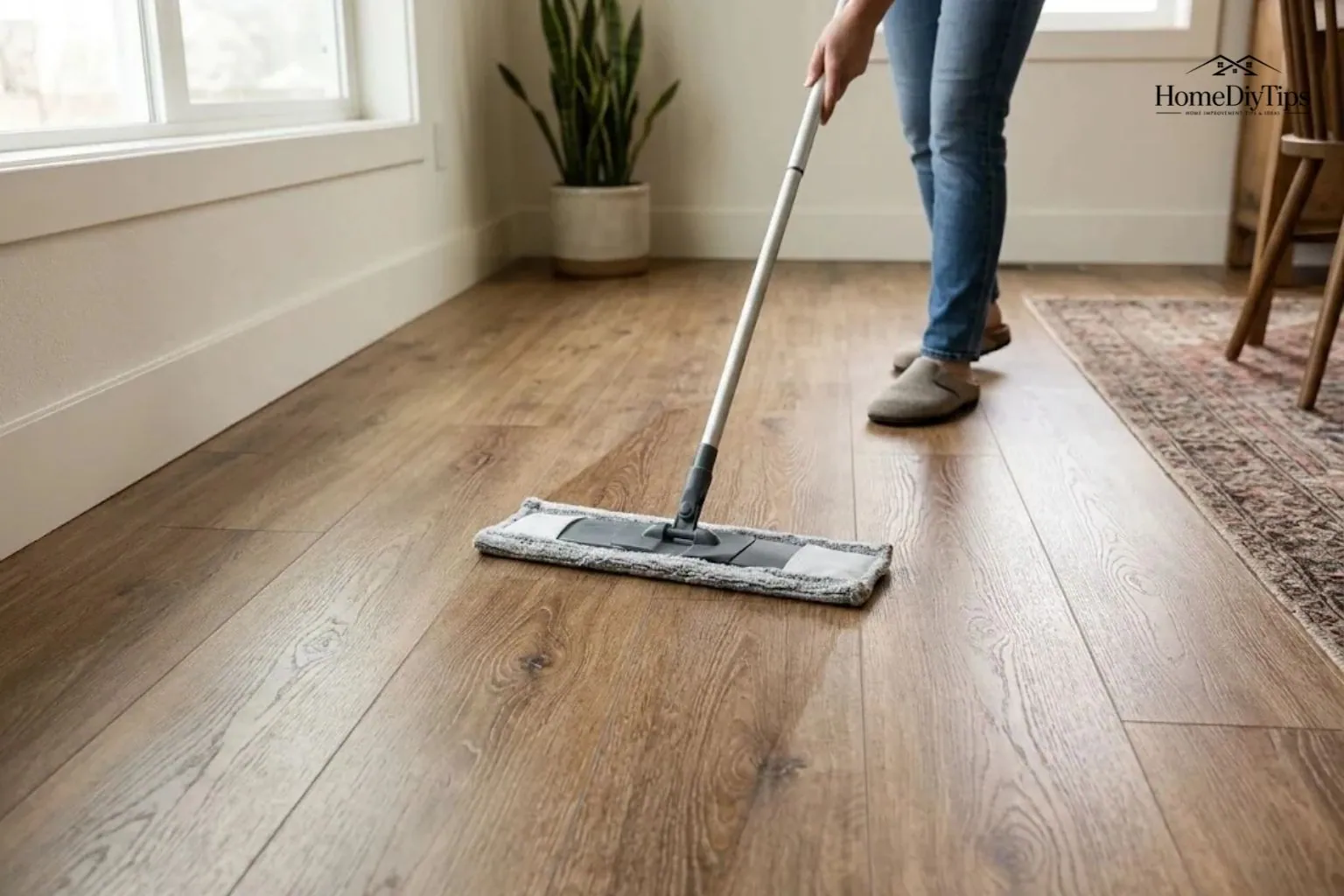
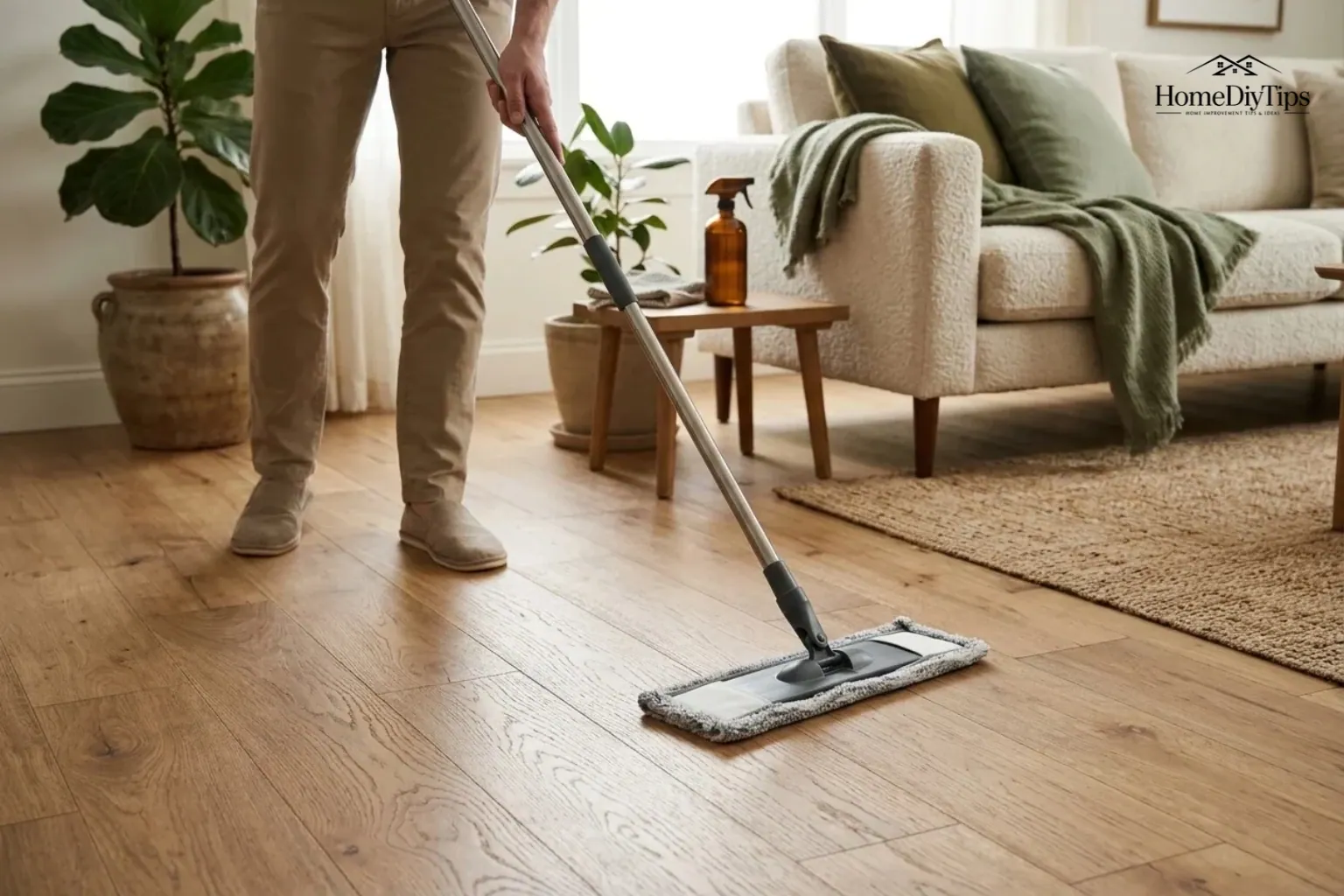
Engineered hardwood floors add warmth and natural beauty to a home, but cleaning them requires the right approach. Too much water, harsh chemicals, or rough cleaning tools can damage the protective finish and the wood beneath it.
The best way to clean engineered hardwood floors is to remove loose dirt with a microfiber dust mop or hardwood-safe vacuum, then use a lightly damp microfiber mop with a cleaner approved for your flooring. Wipe up spills promptly, avoid standing water, and never use a steam mop unless the flooring manufacturer specifically permits it.
You don’t need expensive equipment to keep these floors clean. A suitable microfiber mop, a compatible floor cleaner, and a simple cleaning routine are usually enough.
However, different engineered hardwood products have different finishes and care requirements. Knowing which type you have will help you choose the right cleaning method.
Why Engineered Hardwood Floors Need Special Care
Before choosing cleaning products, it helps to understand how engineered hardwood is made. Although it looks similar to solid hardwood, its construction is different.
What Is Engineered Hardwood?
Engineered hardwood is made with a real-wood surface layer attached to a core made from multiple layers of wood or wood-based materials.
The top layer is called the wood veneer. It gives the floor its natural appearance, including the grain, color, and texture.
Beneath this layer is the core, which provides support and helps improve dimensional stability.
This construction makes engineered hardwood less sensitive to changes in humidity than solid hardwood in many situations. However, it does not mean every engineered floor is waterproof.
Short Definition
Clean engineered hardwood by removing loose dirt first, then using a lightly damp microfiber mop with a cleaner approved for your floor’s finish. Wipe spills promptly and avoid standing water.
Experience
Clean textured grooves with a dry, soft brush attachment first, then use a lightly damp microfiber cloth if needed. Avoid pushing liquid into plank joints, and check the flooring manufacturer’s care instructions before using a cleaner.
Some products have special moisture-resistant or waterproof features, while others require careful moisture control.
How Its Wood Surface and Finish Affect Cleaning
Most engineered hardwood floors have a protective coating that helps resist everyday dirt, spills, and wear.
Common finishes include:
- Polyurethane: A protective surface coating found on many factory-finished wood floors.
- Hard-wax oil: A finish that penetrates and protects the wood while maintaining a more natural appearance.
- Other factory-applied coatings: Some products use specialized finishes with their own maintenance requirements.
The finish matters because a cleaner suitable for one surface may not work well on another.
For example, an oil-finished floor may need a different cleaning product from a polyurethane-finished floor.
Check your flooring paperwork, product label, or manufacturer’s website before choosing a cleaner.
Why Too Much Water Can Cause Problems
Engineered hardwood contains wood, and wood reacts to moisture.
Water that enters through plank edges or damaged areas can cause swelling, changes in appearance, or lifting.
Repeated exposure can also weaken the protective finish.
This is why a lightly damp mop is generally preferable to a soaking wet mop. The goal is to remove dirt without leaving excess moisture behind.
The National Wood Flooring Association’s maintenance guidance also recommends immediate spill cleanup and avoiding wet and steam mops.
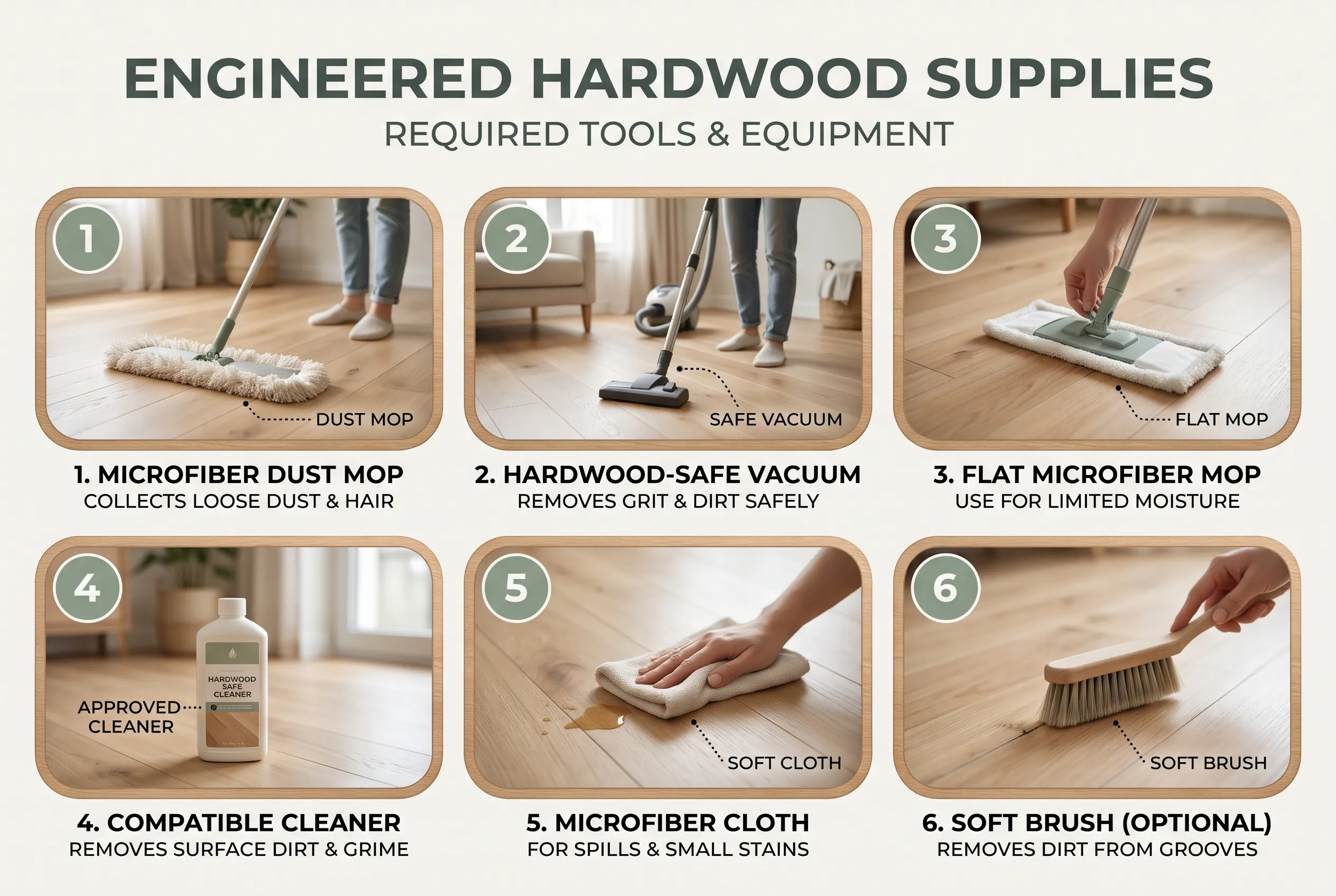
What You Need Before Cleaning Engineered Hardwood Floors
You don’t need a large collection of cleaning supplies. A few suitable tools can handle most everyday cleaning jobs.
| Cleaning tool | Main purpose | Priority |
| Microfiber dust mop | Collects loose dust and hair | Essential |
| Hardwood-safe vacuum | Removes grit and dirt | Very useful |
| Flat microfiber mop | Cleans the floor with limited moisture | Essential |
| Compatible hardwood cleaner | Removes surface dirt and grime | Essential for damp cleaning |
| Soft microfiber cloth | Handles spills and small stains | Essential |
| Soft brush | Helps remove dirt from textured grooves | Optional |
Choose a Soft Microfiber Mop
A microfiber mop is a practical choice because its soft fibers collect dirt without requiring rough scrubbing.
Choose a mop with a washable, removable pad. This makes routine maintenance easier and reduces the need for disposable cleaning supplies.
A flat mop is suitable for ordinary rooms, while a spray mop offers more control over the amount of cleaning solution applied.
Use a Hardwood-Safe Vacuum
Vacuuming helps remove small particles that can scratch the floor when people walk over them.
Choose a vacuum with:
- A hard-floor cleaning setting.
- A soft brush attachment.
- No rotating beater bar touching the floor.
- Smooth wheels that won’t scratch the surface.
Avoid dragging a heavy vacuum across the floor or using a rough rotating brush.
Select a Compatible Floor Cleaner
Look for a cleaner specifically designed for your type of finished hardwood.
Many wood-floor cleaners are pH-neutral, but the pH alone does not prove that a product is suitable. Check the stated surface compatibility and your flooring manufacturer’s instructions.
Avoid assuming that a product labeled for laminate, tile, or general hard surfaces is automatically safe for engineered hardwood.
How to Clean Engineered Hardwood Floors Step by Step
A simple routine can remove everyday dirt while protecting the surface.
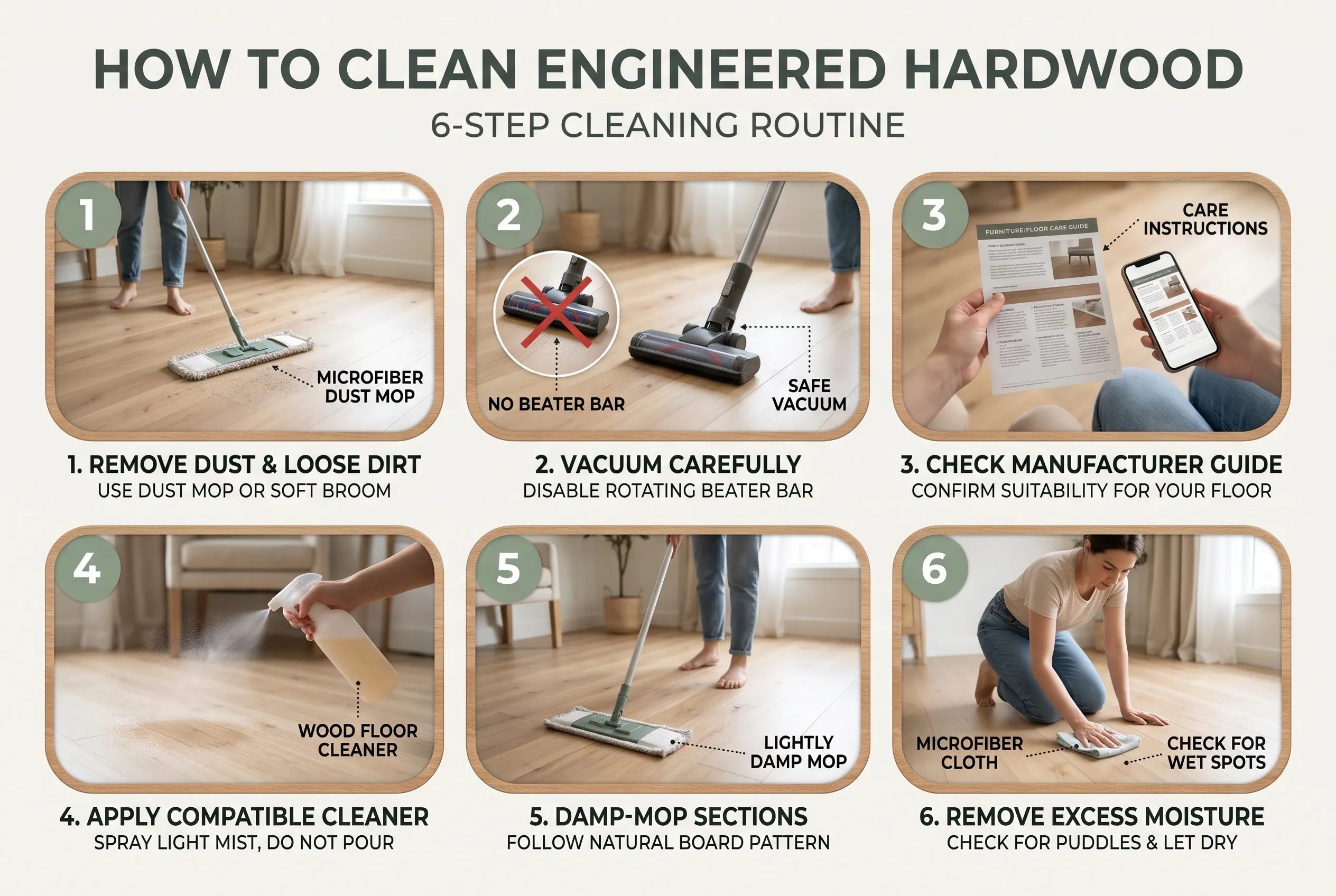
Follow these six steps whenever your floors need a proper cleaning.
Step 1: Remove Dust and Loose Dirt
Start by clearing loose particles from the floor.
Use a microfiber dust mop, soft-bristle broom, or suitable vacuum attachment.
Pay attention to areas that collect more dirt, such as:
- Doorways and entrances.
- Areas around dining tables.
- Kitchen walkways.
- Spaces beneath chairs.
- Corners and furniture edges.
Moving loose dirt first helps prevent it from scratching the floor during damp cleaning.
For ordinary dust, a dry microfiber mop may be enough. You don’t need to damp-mop the entire room every time you notice a few particles.
Step 2: Vacuum Carefully
After dusting, vacuum areas where small particles remain.
Use the bare-floor setting if your vacuum has one. Disable the rotating beater bar so it doesn’t rub against the flooring.
A soft brush attachment can help remove dirt near baseboards and furniture.
If your vacuum has hard plastic wheels, move it carefully rather than dragging it over the surface.
Pay extra attention to spaces between furniture and floor edges. These areas often collect dust that regular sweeping misses.
Step 3: Check the Floor Manufacturer’s Instructions
Before applying cleaner, confirm that the product is suitable for your flooring.
Look for the following information:
- Flooring brand and product name.
- Type of surface finish.
- Approved cleaning products.
- Restrictions on water and damp mopping.
- Warranty-related cleaning instructions.
This is especially important when you have recently moved into a home and don’t know what type of flooring was installed.
If the original product paperwork is missing, look for the manufacturer’s maintenance page or contact its customer support team.
Do not experiment with vinegar, soap mixtures, or other household solutions before confirming compatibility.
Step 4: Apply an Appropriate Wood Floor Cleaner
Once you know which cleaner is suitable, prepare it according to its label.
Some products are ready to spray, while others require dilution.
For a compatible spray cleaner, apply a light mist to a small section of floor or directly to the mop pad, following the product instructions.
Avoid pouring cleaning liquid directly onto the floor.
Using a small amount makes it easier to control moisture and prevents cleaner from collecting between the boards.
Step 5: Damp-Mop Small Sections
Use a clean microfiber mop with a lightly damp pad.
Work in manageable sections rather than trying to clean the entire room at once.
Move the mop smoothly along the flooring boards. This helps you work systematically and notice any dirt or residue that remains.
Rinse or replace the pad when it becomes visibly dirty, following its care instructions.
Do not press too hard or scrub aggressively. A suitable cleaner and clean microfiber pad should handle most ordinary surface dirt.
Step 6: Check for Excess Moisture and Residue
After cleaning, inspect the floor.
It should not have puddles, wet patches, or visible cleaner buildup.
Remove any remaining liquid with a clean, dry microfiber cloth.
Allow the surface to dry completely according to the cleaner’s instructions before returning furniture or rugs to the area.
There is no universal one- or two-minute drying rule for every floor. The important point is to avoid leaving moisture sitting on the surface.
For additional guidance, see Bona’s wood-floor cleaning guide, which explains dry dusting, suitable cleaning products, microfiber pads, and low-moisture cleaning techniques.
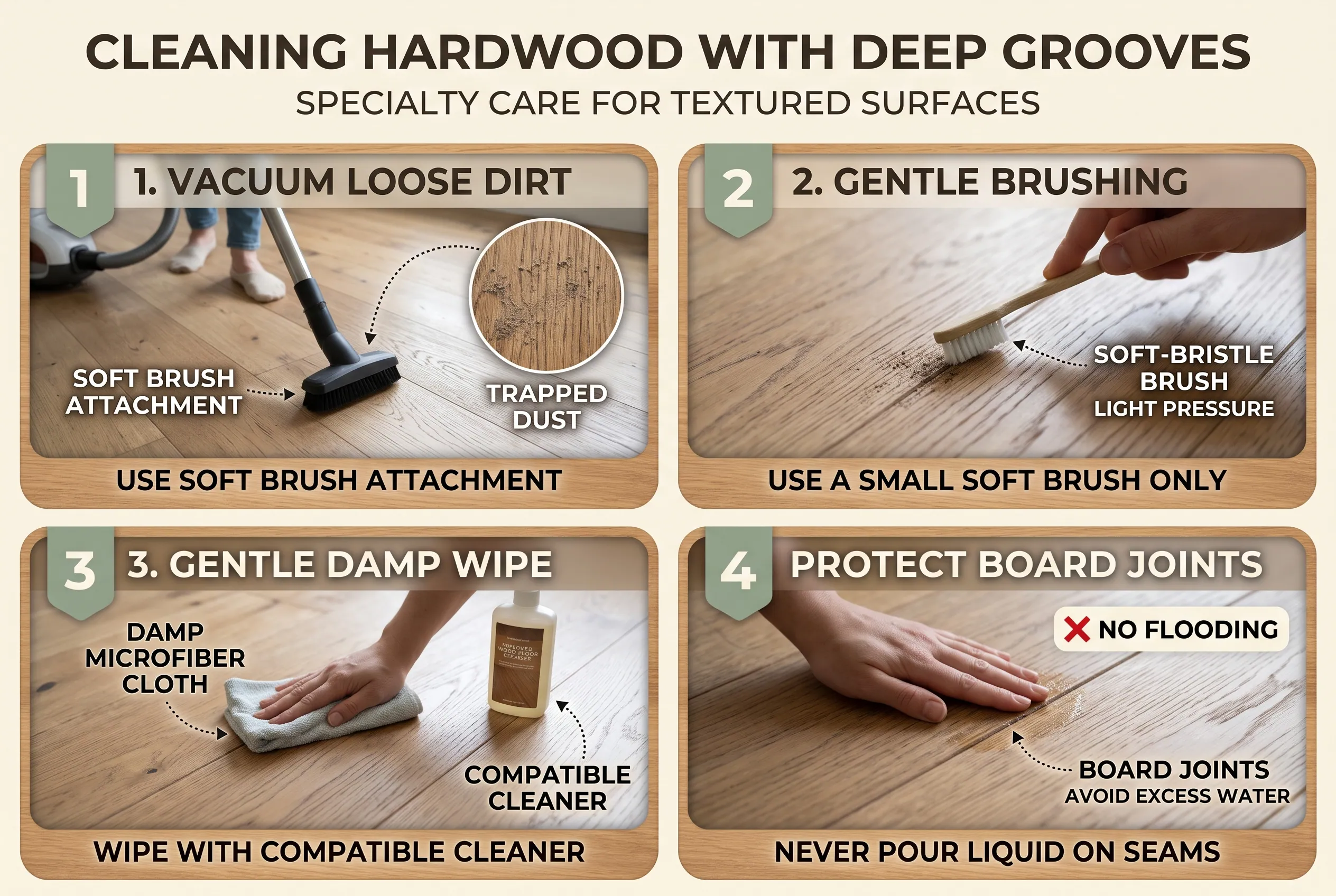
How to Clean Engineered Hardwood Floors With Deep Grooves
Some engineered hardwood floors have textured surfaces, including wire-brushed finishes and visible grain patterns.
These designs look natural, but they can collect dirt in small grooves.
Ordinary mopping may not remove everything because the mop pad mainly touches the raised parts of the surface.
You can clean these areas gently without using aggressive scrubbing methods.
Remove Loose Dirt From Grooves
Start with a hardwood-safe vacuum.
Use a soft brush attachment to collect loose dust from textured areas.
Move slowly along the floor so the attachment can reach dirt around the grain pattern.
A narrow crevice attachment can help with corners and edges, but it should not scrape the surface.
Dry cleaning first is important because mixing loose dirt with liquid can create a muddy residue that becomes harder to remove.
Use a Soft Brush for Stubborn Debris
If dirt remains in a groove, use a clean, soft-bristle brush.
A small soft cleaning brush can help loosen particles from textured areas without requiring heavy pressure.
Work gently and avoid stiff wire brushes, metal tools, or rough scrubbing pads.
The aim is to lift dirt from the surface, not scrape away the protective coating.
Clean Remaining Surface Dirt Carefully
For dirt that remains after brushing, use a microfiber cloth lightly dampened with a compatible hardwood cleaner.
Wipe the affected area gently.
For larger textured sections, a microfiber mop may be more practical.
Always check the cleaner’s instructions before using it on the floor.
Avoid Pushing Water Into Board Joints
Pay attention to the spaces where boards meet.
Do not pour liquid into grooves or attempt to flood textured sections to loosen dirt.
If dirt remains stubbornly attached, stop rather than repeatedly increasing moisture or scrubbing pressure.
The floor manufacturer or a qualified flooring-cleaning professional can advise on a suitable deeper-cleaning method.
How to Choose the Best Cleaner and Mop for Engineered Wood Floors
Choosing cleaning equipment becomes easier when you focus on surface compatibility, moisture control, and ease of use.
What Makes a Hardwood Floor Cleaner Suitable?
A suitable cleaner should be designed for the type of wood-floor finish you have.
Look for products that:
- State that they are suitable for finished hardwood.
- Match your flooring manufacturer’s care instructions.
- Provide clear application directions.
- Do not require excessive water.
- Are intended for your specific floor finish.
A pH-neutral hardwood cleaner is a common choice for many finished floors. However, the flooring manufacturer’s instructions should always take priority.
Avoid selecting a cleaner simply because its packaging says it works on all floors.
Is Bona Hardwood Floor Cleaner a Suitable Choice?
Bona Hardwood Floor Cleaner
Bona is a recognized manufacturer of wood-floor care products. Its hardwood cleaner is designed for compatible finished wood surfaces.
It may be a suitable option when the product label and your flooring manufacturer’s instructions agree.
Before buying it, check the exact product variant.
Also distinguish between three different product types:
Hardwood floor cleaner: Designed to remove everyday dirt and surface grime.
Deep cleaner: Intended for heavier dirt buildup and more difficult cleaning needs.
Polish or refresher: Intended to alter or refresh the floor’s appearance rather than simply remove dirt.
These products are not interchangeable.
For example, Bona offers separate wood-floor cleaning and deep-cleaning products. Its cleaning guidance explains when deeper cleaning may be useful.
Do not apply a polish simply because your floor looks dull. First determine whether the problem is dirt, product residue, or actual finish wear.
How to Choose a Microfiber Mop
Look for a mop with a soft, washable microfiber pad and a head that can reach beneath furniture.
A removable pad is useful because you can clean it after each use.
A wider mop head may help cover open rooms faster, while a smaller head can be easier to control in narrow spaces.
For most households, a simple flat microfiber mop is a practical starting point.
Spray Mop vs. Flat Microfiber Mop
| Feature | Spray mop | Flat microfiber mop |
| Application | Built-in spray system | Cleaner applied separately |
| Moisture control | Convenient measured spraying | Depends on pad dampness |
| Storage | Often compact | Usually simple |
| Best use | Routine cleaning | Flexible everyday cleaning |
| Main consideration | Use a compatible solution | Avoid an overly wet pad |
Neither option is automatically better for every home.
A spray mop may suit readers who prefer convenience. A flat mop may suit those who want greater control over the cleaning solution.
Choose the one that lets you clean gently without leaving excess moisture.
Can You Use Vinegar, Dawn or Swiffer on Engineered Hardwood?
These are common household cleaning questions, but the answers are not identical for every floor.
The important distinction is between general advice and instructions for a specific flooring product.
Can You Clean Engineered Hardwood Floors With Vinegar?
Vinegar is a popular household cleaning ingredient, but it should not be your default engineered hardwood cleaner.
Vinegar is acidic, and repeated use may affect certain wood-floor finishes.
For example, Bruce advises against vinegar on its engineered flooring, while Kentwood permits an occasional diluted vinegar solution for certain situations but warns that extended use may change the floor’s gloss.
Bruce Flooring+1
This difference is why manufacturer instructions matter.
The safer general approach is to use a compatible hardwood-floor cleaner rather than experimenting with homemade vinegar solutions.
Can You Use Dawn to Clean Engineered Hardwood Floors?
Dawn dish soap is designed to remove grease from dishes, but that does not make it suitable for every wood-floor finish.
Bruce’s engineered hardwood cleaning article mentions a few drops of mild dish soap mixed with warm water as a possible homemade cleaning option.
However, other flooring care instructions advise against detergents or soap-based cleaning products.
Some formulas may leave residue or affect the appearance of a finish.
Therefore, do not assume Dawn is safe for your flooring just because another homeowner uses it.
Use it only when your flooring manufacturer specifically allows that type of cleaning solution.
Otherwise, choose a compatible hardwood cleaner.
Can You Use Wet Swiffer on Engineered Hardwood Floors?
The answer depends on the exact Swiffer product and the flooring manufacturer’s instructions.
Bruce’s engineered hardwood guide says Swiffer Wet pads can be used on its flooring. That guidance should not automatically be applied to every engineered hardwood brand or every Swiffer product.
Bruce Flooring
Before using disposable wet pads or a spray-mop solution, check:
- Whether your floor manufacturer permits the product.
- Whether the product is intended for finished wood.
- Whether it leaves excess liquid.
- Whether the cleaning instructions match your flooring warranty.
A traditional microfiber damp mop remains a flexible option when used with an approved cleaning solution.
Why Manufacturer Instructions Matter
There is no single cleaning recipe for all engineered hardwood floors.
A standard polyurethane-finished floor, an oil-finished product, and a specialized waterproof floor may have different cleaning requirements.
When in doubt, check the flooring brand first.
The manufacturer’s instructions should guide your product choices, not a general cleaning tip found online.
What Should You Avoid When Cleaning Engineered Hardwood?
Using an unsuitable cleaning product can create problems even when your cleaning technique is gentle.
Here are the most common mistakes to avoid.
1. Soaking Wet Mops
A soaking wet mop can leave excess moisture on the floor.
Water may enter plank edges and seams, potentially causing swelling or other damage.
Use a lightly damp microfiber mop instead.
2. Steam Mops
Steam mops combine heat and moisture.
These conditions may damage wood flooring or its protective finish.
The NWFA, Bruce and Kentwood all advise against ordinary steam cleaning for their wood-floor care guidance.
NWFA+2
Unless your exact flooring manufacturer expressly permits it, avoid steam mops.
3. Harsh Chemicals
Avoid cleaners containing ingredients that your flooring manufacturer prohibits.
Examples may include:
- Ammonia-based cleaners.
- Bleach-based products.
- Strong abrasive cleaners.
- Acidic homemade mixtures.
- Products intended for unrelated floor surfaces.
These products may discolor, dull, or otherwise affect a floor’s finish.
4. Wax and Oil-Based Soaps
Wax, oil soaps and incompatible floor treatments can leave residue on some modern finished wood floors.
This may create a sticky surface or an uneven appearance.
Do not apply a polish, wax or refresher unless the manufacturer recommends that product for your finish.
5. Abrasive Cleaning Tools
Avoid steel wool, rough scouring pads, stiff metal brushes, and abrasive powders.
These tools can scratch the protective surface.
For stubborn dirt, use a compatible cleaner and a soft microfiber pad instead.
How to Fix Streaks, Dullness and Sticky Residue
Sometimes a floor still looks dirty after cleaning.
This does not always mean the floor needs stronger chemicals or more scrubbing.
The problem may be leftover cleaner, an unwashed mop pad, or normal wear on the finish.
What Causes Streaks?
Streaks can appear when:
- Too much cleaner is applied.
- A dirty mop pad spreads grime.
- Cleaner residue remains on the surface.
- Other household cleaning products land on the floor.
Start by inspecting your cleaning pad.
Replace or wash it if it is dirty, and follow the cleaner’s instructions using a fresh pad.
Bona’s guide to streak-free wood floors also identifies contaminated pads and cleaning-product buildup as common causes.
How to Handle Sticky Cleaner Residue
Sticky residue may result from using too much cleaning solution or an incompatible product.
Do not immediately add another household cleaner.
Instead:
- Stop using the product that may be causing the residue.
- Check whether the cleaner is approved for your floor.
- Follow the manufacturer’s instructions for removing product buildup.
- Use a clean microfiber pad.
- Allow the floor to dry and inspect it again.
Avoid aggressive scrubbing or applying vinegar as a quick fix.
Adding several cleaners can make the problem harder to resolve.
What to Do When Floors Look Dull
Dullness can have several causes.
Sometimes dust and dirt cover the finish, and suitable cleaning restores the appearance.
Other times, cleaning-product buildup or fine scratches make the surface look less attractive.
Start with a gentle cleaning method recommended for your floor.
If the floor remains dull, check whether the finish is worn.
Do not assume another layer of polish will solve the problem.
When Cleaning Is Not Enough
If you notice swollen board edges, lifted sections, persistent discoloration, or finish damage, ordinary cleaning may not solve the issue.
Avoid repeated wet cleaning and seek advice from the manufacturer or a qualified flooring professional.
The National Wood Flooring Association explains that some dull wood floors may need recoating rather than ordinary cleaning.
How to Keep Engineered Hardwood Floors Clean Longer
A few simple habits can reduce dirt buildup and make cleaning easier.
Remove Loose Dirt Regularly
Dust and grit can accumulate quickly in busy areas.
Sweep or dust-mop whenever needed. Homes with pets, children, or frequent visitors may require more frequent attention.
Clean Spills Promptly
Wipe up water, food, and drink spills as soon as possible.
Use a dry or slightly damp microfiber cloth, then follow the floor manufacturer’s instructions when further cleaning is needed.
Use Entryway Mats
Place suitable mats at entrances to collect dirt before people walk across the floor.
Avoid mats with backings that your flooring manufacturer warns against.
Protect the Floor From Furniture
Attach suitable felt protectors to furniture legs.
This helps reduce scratches when chairs and tables move across the surface.
Check the protectors regularly and replace them when they become dirty or worn.
Follow a Simple Cleaning Schedule
Your cleaning schedule should match how much activity each room receives.
| Cleaning task | Practical frequency |
| Remove visible dust and loose dirt | As needed, often several times a week |
| Vacuum busy areas | Weekly or more often when needed |
| Wipe spills | Immediately |
| Damp-mop | When the floor needs it, following manufacturer guidance |
| Inspect furniture protectors | Periodically |
| Review floor-care instructions | Whenever changing cleaning products |
A household with pets or children may need more frequent cleaning than a rarely used guest room.
There is no reason to damp-mop every day when dry dust removal is enough.
Frequently Asked Questions About Engineered Hardwood Floor Cleaning
1. What Is the Best Way to Clean Engineered Hardwood Floors?
The best general approach is to remove loose dirt with a microfiber dust mop or hardwood-safe vacuum. Then use a lightly damp microfiber mop and a cleaner approved for your floor’s finish. Wipe up spills promptly and never leave standing water.
2. Can You Use Wet Swiffer on Engineered Hardwood Floors?
Some manufacturers, including Bruce, permit specific Swiffer Wet products on their flooring. However, this does not guarantee compatibility with every engineered hardwood product. Check your flooring manufacturer’s instructions before using disposable wet pads or spray solutions.
3. Can You Use Dawn to Clean Engineered Hardwood Floors?
Some manufacturer guidance permits a small amount of mild dish soap in a homemade cleaning solution. Other manufacturers advise against detergent-based cleaners. Check your floor’s care instructions before using Dawn. A compatible hardwood-floor cleaner is usually a more straightforward choice.
4. Can You Use Vinegar on Engineered Hardwood Floors?
Vinegar is not a recommended universal cleaner for engineered hardwood. Its acidity may affect some protective finishes. Although certain manufacturers allow occasional diluted vinegar use, others advise avoiding it. Follow your specific flooring manufacturer’s instructions.
5. How Often Should You Clean Engineered Hardwood Floors?
Remove dust and loose dirt regularly, especially in busy areas. Vacuum as needed, clean spills immediately, and damp-mop when necessary using a compatible cleaner. Homes with pets, children, or heavy foot traffic may need more frequent attention.
Final Thoughts
Cleaning engineered hardwood floors does not need to be complicated. The most important habits are removing loose dirt, using a suitable cleaner, controlling moisture, and avoiding aggressive cleaning tools.
A good microfiber mop and a compatible wood-floor cleaner can handle most everyday cleaning needs.
Before trying vinegar, dish soap, steam cleaning, or a new cleaning product, check your flooring manufacturer’s instructions.
With the right cleaning routine and a little regular care, you can help protect your engineered hardwood floors and keep them looking attractive for years.
DisclaimerCleaning requirements vary depending on flooring finishes, product instructions, household conditions, and moisture exposure. Follow your flooring manufacturer’s care guidelines, and consult a qualified flooring professional if you notice swelling, lifted boards, or suspected finish damage.