Luxury vinyl plank (LVP) flooring is designed to handle everyday foot traffic, spills, and busy household routines. However, using the wrong cleaner or too much water can leave streaks, cloudy residue, or surface damage.
The best way to clean LVP flooring is to remove loose dirt first, then damp mop with a suitable vinyl floor cleaner and a clean microfiber mop. Choose a pH-neutral cleaner approved for your flooring, avoid standing water, and follow the manufacturer’s care instructions.
You don’t need expensive equipment or a complicated cleaning routine. A few suitable supplies and the right method can keep your floors looking clean without unnecessary scrubbing.
Short Definition
The best way to clean LVP flooring is to remove loose dirt first, then damp mop with a manufacturer-approved vinyl cleaner and microfiber pad. Avoid puddles, harsh products, and unapproved steam cleaning.
Experience
A clean microfiber mop pad can make a noticeable difference when cleaning LVP flooring, especially when preventing streaks and cloudy residue. Change dirty pads regularly, and avoid adding extra cleaning solution when the floor looks dull.
What Is the Best Way to Clean LVP Flooring?
A simple dry-cleaning and damp-mopping routine is usually the safest approach for everyday LVP maintenance.
Start by removing dust, hair, crumbs, and loose dirt. These particles can scratch or wear the floor’s protective surface when people walk across them. After that, use a suitable floor cleaner to remove footprints, sticky spots, and everyday grime.
LVP stands for luxury vinyl plank. It is a type of resilient flooring made to look like wood or other natural materials. Many products have a protective wear layer, which helps resist everyday scratches, stains, and surface wear.
However, not all LVP products have identical finishes or installation methods. Some use floating click-lock systems, while others are glued down. Their care instructions may differ.
For regular cleaning, follow these basic rules:
- Remove dry dirt before using a mop.
- Choose a soft microfiber mop rather than a rough scrubber.
- Use a cleaner specifically approved for luxury vinyl flooring.
- Keep the mop damp instead of soaking wet.
- Wipe up spills and puddles promptly.
- Avoid products that leave wax, polish, or detergent residue.
One important point: Waterproof LVP does not mean you should leave water sitting on the floor. Moisture can still cause problems around seams, edges, damaged areas, and certain installations.
What Do You Need Before Cleaning LVP Flooring?
You probably already own most of the supplies needed for routine cleaning. Start with a small collection rather than buying several products that perform the same job.
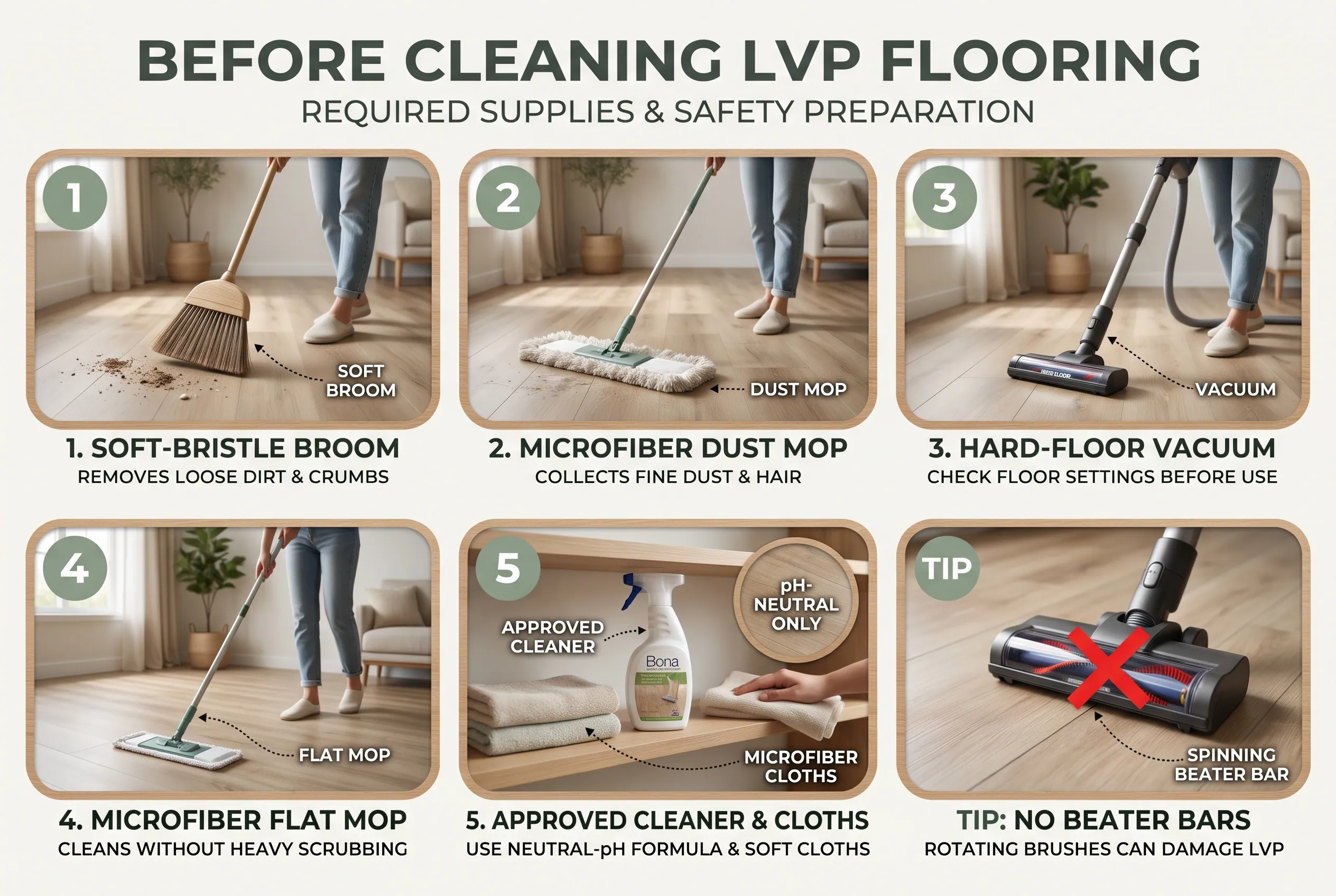
Here is what to prepare:
| Cleaning supply | Why you need it |
| Soft-bristle broom | Removes loose dirt and crumbs |
| Microfiber dust mop | Collects fine dust and hair |
| Hard-floor vacuum | Removes dirt from corners and edges |
| Microfiber flat mop | Cleans the floor without heavy scrubbing |
| LVP-approved floor cleaner | Removes everyday grime and footprints |
| Soft microfiber cloths | Wipes spills and handles small stains |
A vacuum can save time, especially in rooms with pets or heavy foot traffic. However, check its floor settings before using it.
Avoid a rotating beater bar or power brush. Mohawk specifically warns against these vacuum attachments on its vinyl flooring because they can damage the surface.
You can read its official vinyl floor care instructions for additional maintenance guidance.
Do You Need Special Cleaning Products?
A suitable neutral-pH vinyl floor cleaner is a practical choice. Neutral-pH means the product is neither strongly acidic nor strongly alkaline.
For example, Bona Professional Series Luxury Vinyl Floor Cleaner is made for LVT, LVP, and WPC flooring. Its manufacturer describes it as pH-neutral and ready to use.
You can also consider a concentrated neutral-pH cleaner, such as Zep Neutral pH Floor Cleaner, provided the exact product label and your flooring instructions approve its use.
Do not confuse concentrated cleaners with ready-to-use sprays. A concentrate needs the correct dilution, while a ready-to-use cleaner should not be diluted unless its instructions say otherwise.
How to Clean LVP Flooring Step by Step
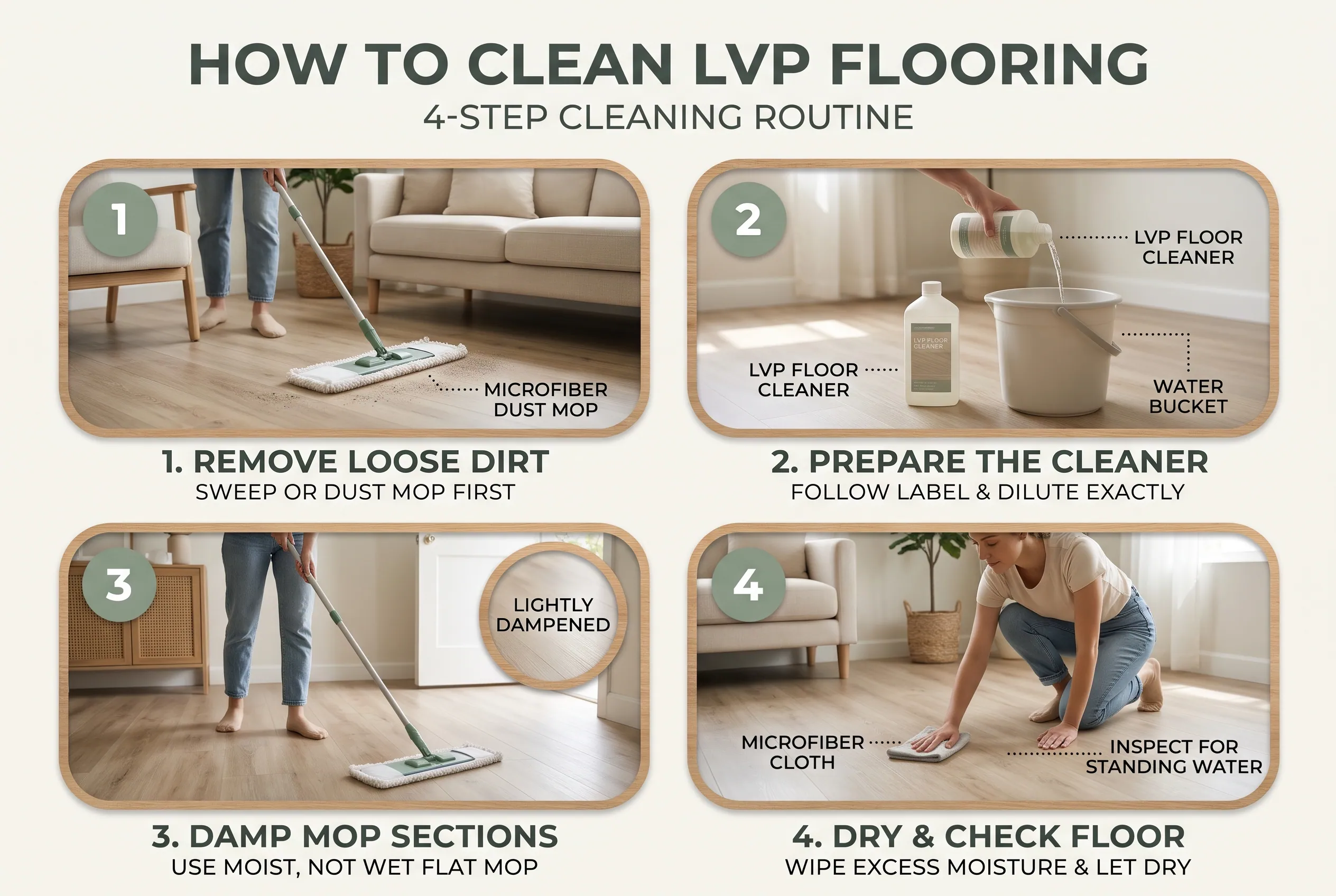
Follow these four steps for a simple cleaning routine. Work in small sections so you can control the amount of moisture and avoid spreading dirt across the room.
Step 1: Remove Loose Dirt and Dust
Start by sweeping the entire floor with a soft broom or microfiber dust mop.
Pay extra attention to:
- Areas beneath dining tables.
- Corners near walls.
- Spaces around furniture.
- Doorways and entrance areas.
- Areas where pets usually rest.
If you use a vacuum, select its hard-floor setting and turn off the rotating brush or beater bar.
This first step matters because dirt and small particles can act like sand under shoes or mop pads. Removing them before wet cleaning reduces unnecessary rubbing against the floor.
Step 2: Prepare the Appropriate Floor Cleaner
Read the cleaner’s label before using it.
If you have a ready-to-use LVP cleaner, follow its spray-and-mop directions. If you have a concentrate, measure and dilute it exactly as instructed.
Never mix different floor cleaners or combine household chemicals to make a stronger solution.
Avoid adding extra cleaner because you think it will make the floor cleaner faster. Too much product may leave a film that attracts more dirt.
If you’re using a new product for the first time, check whether your flooring manufacturer recommends testing it on a small, hidden section.
Step 3: Damp Mop Small Sections
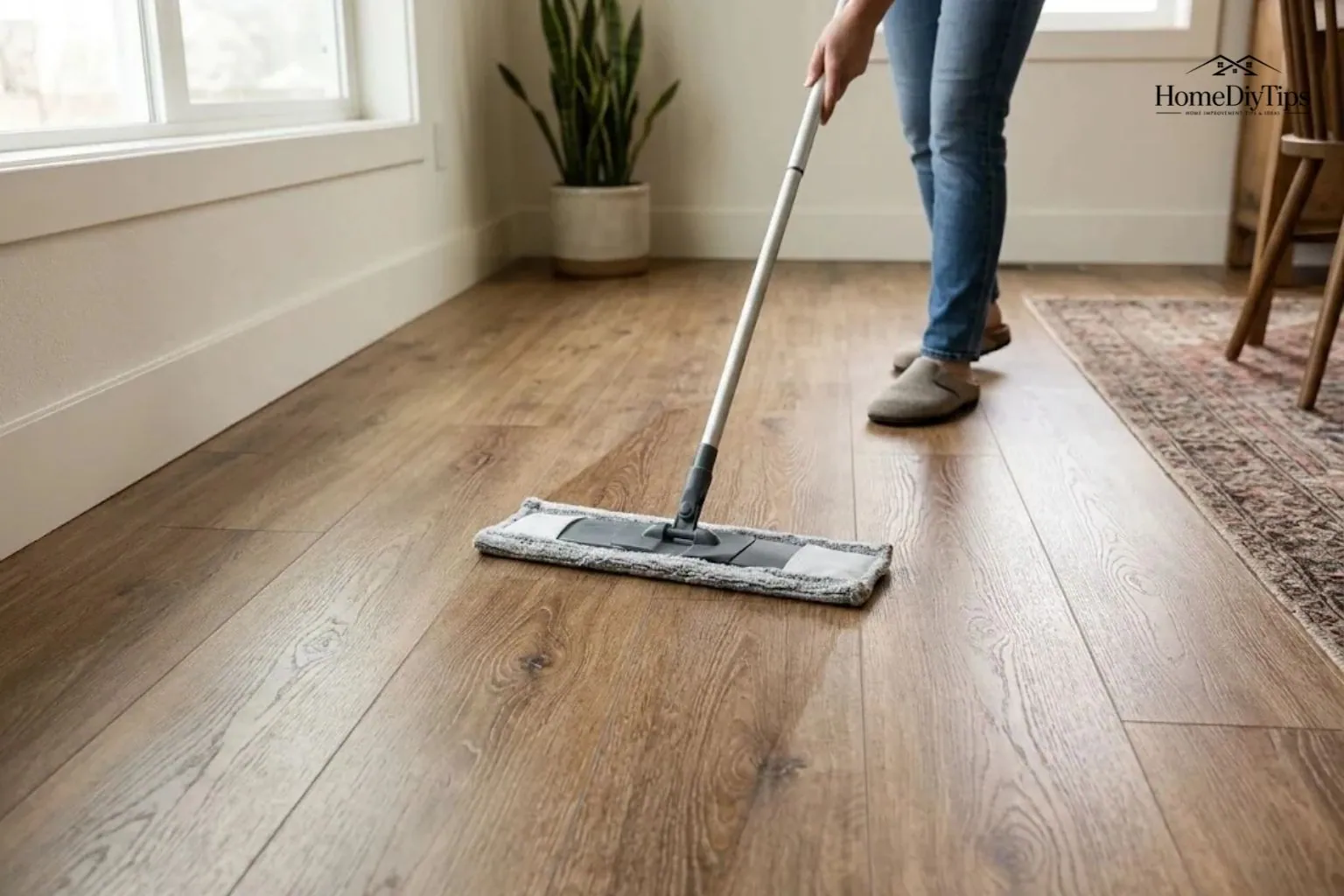
Use a clean microfiber flat mop.
Lightly dampen the mop pad according to the cleaner’s instructions. It should be moist enough to collect dirt without leaving puddles behind.
Start at one side of the room and work toward the exit.
Move the mop in steady passes. Avoid pushing dirty water from one section into another.
If the mop pad becomes visibly dirty, change it or rinse it as appropriate. Using a dirty pad can spread grime and create streaks.
For a large room, clean smaller sections instead of covering the entire floor with cleaning solution at once.
You should not need to scrub hard. Ordinary dirt should come away with gentle passes.
Step 4: Remove Excess Moisture and Check the Floor
Once you’ve finished mopping, inspect the floor.
Look for:
- Standing water.
- Dirty patches.
- Sticky areas.
- Visible cleaner residue.
- Streaks or cloudy marks.
Wipe away excess moisture with a clean microfiber cloth.
Allow the floor to dry according to the cleaning product’s instructions. Keep people and pets off unusually wet areas until they are safe to walk on.
A successful clean should leave the floor free of visible dirt and puddles, without a sticky or cloudy film.
If marks remain, do not immediately add more cleaner. Check whether the mop pad was dirty or whether the previous cleaning product left residue.
How to Clean LVP Flooring Without Streaks
Streaks are frustrating because a floor can look dirty even after you’ve finished cleaning it.
They often develop when too much cleaning solution remains on the surface, the mop pad spreads dirty water, or an unsuitable product leaves residue.
Try these practical adjustments:
Use less cleaning solution. Follow the label rather than applying extra product. More cleaner does not always mean better cleaning.
Start with a clean mop pad. A dirty microfiber pad can spread grease and dust instead of removing them.
Change dirty pads during cleaning. Do not keep using one pad after it becomes heavily soiled.
Avoid household detergents. Some soaps and detergent-based products can leave a film that makes the floor look dull.
Use the right amount of water. A heavily wet mop can push dirt and moisture into unwanted areas. A damp mop gives you better control.
Avoid wax and shine products. LVP generally has its own factory finish. Extra polish can create buildup rather than improve its appearance.
What If Your LVP Floor Already Has a Cloudy Film?
First, consider what you used during the previous cleaning.
For example, suppose you recently cleaned your floor with too much dish soap or a shine-enhancing product. The cloudy appearance may be related to product buildup.
Check the floor manufacturer’s instructions and use an approved cleaner with a fresh microfiber pad. Clean a small section gently and see whether the appearance improves.
Avoid scrubbing the entire floor repeatedly.
If the cloudy appearance remains after suitable cleaning, it may not be ordinary dirt. It could involve surface wear, chemical damage, or another flooring issue.
Contact the flooring manufacturer for guidance before trying stronger chemicals or abrasive treatments.
How to Remove Common LVP Flooring Stains
Most ordinary spills are easier to remove when you deal with them promptly.
For spot cleaning, begin with a soft cloth and a small amount of water or manufacturer-approved cleaner. Avoid aggressive scrubbing and do not let liquid sit on the floor.
Here are some common situations.
Food and Drink Spills
Wipe up the spill with an absorbent cloth or paper towel.
For dried food, lightly dampen a microfiber cloth and gently wipe the affected area.
Use an approved floor cleaner if water alone does not remove the residue. Finish by wiping away excess moisture.
Scuff Marks and Shoe Marks
Shoe marks can appear as dark lines on light-colored vinyl planks.
Try wiping them with a clean microfiber cloth and suitable LVP cleaner.
Use gentle pressure rather than a stiff brush. If the mark remains, check the flooring manufacturer’s stain-removal instructions before trying another method.
Sticky Residue and Grease
Sticky food, cooking oil, and similar messes can require more attention.
Absorb excess material first. Then use a manufacturer-approved cleaner and a microfiber cloth.
Work gently from the outside of the affected area toward the center. This helps prevent spreading the mess across a larger section.
Mohawk recommends using a suitable cleaner on a microfiber cloth and wiping the surface thoroughly when removing stains.
Ink, Paint, and Other Stubborn Marks
Some stains need a product-specific treatment.
Do not automatically reach for bleach, acetone, paint thinner, or other strong solvents. These products may affect the flooring’s finish.
For example, COREtec’s cleaning guidance identifies rubbing alcohol as an option for certain stubborn spots on its own flooring. That does not mean every LVP manufacturer approves the same treatment.
Check your flooring instructions first. Follow any specified spot-testing and rinsing directions.
If you cannot identify the stain or the approved removal method, contact the flooring manufacturer rather than experimenting with harsh products.
How to Clean LVP Floors With Grooves
Textured LVP can be more difficult to clean than smooth flooring.
Some planks have embossed patterns designed to resemble natural wood grain. These small grooves can hold dust, pet hair, crumbs, and fine dirt.
A flat microfiber mop may remove surface dirt but miss particles trapped inside deeper textures.
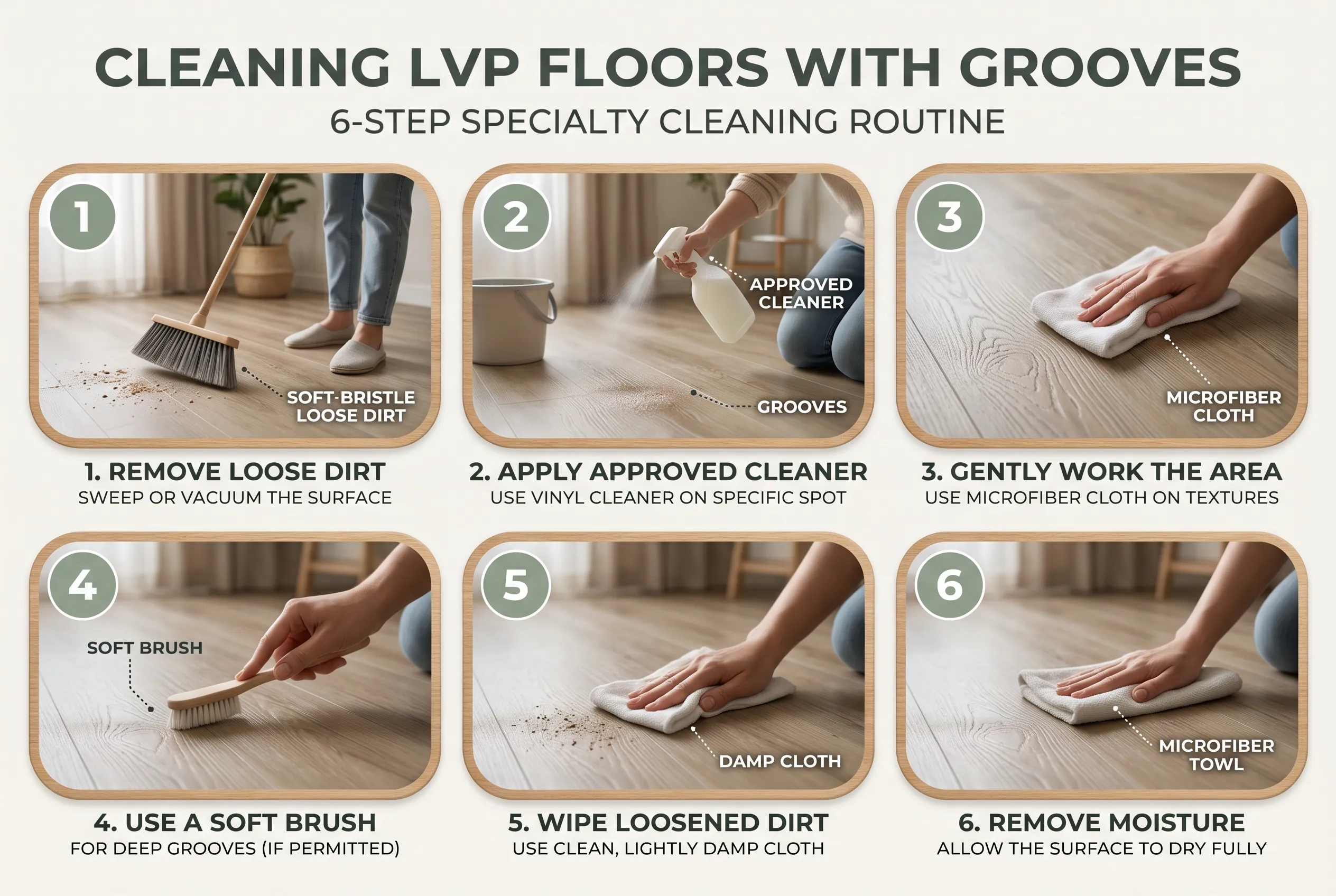
Try this approach:
- Remove loose dirt with a soft broom or suitable vacuum.
- Apply an approved vinyl floor cleaner according to its label.
- Use a clean microfiber cloth to gently work over the textured area.
- For deeper grooves, use a soft brush only when the flooring manufacturer permits it.
- Wipe away loosened dirt with a clean, lightly damp cloth.
- Remove excess moisture and allow the area to dry.
A soft toothbrush may help reach narrow grooves, but use very light pressure and test a hidden spot first if the manufacturer allows it.
Avoid steel wool, stiff-bristle brushes, scouring pads, and abrasive powders.
Why Does Dirt Keep Returning to Textured Flooring?
Sometimes the problem is not simply that the floor needs stronger cleaning.
Dirty mop pads can push particles into the embossed pattern. Cleaner residue may also attract dirt or create an uneven appearance.
Replace heavily soiled pads, use the recommended amount of cleaner, and clean small sections thoroughly.
If the grooves still look dirty, inspect them in good lighting before repeating the process. You may be seeing staining or surface wear rather than removable dirt.
Which Cleaning Products Are Safe for LVP Flooring?
Choosing a suitable cleaner is important because different flooring products can have different care requirements.
Here is how common options compare.
| Product | Is it suitable? | Recommendation |
| Bona Professional Series LVP Cleaner | Yes | A suitable ready-to-use example |
| Zep Neutral pH Floor Cleaner Concentrate | Potentially | Follow exact dilution and floor instructions |
| Dawn dish soap | Not preferred | Avoid as a regular LVP cleaner |
| Swiffer Wet cloths | Yes, according to P&G for vinyl | Confirm flooring manufacturer compatibility |
| Vinegar and water | Not universally suitable | Avoid unless specifically approved |
| Steam cleaner | Manufacturer-dependent | Do not use without explicit approval |
Is Bona Floor Cleaner Safe for Luxury Vinyl Plank?
Bona Professional Series Luxury Vinyl Floor Cleaner is specifically formulated for luxury vinyl tile, luxury vinyl plank, and wood plastic composite floors.
The manufacturer describes this particular product as pH-neutral, ready to use, and designed to dry without streaks or residue.
That makes it a practical option when your flooring manufacturer’s instructions permit it.
You can check the official Bona product information before buying.
Remember that Bona sells different cleaning products for different flooring types. Choose the exact luxury vinyl formula rather than assuming every Bona floor cleaner is interchangeable.
Can You Use Dawn Dish Soap on Vinyl Plank Flooring?
Dawn dish soap is useful for washing dishes, but that does not automatically make it suitable for regular LVP cleaning.
Dishwashing liquid is a detergent. Some flooring manufacturers warn against detergent-based cleaners because they can leave residue or affect the finished surface.
For regular maintenance, choose a suitable vinyl floor cleaner instead.
If your floor has already developed a soapy film, consult the manufacturer’s instructions before attempting to remove it.
Can You Use Swiffer Wet Cloths on Vinyl Plank Flooring?
According to Swiffer’s official guidance, its Wet cloths can be used on vinyl surfaces.
However, there is an important distinction between the general vinyl compatibility information and approval for every individual LVP product.
A particular flooring manufacturer may have more specific restrictions.
Check the care instructions for your floor and follow the Swiffer product label. Do not assume that every Swiffer product, including WetJet cleaning solutions and other disposable pads, has identical compatibility.
What Should You Not Clean Vinyl Plank Flooring With?
Some cleaning products are popular household choices but may not be suitable for LVP.
The following are common examples to avoid unless your flooring manufacturer specifically approves them.
Vinegar-based cleaners: Vinegar is acidic. COREtec and Shaw advise against vinegar-based cleaning on their vinyl flooring. Do not assume that a homemade vinegar solution is safe for every LVP product.
Bleach and ammonia: Strong chemical cleaners may damage finishes or cause discoloration. Use only products approved for your specific floor.
Wax and polish: LVP usually has a factory-applied finish. Additional wax or polish can create buildup and attract dirt.
Abrasive powders: Scouring powders and rough cleaning pads can scratch the surface.
Steel wool: This is too harsh for routine vinyl floor cleaning.
Oil soaps and unsuitable detergents: These products may leave a film that makes cleaning more difficult.
Excess water: Never flood the floor or leave puddles sitting around plank seams and edges.
Unapproved steam mops: Steam introduces heat and moisture that can affect some flooring products and installations. Use one only if the exact flooring manufacturer expressly permits it.
The safest approach is to check your flooring care guide before using an unfamiliar cleaner.
How to Clean LVP Flooring After Installation
Newly installed flooring needs special attention.
After installation, dust, packaging debris, and small particles may remain on the surface. However, the correct cleanup method depends on the flooring type and installation system.
Start with dry cleaning. Use a soft broom or vacuum with an appropriate hard-floor attachment.
Do not immediately use a soaking wet mop.
Some glue-down installations require time for the adhesive to cure. Cleaning too early may introduce moisture or cleaning agents before the installation is ready.
For example, VITL’s published LVT care instructions say not to mop for at least five days after installation. This is a requirement specific to its guidance, not a universal waiting period for every LVP floor.
Follow the instructions supplied with your flooring and adhesive.
If the flooring has already been installed and you do not know which cleaning method is permitted, contact the installer or manufacturer.
Do not scrape away dried adhesive with a metal tool unless the manufacturer specifically approves that method. You could damage the wear layer or edges.
Do You Need an LVP Floor-Cleaning Machine?
Most homeowners do not need a specialized floor-cleaning machine for regular LVP maintenance.
A soft broom, suitable vacuum, microfiber mop, and approved cleaner are usually enough.
Powered machines can add unnecessary cost and may introduce risks such as:
- Excess moisture.
- High heat.
- Aggressive brushing.
- Surface abrasion.
- Damage around plank joints.
Mohawk specifically warns against power scrubbers on its vinyl flooring.
A steam mop or powered floor washer should not be your automatic next purchase. Check both the flooring instructions and the cleaning machine’s compatibility guidance before using one.
For an ordinary kitchen, living room, hallway, or bedroom, a simple microfiber mop gives you better control over the cleaning process.
Consider buying a machine only when your floor manufacturer approves the exact type and your household genuinely needs it.
How to Keep LVP Flooring Clean Longer
You can reduce cleaning work by preventing dirt from spreading around the home.
These habits are simple and do not require expensive products.
Use entrance mats. Place suitable walk-off mats near outside doors. Choose non-staining materials with backing approved for your flooring. Some rubber or latex-backed mats can discolor vinyl surfaces.
Remove dirt regularly. Sweep or dust-mop areas with frequent foot traffic. This helps reduce the grit that can scratch the protective surface.
Clean spills promptly. Food, drinks, mud, and pet messes are easier to remove before they dry.
Use furniture protectors. Place suitable felt or non-staining floor protectors beneath chair and table legs.
Avoid dragging heavy furniture. Lift heavy items when possible. Otherwise, use an appropriate protective moving surface approved for the flooring.
Keep mop pads clean. Dirty pads can spread residue and make the floor look dull.
Protect against prolonged direct sunlight. Some vinyl floors can discolor after extended exposure to strong sunlight. Suitable window coverings can help reduce exposure.
A Simple LVP Cleaning Routine
You do not need to wet-mop your entire floor every day.
Adjust your routine to household traffic, pets, children, and visible dirt.
- Regularly: Remove dust, hair, and loose debris.
- When spills occur: Wipe them promptly.
- As needed: Damp mop with a suitable cleaner.
- During cleaning: Change dirty microfiber pads.
- Occasionally: Inspect high-traffic areas, textured grooves, and furniture contact points.
The goal is to keep the floor free of abrasive dirt and visible buildup without exposing it to unnecessary moisture or chemicals.
Frequently Asked Questions About Cleaning LVP Flooring
1. Can I use Dawn dish soap on vinyl plank flooring?
Dawn is a detergent and is not the preferred choice for regular LVP cleaning. Some manufacturers warn against detergents because they can leave residue. Use a cleaner approved for your specific vinyl flooring instead.
2. Is Bona floor cleaner safe for luxury vinyl plank?
Bona Professional Series Luxury Vinyl Floor Cleaner is specifically formulated for LVP, LVT, and WPC flooring. It is pH-neutral and ready to use. Confirm that your flooring manufacturer’s instructions permit the product before using it.
3. Can I use Swiffer Wet cloths on LVP flooring?
Swiffer’s official guidance lists vinyl as a suitable surface for its Wet cloths. However, check your flooring manufacturer’s care instructions because individual LVP products may have different requirements.
4. Can I clean LVP flooring with vinegar?
Do not assume vinegar is safe for every LVP floor. Shaw and COREtec advise against vinegar-based cleaners for their vinyl products. Use a manufacturer-approved floor cleaner instead.
5. Can I use a steam mop on luxury vinyl plank flooring?
Only when the manufacturer of your exact flooring product expressly allows it. Heat and moisture from steam cleaning may damage certain vinyl floors or their installation systems. A damp microfiber mop is the safer everyday choice.
A Simple Cleaning Routine Is Usually Enough
The best way to clean LVP flooring does not involve strong chemicals, heavy scrubbing, or expensive machines.
Remove dry dirt first, use a suitable vinyl floor cleaner, and damp mop with a clean microfiber pad. Wipe up excess moisture and follow your flooring manufacturer’s care instructions.
Pay extra attention to textured grooves, stubborn stains, and newly installed planks. Choosing the right products and avoiding unnecessary moisture can make routine floor care easier and help protect your investment.
Disclaimer
Cleaning requirements vary depending on your flooring product, installation method, home conditions, and maintenance needs. Always follow the manufacturer’s instructions and seek qualified flooring help for persistent damage, loose planks, or suspected moisture beneath the floor.