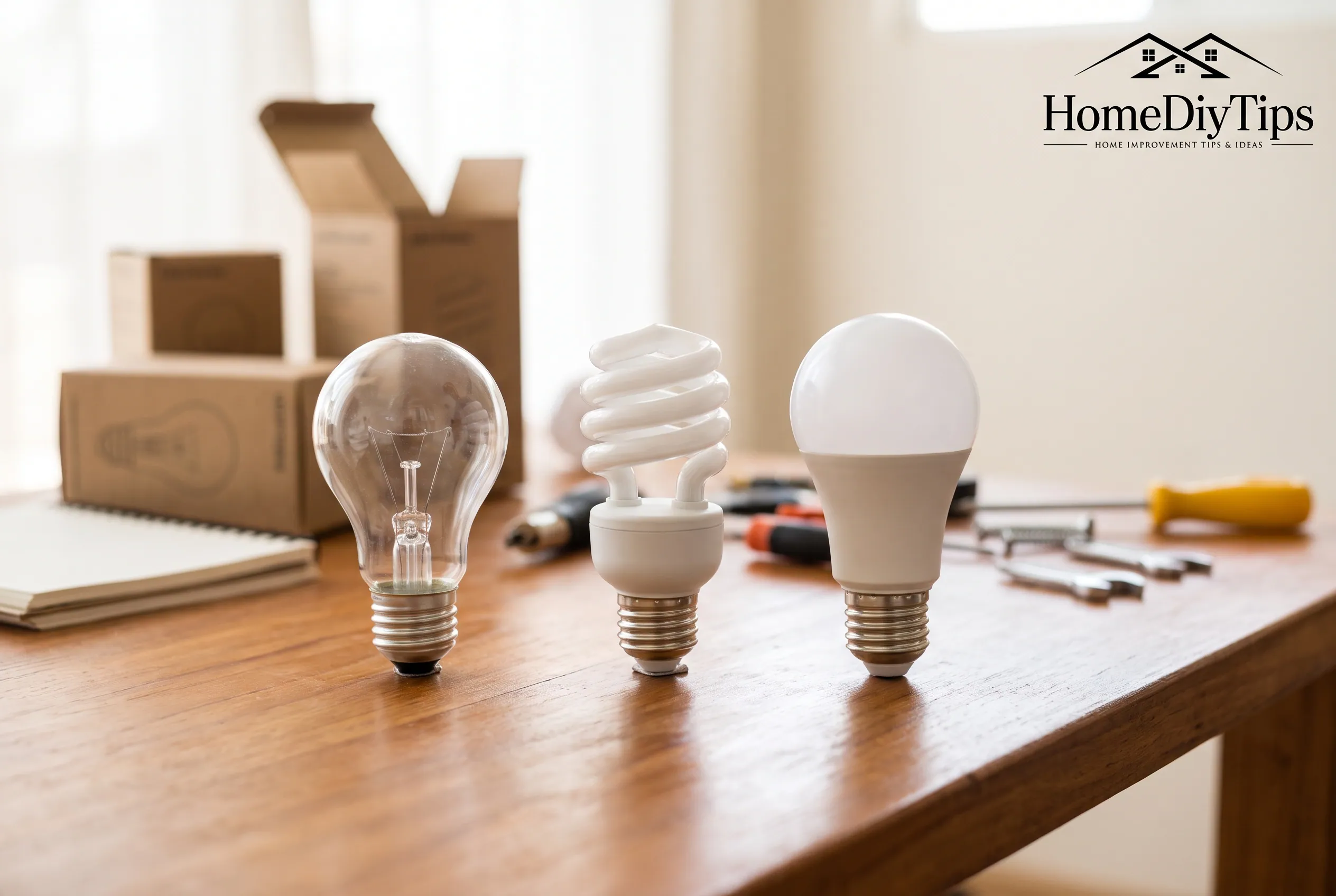
Electric control is the use of switches, sensors, controllers, and other devices to start, stop, or manage electrical equipment. You can find it in everyday items such as light switches and thermostats, as well as in building automation systems and industrial machinery.
An electrical control system may be simple or complex. A wall switch lets you control a light by hand, while a thermostat can measure room temperature and automatically control heating or cooling. The right type depends on what you want to control, how much automation you need, and whether your existing equipment supports it.
Understanding electric control helps you choose suitable devices, recognize their main parts, and know when electrical work requires a qualified professional.
Direct Answer
Electric control uses switches, sensors, controllers, and related devices to start, stop, adjust, or monitor electrical equipment. Systems range from simple wall switches to automatic thermostats and industrial controllers.
Experience
Practical Home Tip: Before buying a smart control, check that it supports your existing equipment and its electrical requirements. A device with more features is not automatically the right choice, and unfamiliar wiring is a reason to consult a qualified professional.
What Is Electric Control?
Electric control refers to the devices and systems used to manage how electrical equipment operates. These controls can turn equipment on or off, adjust its operation, respond to changes, or follow a programmed schedule.
The term is broad. It does not refer to one particular product. A simple switch, a smart thermostat, a motor starter, and an industrial control panel can all form part of an electrical control system.
Consider these everyday examples:
- A light switch lets you turn a room light on or off.
- A thermostat checks the temperature and calls for heating or cooling when needed.
- A timer turns selected lights or equipment on or off at set times.
- An occupancy sensor detects movement and can activate compatible lighting.
- A washing machine uses built-in controls to manage its operating cycle.
These devices do not all work in the same way. Some need a person to operate them, while others respond to sensors or programmed instructions.
Electric control is also different from electrical protection. A control device manages equipment operation. A protective device, such as a circuit breaker, helps protect a circuit under specified fault conditions. Some systems need both.
How Does an Electrical Control System Work?
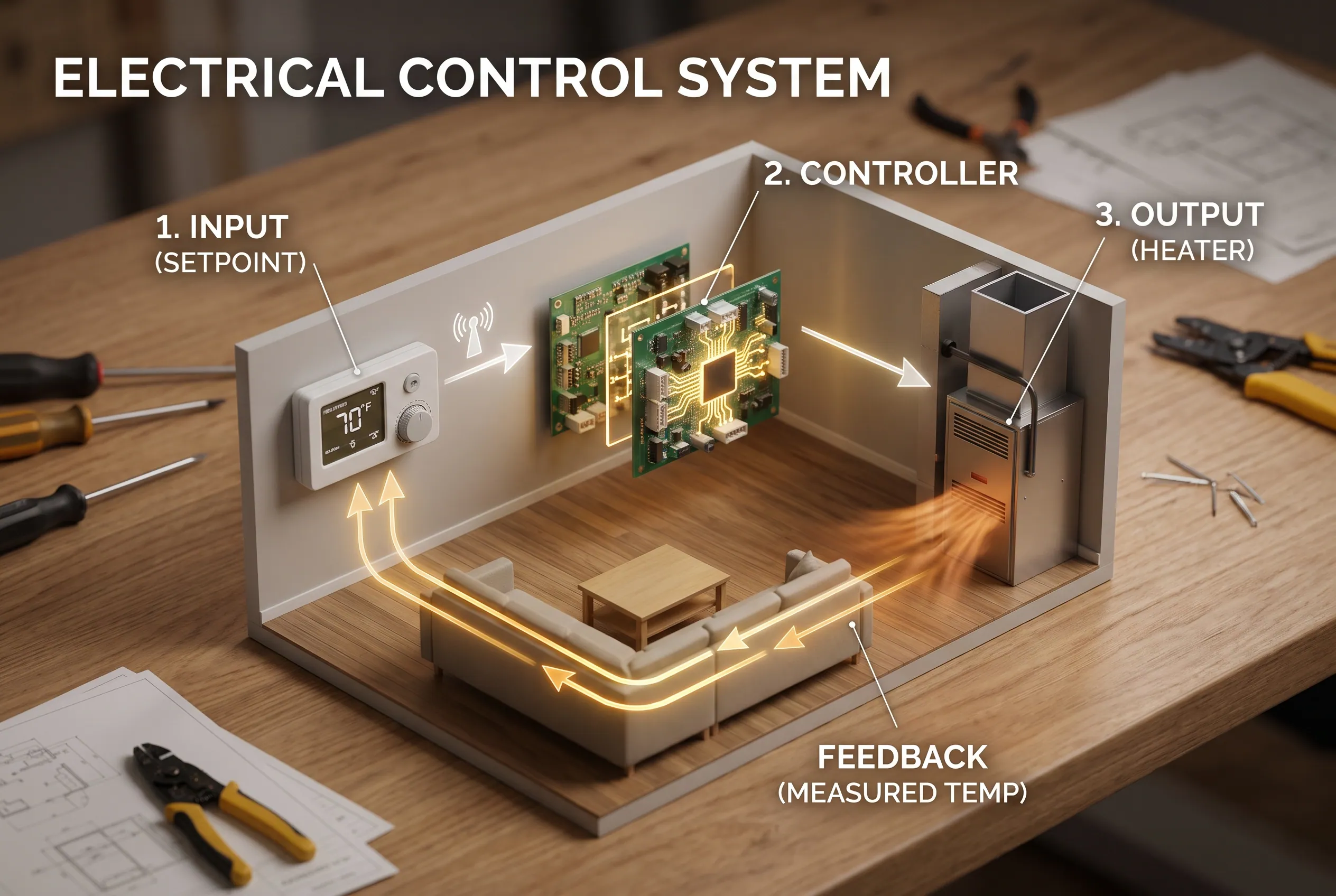
A basic electrical control system receives an input, uses a control method to decide what should happen, and produces an output. More advanced systems also check the result and adjust their operation.
Many systems use three basic elements:
- Input: A signal from a person, switch, or sensor.
- Controller: A device that uses the input and its control rules to decide what action to take.
- Output: The equipment or switching device that carries out the action.
Some systems also use feedback. Feedback means the system measures what is happening and uses that information to guide its next action.
Example: A thermostat controlling room temperature
Imagine that a home thermostat is set to 70°F.
The thermostat measures the room temperature. If the temperature falls below its heating set point, it can signal compatible heating equipment to run. When the room reaches the target temperature, the thermostat can signal the heating system to stop.
The exact operating sequence depends on the thermostat and HVAC equipment. Some systems also use timing rules, safety limits, or other settings.
In this example:
- The room temperature is the measured condition.
- The thermostat is the controller.
- The heating equipment is the output.
- The temperature measurement provides feedback.
This arrangement helps the system respond to changing conditions rather than simply running for a fixed period.
What are open-loop and closed-loop controls?
These terms describe whether a control system uses feedback.
Open-loop control follows a command without measuring the result to adjust its action. For example, a simple timer might run a device for a set period without checking whether the intended result has occurred.
Closed-loop control uses feedback to compare the actual condition with a target and adjust operation. A thermostat is a familiar example because it measures temperature while controlling heating or cooling.
Neither approach is automatically right for every task. Open-loop controls can be simple and suitable for predictable operations. Closed-loop controls are useful when the system needs to respond to changing conditions.
What Are the Main Types of Electrical Control?
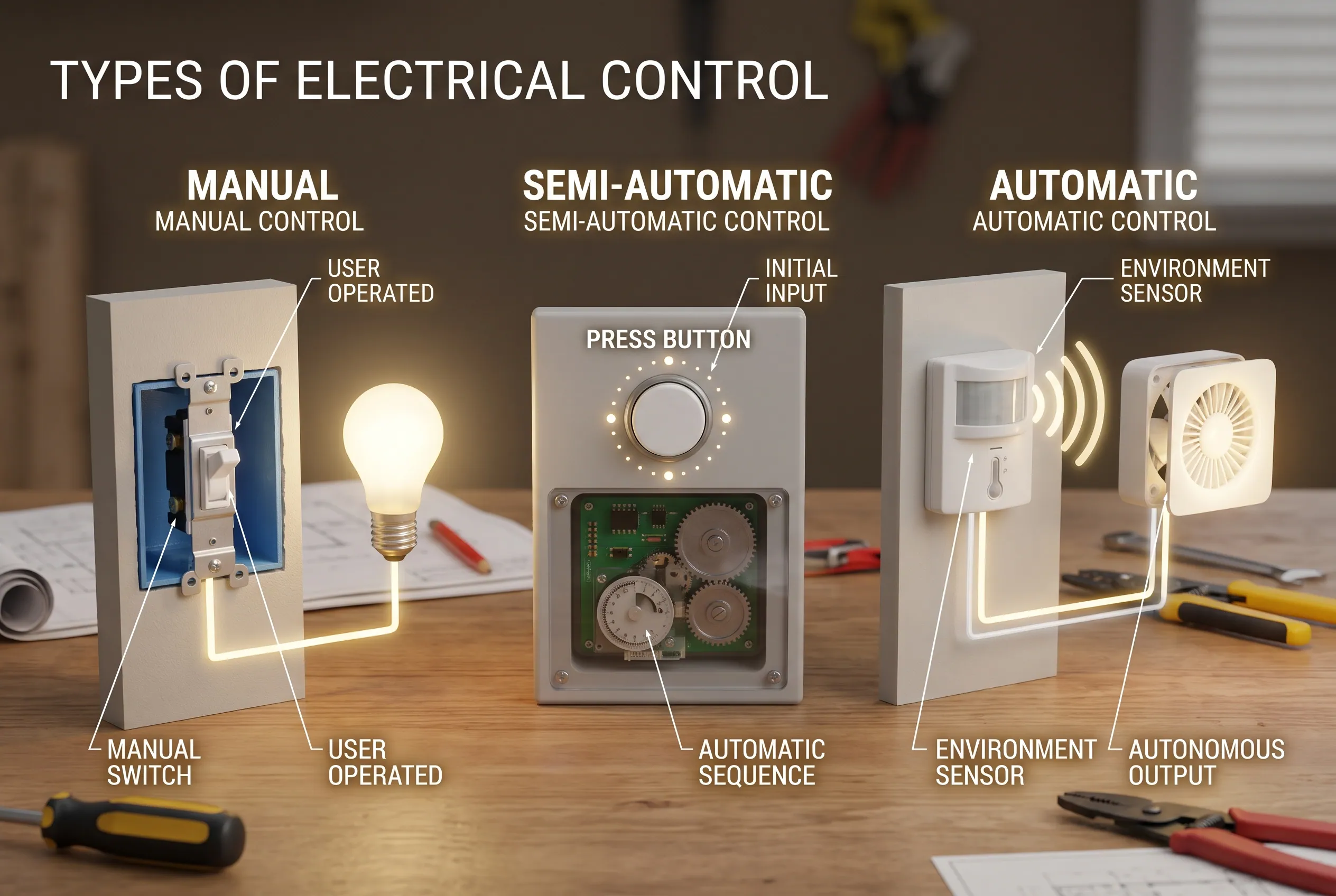
One common beginner classification divides electrical controls into manual, semi-automatic, and automatic control. These groups describe how much human action the system needs.
They are not the only way to classify controls. Open-loop and closed-loop control, for example, describe whether a system uses feedback rather than how a person starts it.
1. Manual control
Manual control requires a person to operate a control directly. A wall switch is one of the simplest examples.
Other examples include a manual switch on equipment or a hand-operated control that starts and stops a motor.
Advantages:
- Simple to understand and operate.
- Often suitable for straightforward tasks.
- Lets the user decide when to operate the equipment.
Limitations:
- Requires a person to take action.
- Does not automatically respond to temperature, movement, or other changes unless additional controls are used.
Manual controls can be a sensible choice when a task does not need scheduling or automatic response.
2. Semi-automatic control
A semi-automatic system combines human action with some automatic operation. A person may start a process or make a selection, then let the equipment carry out a defined sequence.
The exact meaning of semi-automatic varies by industry and product. For example, some equipment requires the user to start each stage, while other equipment runs several stages after the initial command.
A semi-automatic system can reduce repeated manual work without giving the system full control over every decision.
Its limitation is that a person may still need to monitor the process or take action at certain points. Always check the equipment’s operating instructions to understand which tasks happen automatically.
3. Automatic control
Automatic control allows equipment to act according to programmed rules, sensor inputs, or set conditions. A person may still start, configure, or stop the system, but the system handles some actions without continuous input.
Examples include:
- A thermostat controlling heating or cooling.
- Motion-sensor lighting that switches compatible lights on when movement is detected.
- A pump controller that responds to a suitable level sensor.
- A building automation system that follows schedules and sensor readings.
Automatic controls can improve convenience and help equipment respond consistently. However, the result depends on correct setup, suitable equipment, and reliable inputs.
A sensor placed poorly, an unsuitable schedule, or an incompatible device can prevent a system from working as expected. Automation also does not remove the need for suitable electrical protection.
What Are the Main Components of an Electrical Control System?
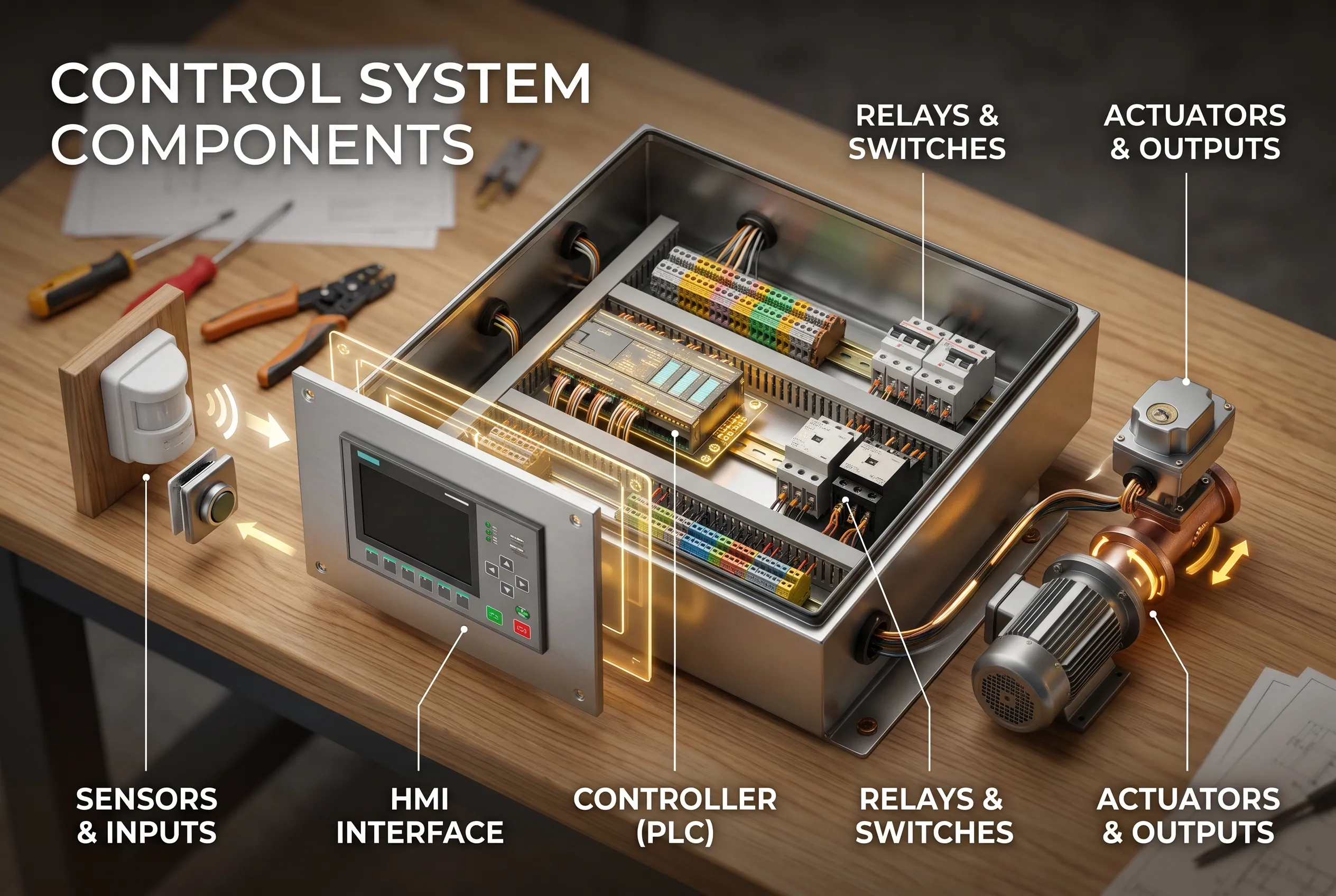
An electrical control system may contain several parts. A simple device can combine multiple functions inside one enclosure, while a larger system may use separate sensors, controllers, relays, motors, and panels.
The main parts serve different roles.
Sensors and inputs
A sensor detects a condition and sends a signal to a control system. Depending on the application, it may measure temperature, pressure, movement, liquid level, or another condition.
For example, an occupancy sensor can detect movement in a room. A temperature sensor measures heat, while a suitable level sensor can help a pump system respond to water level.
Not every input comes from a sensor. A button, switch, or user command can also tell a controller what to do.
Controllers and control logic
A controller processes inputs and follows defined rules. In a home thermostat, the controller uses temperature information and settings to decide when to call for heating or cooling.
More complex systems may use a programmable logic controller (PLC). A PLC is an industrial controller designed to run programmed operations, often for machines, motors, production equipment, or process systems.
The controller’s job is different from the job of the equipment being controlled. It makes or applies the control decision; another device may carry out the physical action.
Switches, relays, contactors, and motor starters
These devices help control the flow of electrical power to equipment, but they are not interchangeable.
- Switch: Opens or closes a circuit as part of a control action.
- Relay: Uses an electrical control signal to operate contacts that switch a circuit.
- Contactor: A switching device commonly used to control equipment such as motors and other electrical loads within its ratings.
- Motor starter: A device or assembly used to start and stop a motor, often with overload protection.
A relay may allow a small control signal to operate a separate circuit. A contactor is commonly used for loads that require a suitable power-switching device.
Motor starters may include overload protection, which helps respond to certain motor overload conditions. That function is not a replacement for all required circuit protection. The correct equipment depends on the motor, circuit, application, and applicable electrical requirements.
For a more technical explanation, Eaton’s guide to understanding electrical starters describes starter components and their roles.
Actuators and outputs
An actuator carries out a physical action when it receives a suitable signal. Examples include operating a valve, moving a mechanism, or positioning a device.
In an electrical control system, the output might be a light, motor, pump, valve, or another piece of equipment. The controller sends the appropriate command, while the output device performs the action.
Electrical control panels and interfaces
An electrical control panel houses or organizes control components. Depending on the system, it may contain controllers, relays, switching equipment, indicators, and other parts.
An HMI, or human-machine interface, gives a person a way to view information or enter commands. It might be a screen with buttons, status indicators, and settings.
Not every control panel includes an HMI, and not every control system needs a large panel. A small household device may have its control functions built into the product.
Where Are Electrical Controls Used in Homes and Buildings?
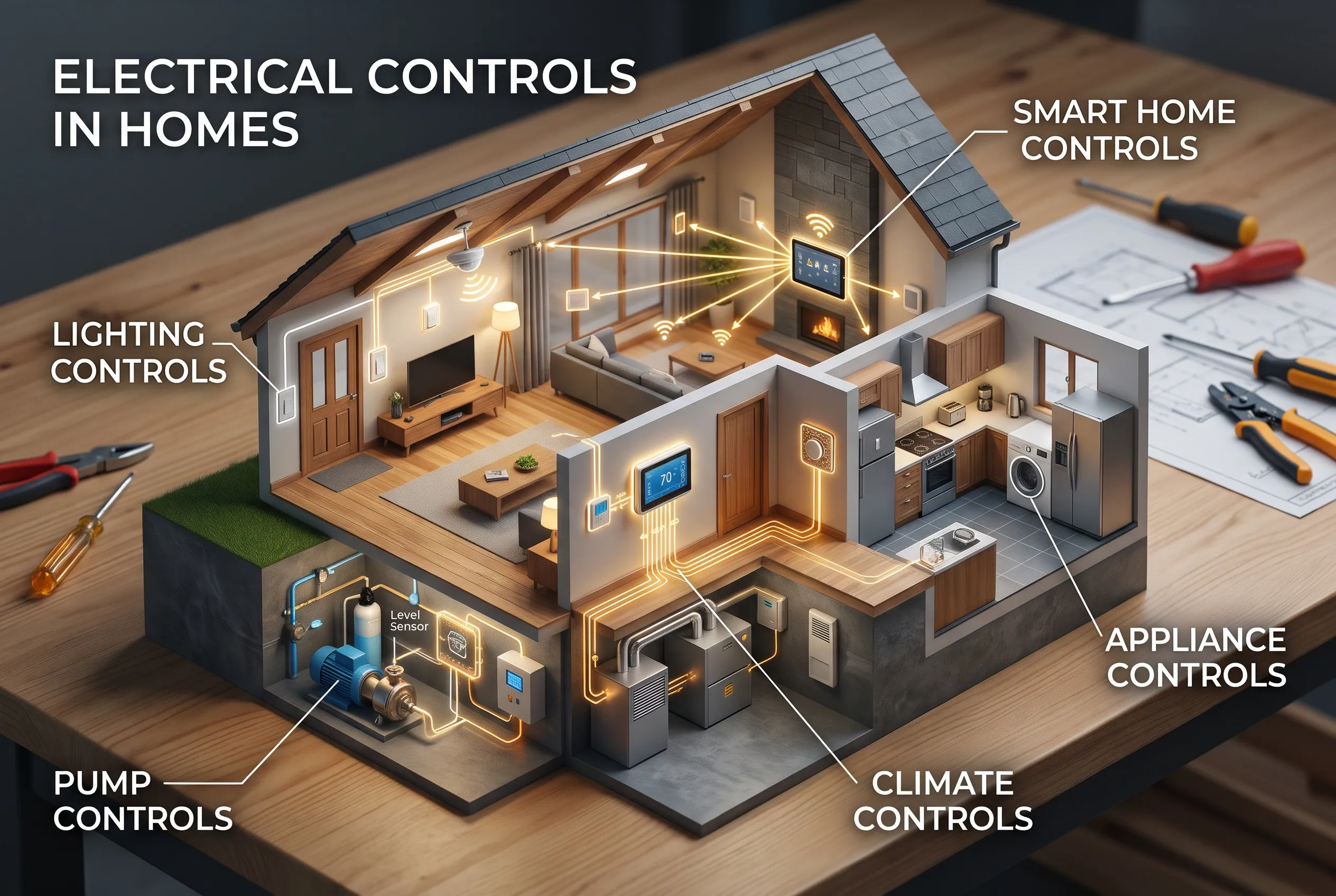
Electrical controls are used in many areas of a home. Some are simple and easy to recognize; others work inside equipment and need little attention during normal use.
Lighting controls
Wall switches, dimmers, timers, and occupancy sensors are common examples.
A standard switch provides direct control. A compatible dimmer adjusts light output. A timer follows a schedule, while an occupancy sensor can respond to movement.
Before installing a new lighting control, check the control’s compatibility with the light source and electrical setup. Not every dimmer works with every LED lamp, and not every control supports every type of load.
Heating and cooling systems
Thermostats help manage indoor temperature by communicating with compatible heating and cooling equipment.
Basic thermostats may use straightforward settings, while smart thermostats can offer schedules, app access, and additional features. These features vary by product and HVAC system.
Before buying a replacement thermostat, check its compatibility with the existing system. Wiring, operating voltage, equipment type, and the need for a common wire or other parts may affect the choice.
Appliances
Many appliances use built-in electrical controls. A washing machine may use programmed settings to manage its cycle. An electric kettle with temperature control may stop heating or change its operation when it reaches a selected condition, depending on the model.
These examples illustrate the control principle, but internal parts and operating rules differ between products. The product manual is the right place to check features, maintenance instructions, and troubleshooting steps.
Pumps and valves
Suitable controllers can manage pumps or electrically operated valves based on user commands or system inputs. A pump installation might use a level or pressure signal, depending on its purpose and design.
However, pump control is equipment-specific. A household well pump, for example, may need correctly matched control and protection components. Do not use a generic wiring diagram for an unidentified pump or control box.
Smart-home systems
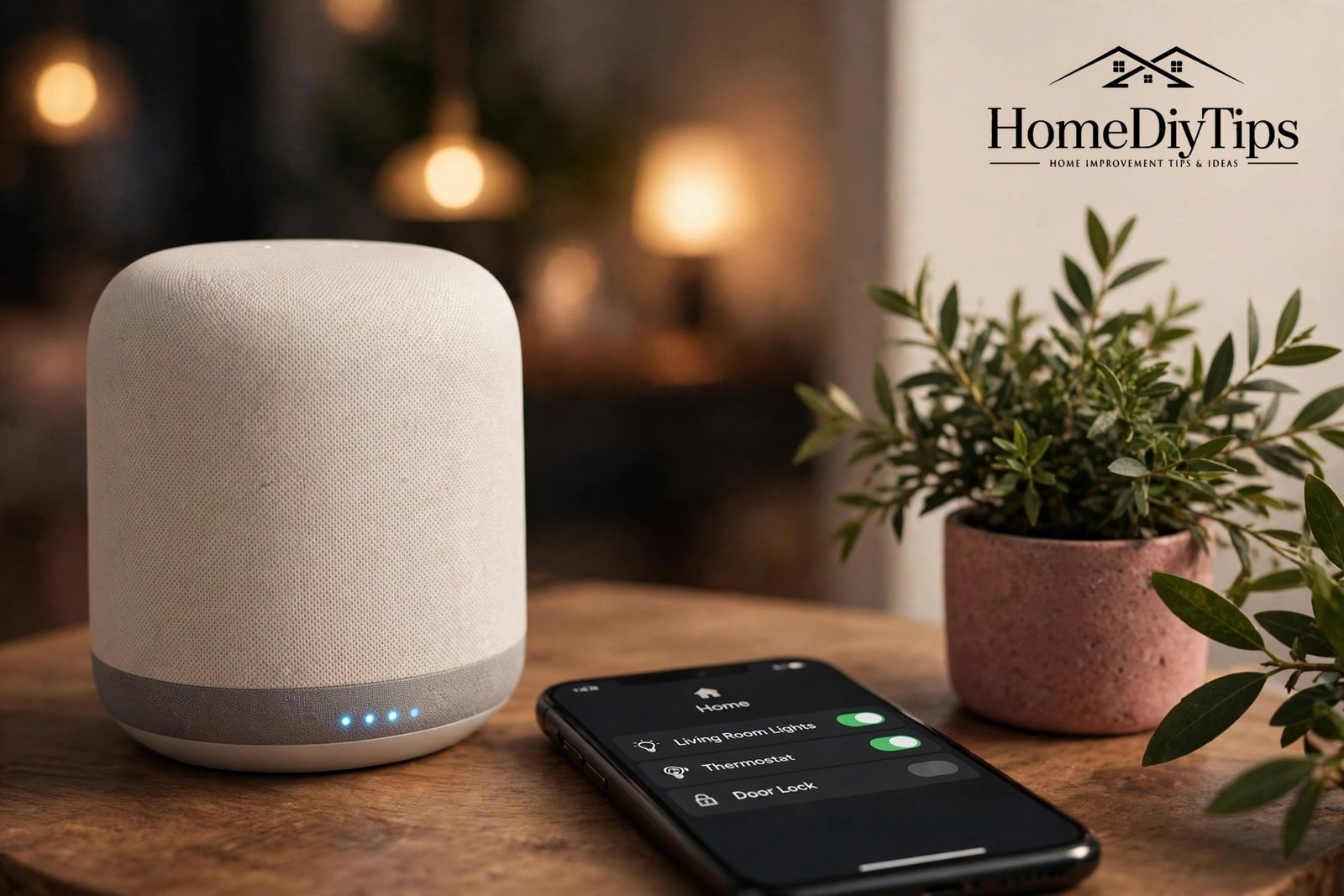
Smart-home controls can connect compatible devices to schedules, sensors, hubs, or an app. For example, a user may set a lighting schedule or adjust a thermostat remotely.
The practical value depends on the task. A smart control may be helpful when you need scheduling or remote access. For a light that only needs to be switched by hand, a simple switch may be more appropriate.
Automatic features do not guarantee lower energy bills. Results depend on the device, settings, building conditions, and how the equipment is used.
Building controls can also coordinate heating, cooling, lighting, and other building systems. The U.S. Department of Energy’s overview of building controls explains their role in building operation and energy management.
How Do Building Controls Differ from Industrial Control Systems?
Building control and industrial control systems share basic ideas: they receive inputs, apply control rules, and manage equipment. Their purpose, complexity, and working conditions can still be very different.
A building automation system (BAS) may coordinate heating, ventilation, air conditioning, lighting, or other building services. It can use schedules, sensors, and central monitoring to manage several systems.
An industrial control system may manage production machinery, conveyors, pumps, motors, or a manufacturing process. It may require more detailed monitoring and carefully designed responses to particular operating conditions.
Industrial systems often use PLCs and HMIs. Some use larger systems to monitor and supervise several controllers or processes. These are specialized arrangements, so a household thermostat should not be treated as interchangeable with an industrial controller.
For a general introduction to industrial equipment and system types, IBM’s guide to industrial control systems explains several common components and applications.
The important point is that familiar control principles appear in both settings, but equipment selection and installation depend on the specific system. Industrial components should not be substituted into a home setup without confirming their suitability and requirements.
What Should You Check Before Choosing an Electric Control Device?
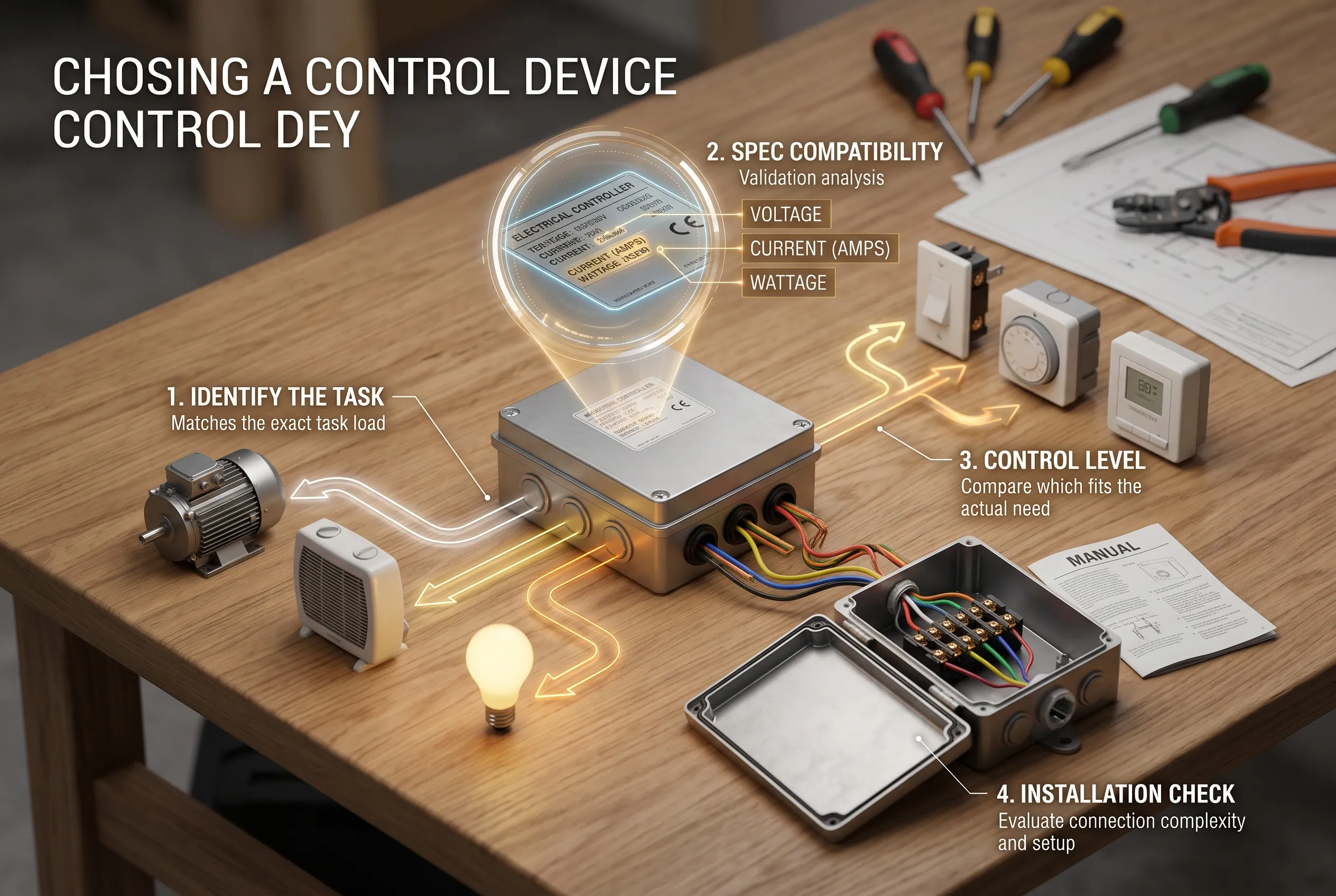
Start with the task you want the device to perform. A controller should solve a real need rather than add features that make the system harder to manage.
1. Identify the equipment and purpose
Decide whether you need to switch a light, regulate temperature, control a motor, follow a schedule, or respond to a sensor.
Write down the equipment model and relevant specifications when available. A device suitable for lighting may not be suitable for a motor, heater, pump, or HVAC system.
2. Check compatibility
Confirm that the new control supports the existing equipment and its electrical requirements. Look at the manufacturer’s specifications rather than assuming that devices with similar names will work together.
For smart devices, check the required network or hub, supported equipment types, and any wiring or accessory requirements.
3. Choose the right level of control
A useful rule is to choose the simplest control that meets your actual need.
| Your need | Option to consider | Main point to check |
| Turn something on or off by hand | Manual switch | Suitable rating and intended use |
| Operate equipment at set times | Timer or programmable control | Supported schedule and load |
| Respond to temperature | Compatible thermostat or temperature controller | Equipment compatibility |
| Respond to movement | Suitable occupancy sensor | Sensor coverage and device compatibility |
| Manage several systems together | Building or smart-home controls | System compatibility and setup needs |
These are general examples, not installation instructions. The correct device depends on the equipment and its specifications.
4. Consider installation and maintenance
A device with more features may also need more setup, troubleshooting, or maintenance. Read the manual before buying and make sure you understand any additional components the system requires.
If the selection depends on unfamiliar wiring, electrical ratings you cannot verify, or a system fault, get guidance from the manufacturer or a qualified professional before proceeding.
Electrical Control Safety: When Should You Get Professional Help?
Understanding what a control device does is different from safely installing or repairing it. Electrical systems can contain live parts even when a control appears to be off.
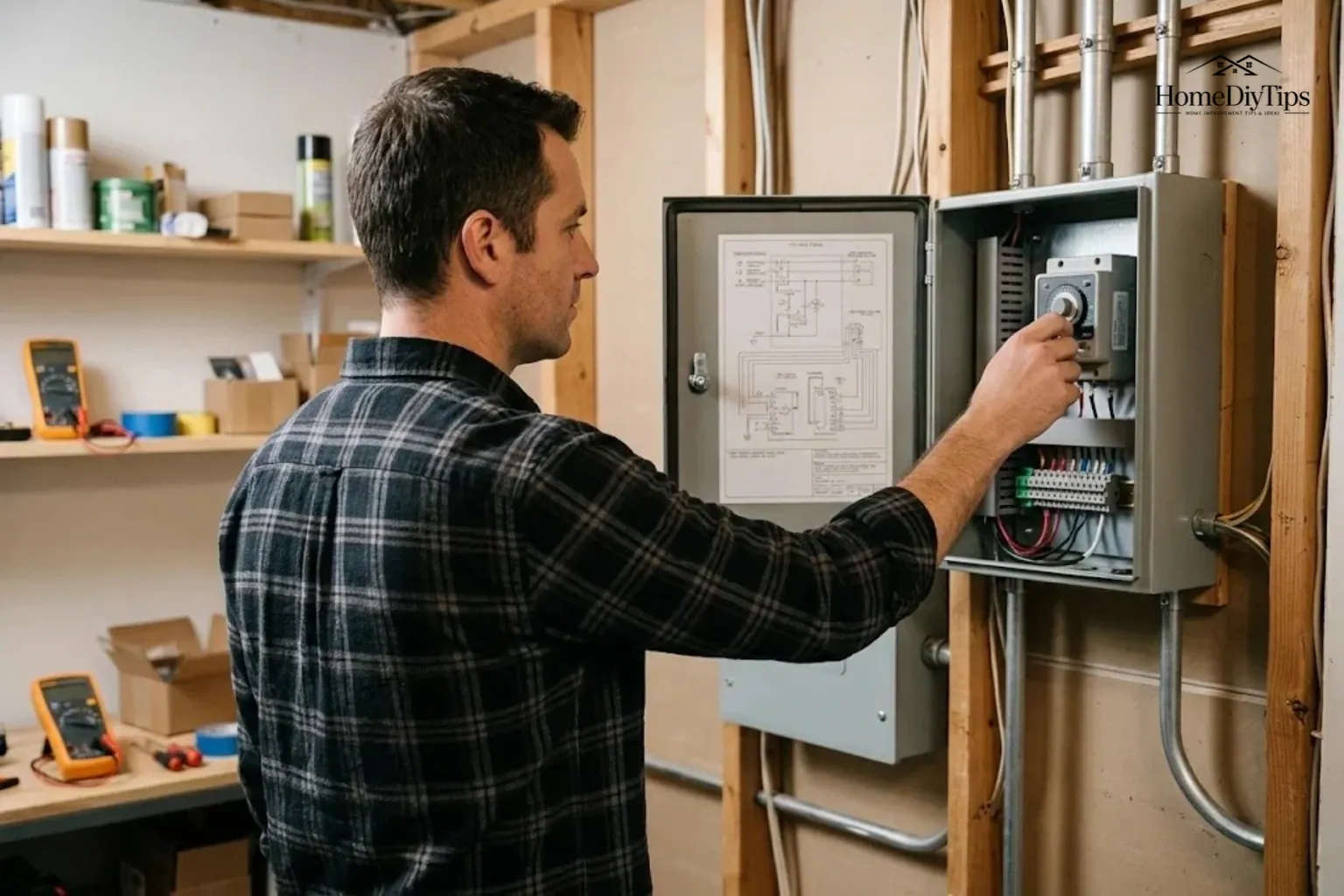
Do not open a live electrical panel, handle exposed conductors, or modify control wiring unless you are qualified to perform that work and have followed the required safety procedures. Turning a wall switch off does not prove that internal wiring is safe to touch.
Stop using affected equipment and seek appropriate help if you notice:
- Exposed or damaged electrical wires.
- A burning smell or unusual heat near electrical equipment.
- Repeated circuit-breaker trips.
- Sparks, buzzing, or visible damage.
- An unexplained fault that returns after following the manufacturer’s permitted checks.
Avoid repeatedly resetting a breaker without identifying the cause. A recurring trip may indicate a fault that needs investigation.
For electrical repair boundaries and general safety advice, consult the Electrical Safety Foundation International’s DIY electrical safety guidance. Local electrical rules can vary by state, city, and project, so do not assume one set of requirements applies everywhere in the United States.
Common Electrical Control Mistakes to Avoid
A few mistakes can lead to unsuitable purchases or unsafe troubleshooting.
Choosing a device based only on its features: A smart app or extra setting is not helpful if the device cannot control your existing equipment. Confirm compatibility first.
Confusing control with protection: A switch or controller does not automatically provide the protection that a circuit or motor requires. Make sure the complete system is designed for its intended use.
Assuming all control wiring is the same: Connections differ by product, voltage, equipment, and application. A diagram for one model may be wrong for another.
Expecting automatic control to solve every problem: Sensors, settings, and controlled equipment must all work properly. Automation cannot compensate for a damaged component or unsuitable installation.
Treating energy savings as guaranteed: Controls may help manage usage, but actual results depend on equipment, conditions, and operating habits.
Repairing unfamiliar wiring by trial and error: Guessing at connections or testing unknown circuits can lead to injury or equipment damage. Use manufacturer guidance and qualified help when needed.
Frequently Asked Questions
What Are the Four Types of Controllers?
There is no single, universal list of four controller types that applies to every electrical control system. Controllers can be grouped by how they work, what they control, or where they are used. Examples include thermostatic controllers in HVAC systems and programmable logic controllers in industrial equipment. The right classification depends on the application.
What Is the Difference Between an Electric Controller and a Relay?
A controller uses input signals and control rules to decide what action should occur. A relay is a switching device that uses a control signal to operate electrical contacts. In some systems, the controller commands a relay, and the relay switches the circuit that operates the equipment.
Are Electrical Control Systems the Same as Electrical Protection Devices?
No. Control systems manage equipment operation, such as switching a motor on or regulating a room’s temperature. Protection devices help guard against specified faults or unsafe operating conditions. An installation may need both functions, and the correct arrangement depends on the equipment and applicable requirements.
Can I Install a Smart Thermostat Myself?
That depends on the thermostat, the existing HVAC system, the manufacturer’s instructions, and your ability to handle the work safely. Check compatibility before buying. If the wiring is unfamiliar, the system requirements are unclear, or the installation involves work outside your skill level, consult a qualified HVAC or electrical professional.
Choose the Right Level of Control for Your Needs
Electric control ranges from a basic switch to a system that uses sensors, programmed rules, and several connected devices. The most suitable option depends on the job: start with the equipment you want to control, check compatibility, and decide whether manual operation or automation offers a real benefit.
Simple tasks often need simple controls. More advanced systems can offer scheduling or automatic responses, but they also require suitable components and correct setup. When a decision involves unfamiliar wiring, a control-panel fault, or electrical repair, use the manufacturer’s guidance and get qualified help rather than guessing.
Disclaimer
Homes, electrical systems, budgets, and equipment needs vary, so check the product documentation and applicable local requirements before making changes. For wiring, panel work, recurring electrical faults, or installations you are not qualified to handle, consult a qualified professional.