A loveseat is a popular choice for living rooms, apartments, bedrooms, and small seating areas. However, finding the right size can be confusing when furniture stores use different measurements and styles.
So, how long is a loveseat? Most standard loveseats measure 48 to 72 inches long (4 to 6 feet), measured from the outside of one armrest to the outside of the other. Many common models fall between 52 and 66 inches. Compact designs can be shorter, while reclining and console models may need more space.
Length is only one part of the decision. You should also consider the loveseat’s depth, height, seat size, and the space needed to move around it. If you are buying furniture online, checking these measurements before placing an order can help prevent an expensive sizing mistake.
Short Definition
A standard loveseat usually measures 48–72 inches long (4–6 feet). Many common models fall between 52 and 66 inches, depending on their design and armrests.
Experience
Before buying a loveseat, mark its full length and depth on your floor using painter’s tape. Also measure your doorway and hallway to make sure the furniture can reach its intended location.
How Long Is a Standard Loveseat?
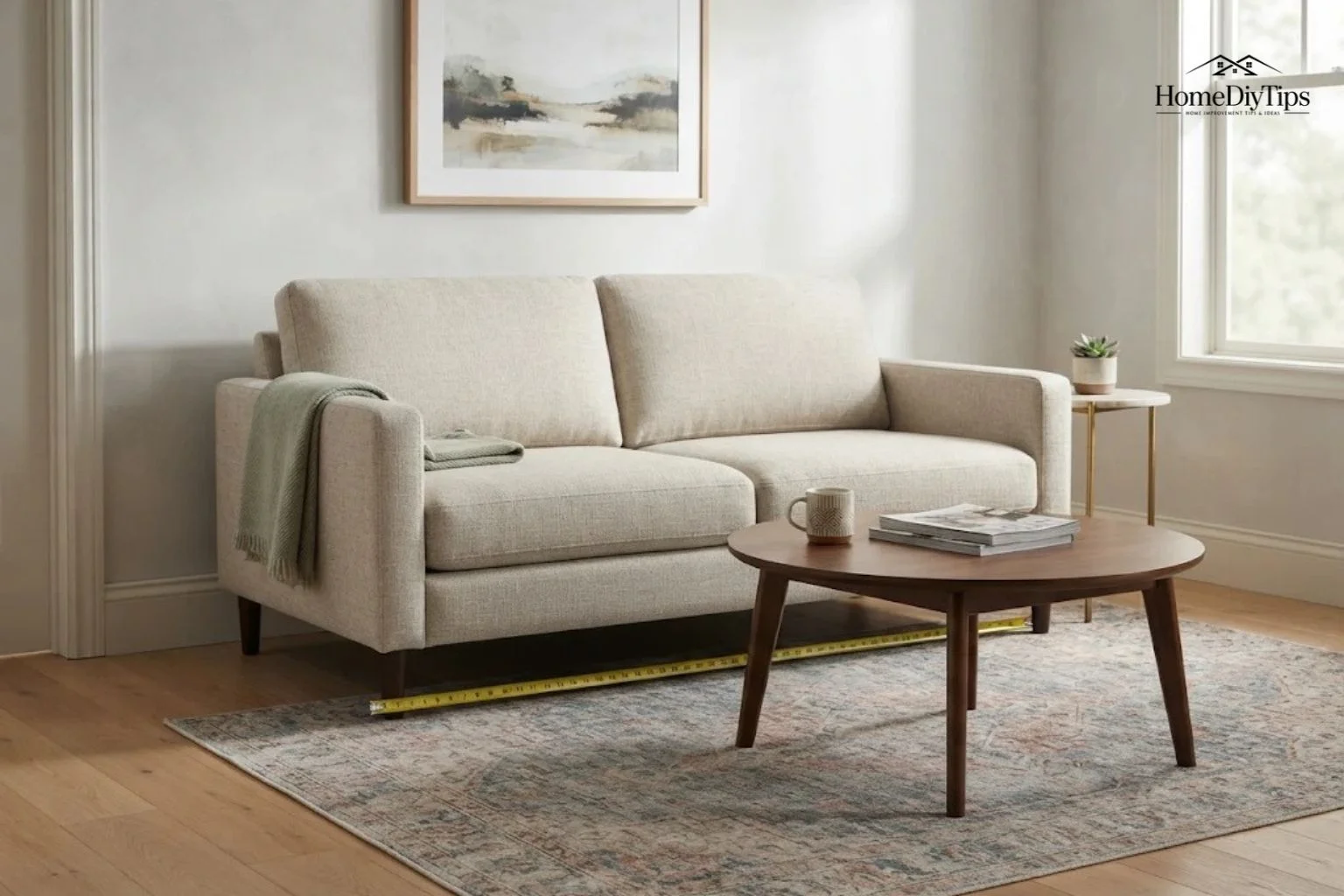
A standard loveseat is usually 48 to 72 inches long. This measurement represents the complete outside width of the furniture, including both armrests. It does not describe the length of the sitting area alone.
The exact length depends on the design, frame, armrests, and number of features included.
Here is a simple guide:
| Loveseat Size | Approximate Length | Equivalent in Feet |
| Compact | 48–52 inches | 4–4.3 feet |
| Medium | 53–59 inches | 4.4–4.9 feet |
| Standard | 60–66 inches | 5–5.5 feet |
| Large | 67–72 inches | 5.6–6 feet |
These categories are useful shopping guidelines, not fixed furniture industry standards. A retailer may classify a 58-inch model differently from another manufacturer.
For example, a 50-inch loveseat may work well in a small apartment or bedroom. A 64-inch model may provide more comfortable seating in a family living room.
Before choosing one, check the manufacturer’s actual dimensions. Two loveseats with similar seating capacity can have different outside measurements.
Loveseat Sizes: Compact, Medium, and Large
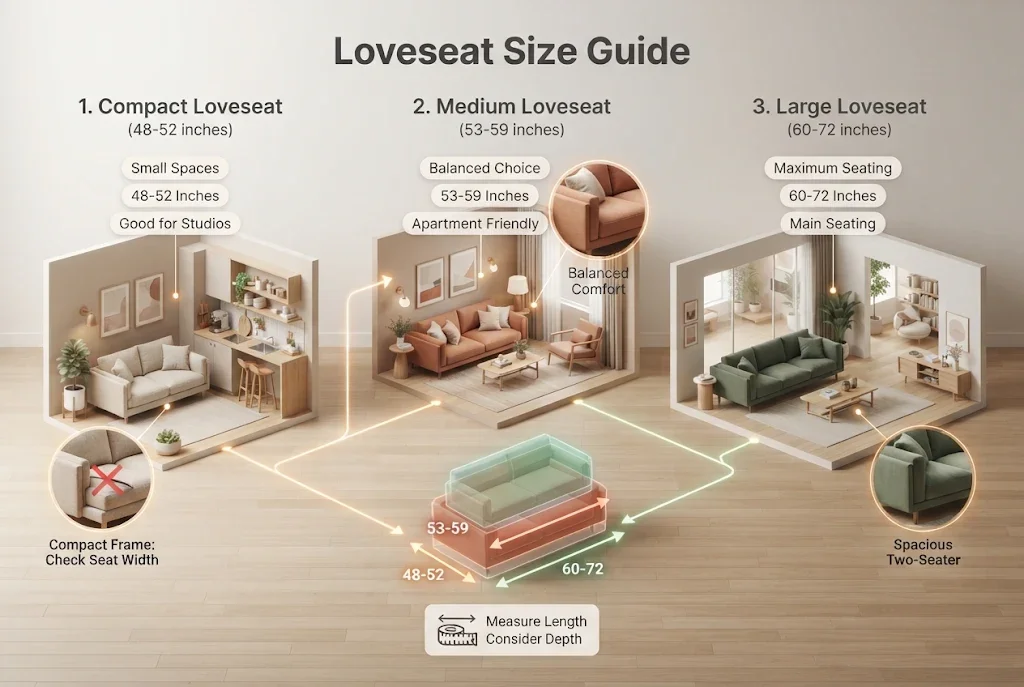
Loveseats come in several sizes to suit different homes. The best option depends on how much space you have and how you plan to use the furniture.
Compact Loveseats
Compact loveseats generally measure around 48 to 52 inches long.
They are useful when a full-size sofa would take up too much room. Their smaller frames can make it easier to arrange other furniture without blocking walkways.
Consider a compact loveseat for:
- Small apartments and studio homes
- Bedrooms and guest rooms
- Home offices with a seating corner
- Small reading areas
- Apartments with limited living room space
However, a shorter loveseat does not always provide the same comfort as a larger model.
Some compact designs have narrow seats or thicker armrests. If two adults will use the furniture regularly, check the actual seat width before purchasing.
Medium Loveseats
Medium loveseats often measure around 53 to 59 inches long.
This size offers a useful balance between seating space and room size. It can work in apartments, smaller family rooms, and living rooms where a large sofa would feel too dominant.
A medium loveseat may provide enough seating for two adults while leaving room for a coffee table or another chair.
Pay attention to the armrests. Wide, padded arms can reduce the usable seating area, even when the outside dimensions look generous.
Large Loveseats
Large loveseats usually measure around 60 to 72 inches long.
They are suitable for people who want more seating space without moving to a traditional three-seat sofa.
A larger loveseat may be useful in:
- Family living rooms
- Larger apartments
- Open-plan living areas
- Guest rooms with extra floor space
- Homes where a loveseat will be the main seating piece
A 70-inch loveseat may look similar in length to a small sofa. The main difference is often the seating arrangement and design rather than a strict size boundary.
If your room is small, check the depth too. A long, deep loveseat can occupy more floor space than you expect.
Loveseat Dimensions in Inches, Feet, and Centimeters
Furniture stores in the United States usually list dimensions in inches. However, centimeters and feet can make measurements easier to understand when comparing furniture or planning a room.
Here are some common loveseat length conversions:
| Length in Inches | Length in Feet | Length in Centimeters |
| 48 inches | 4 feet | 121.9 cm |
| 50 inches | 4.17 feet | 127 cm |
| 52 inches | 4.33 feet | 132.1 cm |
| 54 inches | 4.5 feet | 137.2 cm |
| 56 inches | 4.67 feet | 142.2 cm |
| 58 inches | 4.83 feet | 147.3 cm |
| 60 inches | 5 feet | 152.4 cm |
| 64 inches | 5.33 feet | 162.6 cm |
| 66 inches | 5.5 feet | 167.6 cm |
| 70 inches | 5.83 feet | 177.8 cm |
| 72 inches | 6 feet | 182.9 cm |
For quick calculations, remember these basic conversions:
- 1 foot = 12 inches
- 1 inch = 2.54 centimeters
- 1 meter = approximately 3.28 feet
For example, if a loveseat measures 60 inches long, divide 60 by 12. The result is 5 feet.
If you find a loveseat listed as 150 cm long, divide 150 by 2.54. It measures approximately 59 inches.
These conversions are helpful when comparing American furniture listings with measurements from international furniture websites.
Always use the manufacturer’s listed dimensions for the final decision. Rounded conversions are useful for planning but should not replace exact measurements.
What Are the Standard Width, Depth, and Height of a Loveseat?
Length tells you how much wall space a loveseat may need. However, depth and height also affect how the furniture fits into your home.
A loveseat that looks short enough for your room may still extend too far into the walking area.
Overall Width
The overall width is the measurement from the outside edge of one armrest to the outside edge of the other.
For a typical loveseat, this measurement is often around 48 to 72 inches.
Do not confuse overall width with seat width.
Imagine a loveseat that measures 60 inches from armrest to armrest. If it has two wide padded arms, the actual sitting area will be considerably narrower.
This matters when two adults need enough room to sit comfortably.
When comparing models, check both the overall width and the inside seat width if the manufacturer provides them.
Seat Depth and Overall Depth
Depth measures how far the loveseat extends from front to back.
Many traditional loveseats have an overall depth of approximately 30 to 40 inches, although deep-seat and reclining models can differ.
There are two measurements worth understanding:
- Overall depth: The distance from the front edge of the furniture to its back.
- Seat depth: The distance from the front of the seat cushion to the back cushion.
A deeper seat may feel comfortable for taller people or those who enjoy sitting with their legs tucked up. However, it may not suit everyone.
A shorter seat depth can be more comfortable for people who prefer to sit upright with their feet resting on the floor.
Check the seat depth rather than assuming that a larger loveseat automatically provides better comfort.
Seat Height and Back Height
Seat height measures the distance from the floor to the top of the seat cushion.
Many residential sofas and loveseats have seat heights around 17 to 19 inches, but individual designs vary.
Back height measures the distance from the floor to the top of the backrest.
This can affect the appearance of the furniture and the amount of support it provides.
For example, a low-back loveseat may look modern and work well in an open living room. A higher back may provide more support for someone who prefers a more upright seating position.
If possible, compare these measurements with a chair or sofa you already find comfortable.
Loveseat vs. Sofa: How Much Longer Is a Couch?
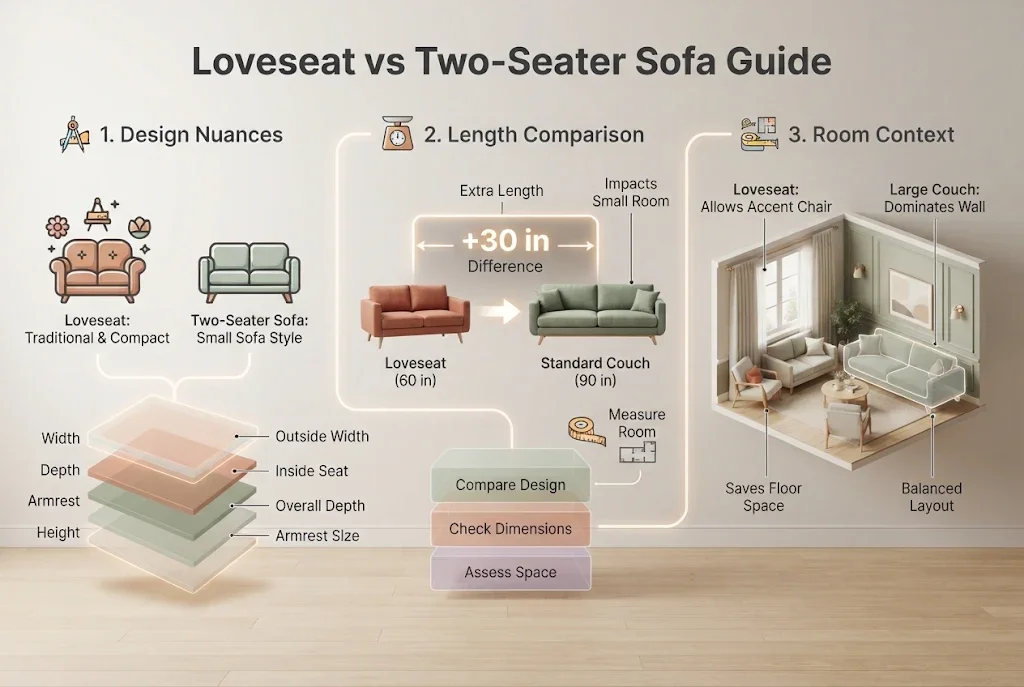
A loveseat is generally shorter than a standard three-seat sofa.
However, there is no exact length difference that applies to every model. Some large loveseats overlap with small sofas in overall width.
Here is a general comparison:
| Furniture Type | Approximate Length | Typical Seating |
| Compact loveseat | 48–52 inches | 2 people |
| Standard loveseat | 53–66 inches | 2 people |
| Large loveseat | 67–72 inches | 2 people |
| Standard sofa | 72–96 inches | 3 people |
| Large sofa | 90–110 inches | 3 or more people |
These are approximate shopping ranges. Manufacturer specifications should always guide your final choice.
What Is the Main Difference Between a Loveseat and a Two-Seater Sofa?
A loveseat and a two-seater sofa can be very similar.
Both are designed to seat two people. The terms are sometimes used interchangeably by furniture retailers.
The difference often comes down to the manufacturer’s naming and the overall design.
A loveseat may have a compact frame and a more traditional two-person seating arrangement. A two-seater sofa may have a longer frame or resemble a smaller version of a standard sofa.
When shopping, do not depend only on the product name. Compare the following:
- Total outside width
- Inside seat width
- Overall depth
- Armrest size
- Seat height
- Cushion arrangement
These details tell you more about the furniture than the label.
How Much Longer Is a Couch Than a Loveseat?
A standard three-seat couch often measures around 72 to 96 inches, while a loveseat commonly measures 48 to 72 inches.
This means a couch may be anywhere from a similar length to several feet longer, depending on the models being compared.
For example, a 90-inch couch is 30 inches longer than a 60-inch loveseat.
That extra length can make a difference in a small living room. A loveseat may leave enough space for an accent chair, while a larger couch may use most of the available wall.
How Long Is a Loveseat With a Console or Recliner?
Special loveseat designs can have different measurements from traditional fixed-frame furniture.
Reclining mechanisms, center consoles, cup holders, and additional padding can change the overall dimensions.
If you are shopping for one of these styles, use the product’s complete specification sheet.
Reclining Loveseat Dimensions
A reclining loveseat can have a similar overall width to a traditional loveseat. However, it needs extra space when the footrests and reclining backs move.
For example, La-Z-Boy’s Trouper reclining loveseat specifications show a model with an approximately 56-inch overall width and a 66-inch extended measurement.
This is a model-specific example, not a standard measurement for every recliner.
Before buying, check:
- Width with both seats in their normal position
- Depth when the seats are upright
- Fully extended depth
- Wall clearance requirements
- Space needed for footrests
- Whether the reclining mechanism needs a power connection
Some wall-hugger recliners are designed to recline with less distance between the furniture and the wall.
However, the exact clearance depends on the model. Follow the manufacturer’s installation instructions.
How Long Is a Loveseat With a Center Console?
A console loveseat has a storage or cup-holder section between the two seats.
This design is common in reclining furniture and home entertainment seating.
The console can increase the total width, so these models may be longer than a traditional two-seat loveseat.
For example, La-Z-Boy’s James product specifications include a 79-inch reclining loveseat with a center console.
That is wider than many standard loveseats, so it may not fit comfortably in a small living room.
Check the complete product measurements rather than estimating the console size separately.
Also consider whether the console lid needs room to open and whether cup holders will be easy to reach.
How Much Room Do You Need for a Loveseat?
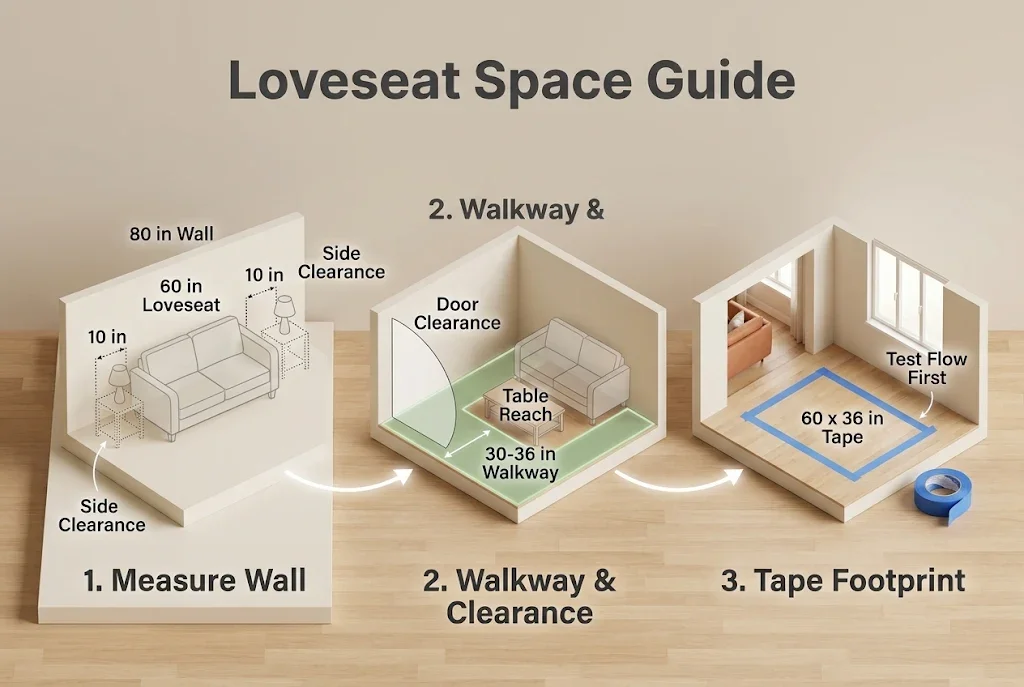
The space needed for a loveseat depends on its length, depth, and the layout of your room.
A 60-inch loveseat may fit against a wall but still make the room feel crowded if there is not enough space in front of it.
For comfortable room planning, consider the complete floor footprint rather than just the advertised length.
Measure Your Available Floor Space
Start by measuring the wall or area where you want to place the loveseat.
For example, imagine your available wall space is 80 inches wide.
A 60-inch loveseat would leave 20 inches of extra wall space. You could divide that space between the two sides or leave more room on one side for a table or floor lamp.
However, wall space is not the only consideration.
Measure the distance from the wall to the opposite furniture or walking area. This helps you understand how much of the room the loveseat will occupy.
Leave Room for Movement
A living room should have enough space for people to walk around without constantly moving furniture.
Consider these practical planning guidelines:
- Keep the main walking route clear.
- Leave enough room to use nearby doors.
- Check whether coffee tables can be reached comfortably.
- Make sure drawers, cabinets, and storage doors can open.
- Allow extra space if the loveseat reclines.
A walkway around 30 to 36 inches is a useful planning target in many living rooms, although smaller spaces may require a different arrangement.
Do not force this measurement into every layout. The location of doors, furniture, and the main walking route matters more than following one number blindly.
Mark the Loveseat Footprint
One simple way to check whether a loveseat will fit is to mark its size on the floor.
For example, suppose you want to buy a loveseat measuring 60 inches wide and 36 inches deep.
Use painter’s tape to mark a 60-by-36-inch rectangle in the planned location.
Then walk around it and check:
- Can people pass without squeezing?
- Is there enough room for a coffee table?
- Can nearby doors open?
- Does the arrangement leave enough space for other furniture?
This simple check can reveal layout problems before you spend money.
How to Measure a Loveseat Before Buying
Measuring furniture before purchasing helps you avoid two common problems: buying something too large for the room and discovering that it cannot pass through the entrance.
Follow these steps before placing your order.
1. Check the Overall Length
Find the manufacturer’s width measurement.
Make sure it includes both armrests and any other fixed parts of the frame.
Do not use the inside seating measurement as the total length.
2. Measure the Depth and Height
Check the distance from the front to the back of the loveseat.
Then measure its height from the floor to the highest point of the backrest.
These measurements help you understand the complete furniture footprint and whether the design suits the room.
3. Measure the Available Room Space
Measure the wall, floor area, and distance to nearby furniture.
If the loveseat will sit beside a window, check that it does not block curtains or other access points.
If it will sit near a door, make sure the door can open fully.
4. Check Doorways and Hallways
Measure the entrance, hallway, and any narrow passage the furniture must cross.
Also check stairs, elevator doors, and tight turns.
A loveseat may fit through a doorway when positioned upright but fail to turn in a narrow hallway.
Some furniture can be moved through tight spaces at an angle. However, this depends on its frame, shape, and removable parts.
Ask the retailer about delivery requirements if the route looks difficult.
5. Check the Reclining Space
If you are buying a reclining loveseat, check its extended dimensions.
A model that fits against a wall in its normal position may need additional space when fully reclined.
Use the manufacturer’s clearance measurements rather than guessing.
6. Confirm Delivery Access
Before completing the purchase, check the retailer’s delivery requirements.
Ask whether the delivery team can remove packaging, whether the legs can be detached, and whether the furniture comes in separate sections.
Some loveseats have removable legs or modular parts, which can make delivery easier.
Do not assume every model can be taken apart. Confirm this with the manufacturer or seller.
Common Loveseat Measuring Mistakes
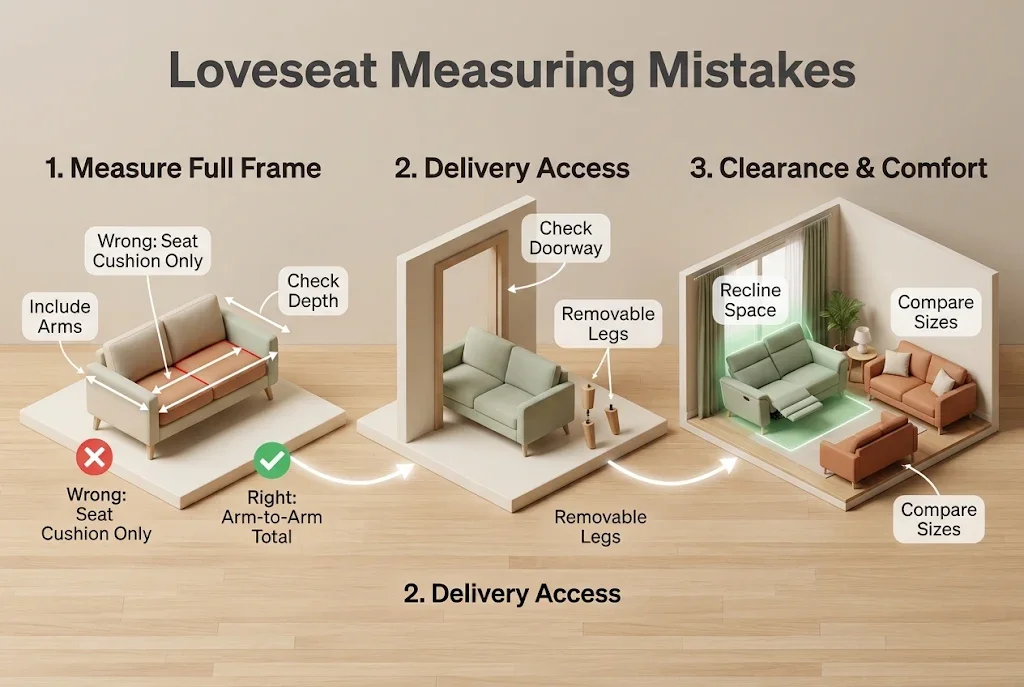
Even a simple furniture purchase can become frustrating when measurements are incomplete.
Avoid these common mistakes.
Measuring only the seat cushions: The complete loveseat is wider because the measurement includes both arms.
Ignoring overall depth: A loveseat may fit along the wall but extend too far into the room.
Forgetting the doorway: Room measurements do not confirm that furniture can enter the home.
Overlooking reclining clearance: Reclining furniture needs additional operating space.
Assuming all two-seaters are the same size: Different manufacturers use different frame designs and product names.
Ignoring removable parts: Some furniture has detachable legs or other parts that affect delivery access.
Choosing by appearance alone: A beautiful loveseat may not provide comfortable seating or fit your room properly.
A few extra measurements before ordering can prevent many of these problems.
How to Choose the Right Loveseat Size for Your Home
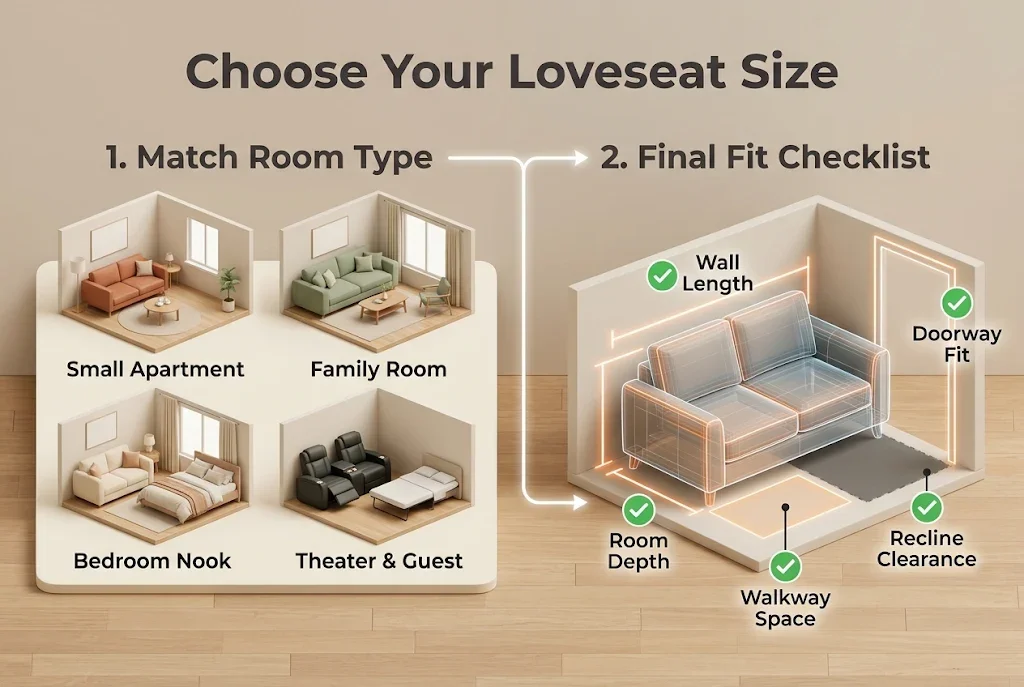
The right loveseat depends on your room, seating needs, and furniture preferences.
Instead of automatically choosing the largest model, think about how you will use the space.
Here are some practical situations to consider.
For a small apartment: A compact or medium loveseat may leave more room for a coffee table, storage unit, or accent chair.
For a family living room: A larger loveseat may provide more comfortable seating for two adults. If several people regularly use the room, consider combining it with another sofa or chair.
For a bedroom: A shorter loveseat can create a comfortable seating corner without taking over the available floor space.
For a home theater: A reclining loveseat with a console may offer useful features, but check its full width and extended depth.
For a guest room: A compact loveseat may be enough for occasional seating. If overnight sleeping space is important, compare sleeper models and their open dimensions.
Before making your final choice, use this quick checklist:
- Does the overall length fit the available wall?
- Is the depth suitable for the room?
- Does the seat provide enough space for its intended users?
- Can the furniture pass through the entrance?
- Is there enough clearance for walking?
- Does a reclining mechanism need additional room?
- Are the manufacturer’s dimensions clearly listed?
If the answer to each important question is yes, you are much closer to choosing a suitable loveseat.
Frequently Asked Questions
1. What Is the Main Difference Between a Loveseat and a 2-Seater Sofa?
A loveseat and a two-seater sofa are both designed for two people. The terms are often used interchangeably by furniture retailers.
A loveseat is commonly associated with a smaller seating design, while a two-seater sofa may have a longer frame. Always compare the actual dimensions rather than relying on the product name.
2. How Much Longer Is a Couch Than a Loveseat?
A standard three-seat couch often measures 72 to 96 inches, while a loveseat commonly measures 48 to 72 inches.
The actual difference depends on the models. For example, a 90-inch couch is 30 inches longer than a 60-inch loveseat.
3. Are Loveseats Outdated?
No. Loveseats remain a practical furniture choice for apartments, bedrooms, family rooms, and smaller living areas.
Modern designs include traditional upholstered models, minimalist styles, reclining options, and loveseats with built-in storage or consoles.
Their usefulness depends on your room and seating needs, not whether they follow a particular design trend.
4. What Is the Typical Length of a 2-Seater Sofa?
A two-seater sofa commonly measures around 48 to 72 inches long, although some models fall outside this range.
Always check the manufacturer’s overall width because two-seater sofa dimensions vary by design and brand.
5. How Much Space Should You Leave Around a Loveseat?
There is no single clearance measurement for every living room.
As a general planning guide, aim for a comfortable walking route of around 30 to 36 inches where possible. Also consider the distance needed to use nearby furniture, open doors, and operate reclining seats.
Final Thoughts
Most loveseats measure approximately 48 to 72 inches long, with many common models falling between 52 and 66 inches.
A compact design can suit a small apartment, while a larger loveseat may work better in a spacious family room. Reclining and console models need extra attention because their dimensions can differ considerably.
Before buying, compare the complete length, depth, and height. Measure your available floor space and check the route through your doors and hallways.
A few careful measurements can help you choose a loveseat that fits your home, feels comfortable, and leaves enough room for everyday movement.
Disclaimer
Furniture dimensions, room layouts, and comfort needs vary between homes and individuals. Always check the manufacturer’s specifications before purchasing, and seek qualified assistance when a furniture installation or property modification involves structural or other specialized work.