A vacuum filter collects dust and helps keep it from moving back into your room. When it becomes clogged, airflow can drop and the vacuum may pick up less dirt. Cleaning it can help, but the right method depends on the filter.
First, check your vacuum’s manual to see whether the filter is washable. Turn the machine off, unplug it or disconnect its battery, and remove the filter as directed. Gently remove loose dust. Rinse only filters approved for washing; clean non-washable filters with the dry method allowed by the maker, or replace them. Let every washed filter dry completely before you put it back. Some models require at least 24 hours.
Short Definition
Clean a vacuum filter by first checking whether it is washable. Remove loose dust, use only the approved cleaning method, and let washable filters dry completely before reinstalling them.
Experience
Check every filter in the vacuum, not just the one you can see near the dust cup. Some machines have separate pre-motor and post-motor filters, and their cleaning rules may differ.
1. How to Know Whether Your Vacuum Filter Is Washable
Identify the filter before using water. A foam filter may be washable while a pleated filter beside it must stay dry. Even HEPA filters have different cleaning rules.
Find the vacuum’s model number, often on a label near the back, bottom, dust cup, or battery. Use it to find the owner’s manual. Look for “washable,” “rinse,” “dry clean,” or “replace.” If the manual says not to wash the filter, keep it dry.
Common types of vacuum filters
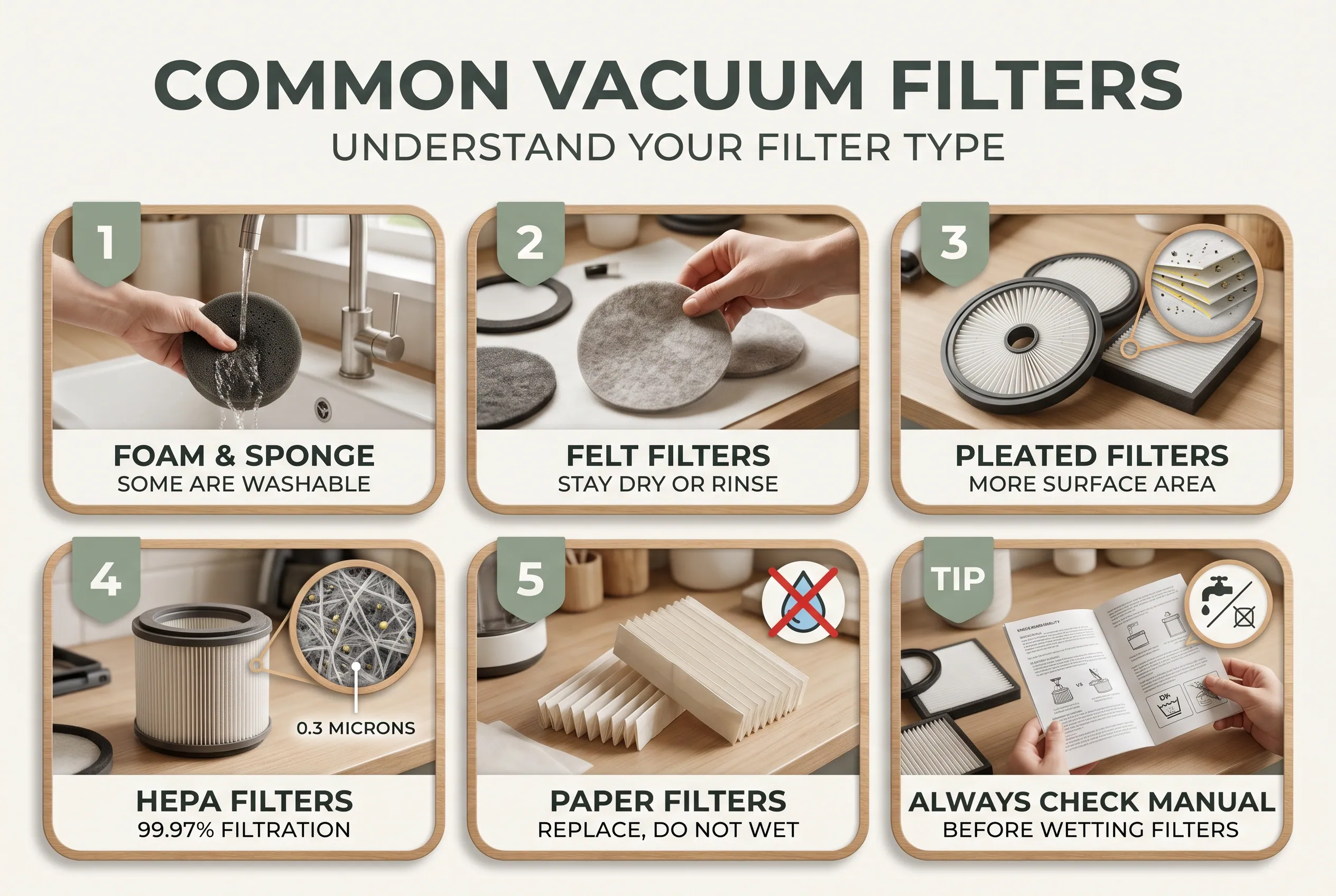
Foam and sponge filters: Some can be rinsed and gently squeezed to release dirt. Others need a different method or replacement. A soft texture alone does not prove that a filter is washable.
Felt filters: Some felt pre-motor filters can be rinsed. Other felt filters, including some post-motor types, must stay dry.
Pleated filters: Folded material creates more surface area for capturing particles. Some pleated filters are washable; others can be damaged by water or rough brushing.
HEPA filters: HEPA means high-efficiency particulate air. The U.S. Environmental Protection Agency says a HEPA filter can theoretically capture at least 99.97% of particles measuring 0.3 microns under defined test conditions. That describes filtration, not washability. Some vacuum HEPA filters can be washed; others must stay dry or be replaced. (EPA; Philips filter instructions)
Paper filters: Many paper-like filters are designed for replacement, not rinsing. Water can weaken their material, so use only the method listed by the maker.
What are pre-motor and post-motor filters?
A pre-motor filter sits before the motor and helps protect it from dust. A post-motor filter sits after the motor and catches particles before air leaves the vacuum. A machine may have both, with different cleaning rules.
For example, BISSELL says the CleanView/PowerClean foam pre-motor filter can be washed with warm water and mild detergent. Its post-motor filter must stay dry and should be tapped gently over a trash can. (BISSELL support)
Do not confuse a filter with a dust bag
A bagged vacuum has a dust bag plus separate filters. Replace a disposable bag as directed; do not wash it as if it were a reusable filter. Some handheld vacuums use a dust bowl and reusable filter instead. BLACK+DECKER’s CHV1410L manual specifically warns users not to confuse its reusable filter with a disposable dust bag. (Philips; BLACK+DECKER manual)
2. What Do You Need Before Cleaning a Vacuum Filter?
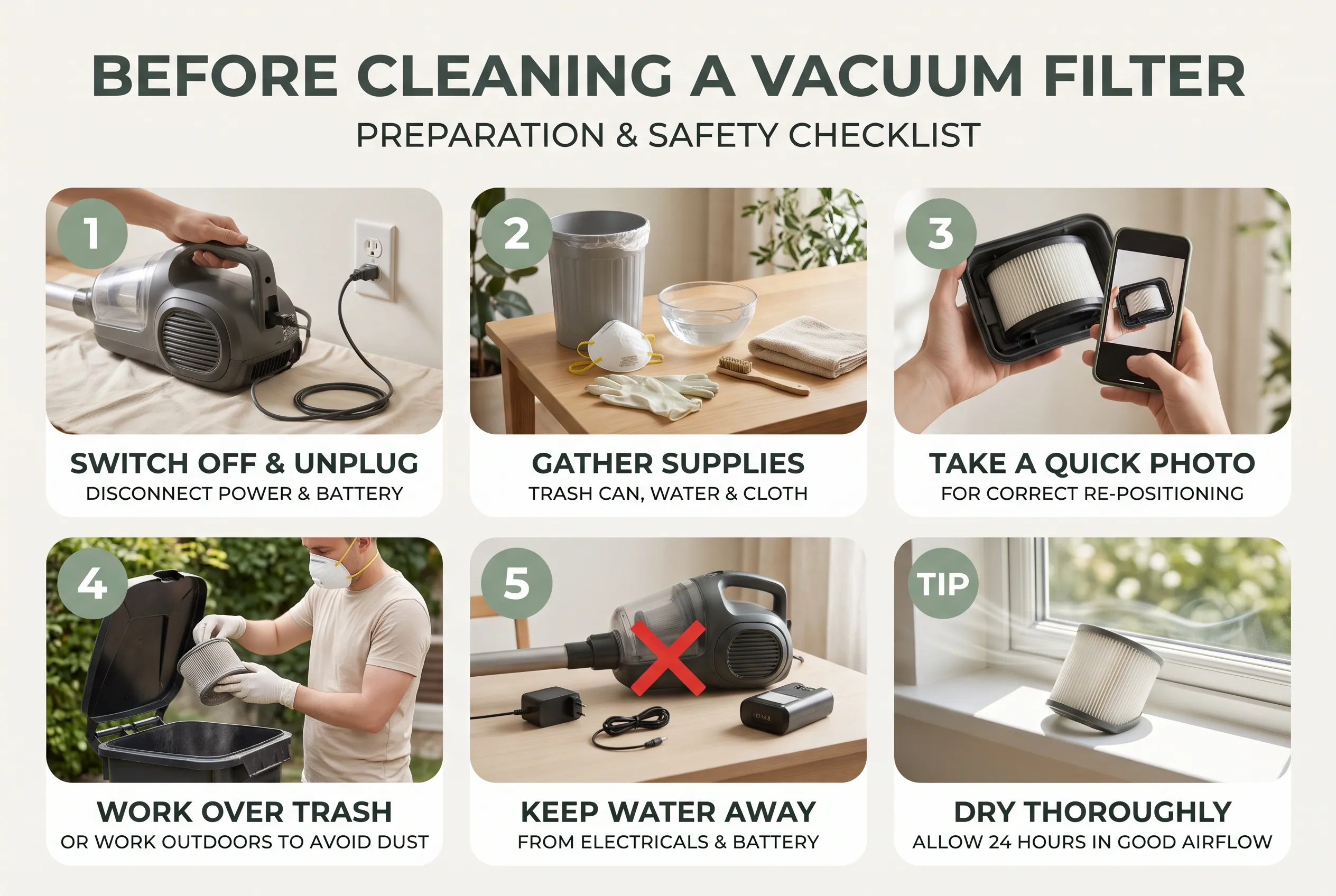
You usually need only a trash can, clean water for an approved washable filter, a soft cloth, and a dry place with good airflow. Use a soft brush or mild detergent only when the manual allows it.
If the filter is dusty, work outdoors or over a trash can. A dust mask and gloves can help when it is heavily soiled.
Switch off the vacuum first. Unplug a corded model; on a cordless model, follow the manual’s battery instructions. Keep water away from the vacuum body, charger, battery, and electrical parts. A quick photo of the filter before removal can help you put it back in the correct position.
3. How Do You Clean a Washable Vacuum Filter?
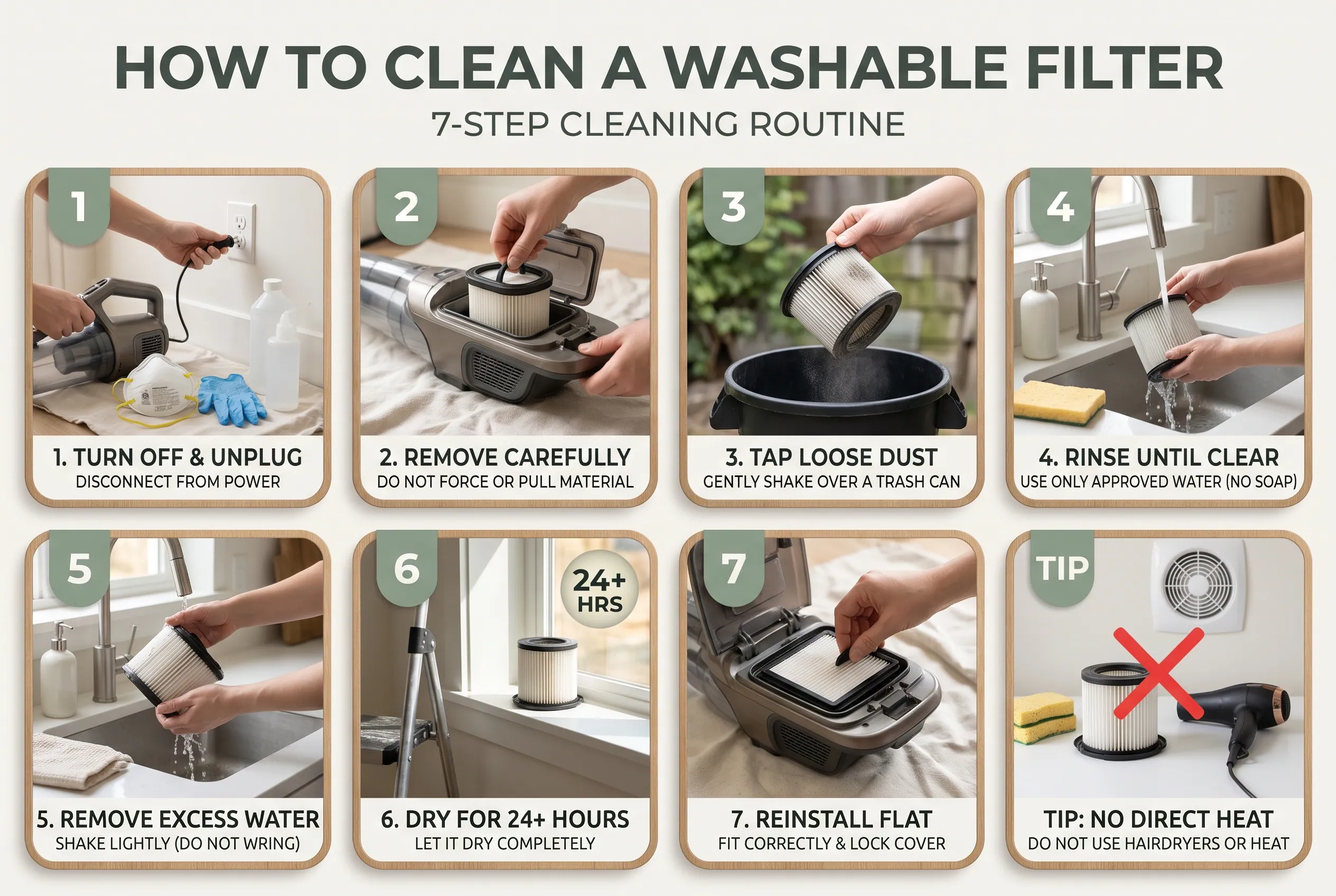
Use these steps only when your manual identifies the filter as washable. The exact water temperature and whether soap is allowed vary by model.
Step 1: Turn off and unplug the vacuum
Switch the vacuum off and disconnect it from power. On a cordless model, follow the manual’s instructions for switching off or removing the battery.
Step 2: Remove the filter carefully
Empty the dust cup if the manual recommends it. Open the filter compartment and remove the filter by its handle or tab. Do not pull on the filter material or force a stuck part; check the manual if you are unsure.
Keep multiple filters separate. A foam filter and a pleated post-motor filter may need different care.
Step 3: Remove loose dust
Hold the filter over a trash can and tap it gently to remove loose debris. Do not bang it against a wall or scrape it with a sharp tool. Skip tapping if the manual says not to.
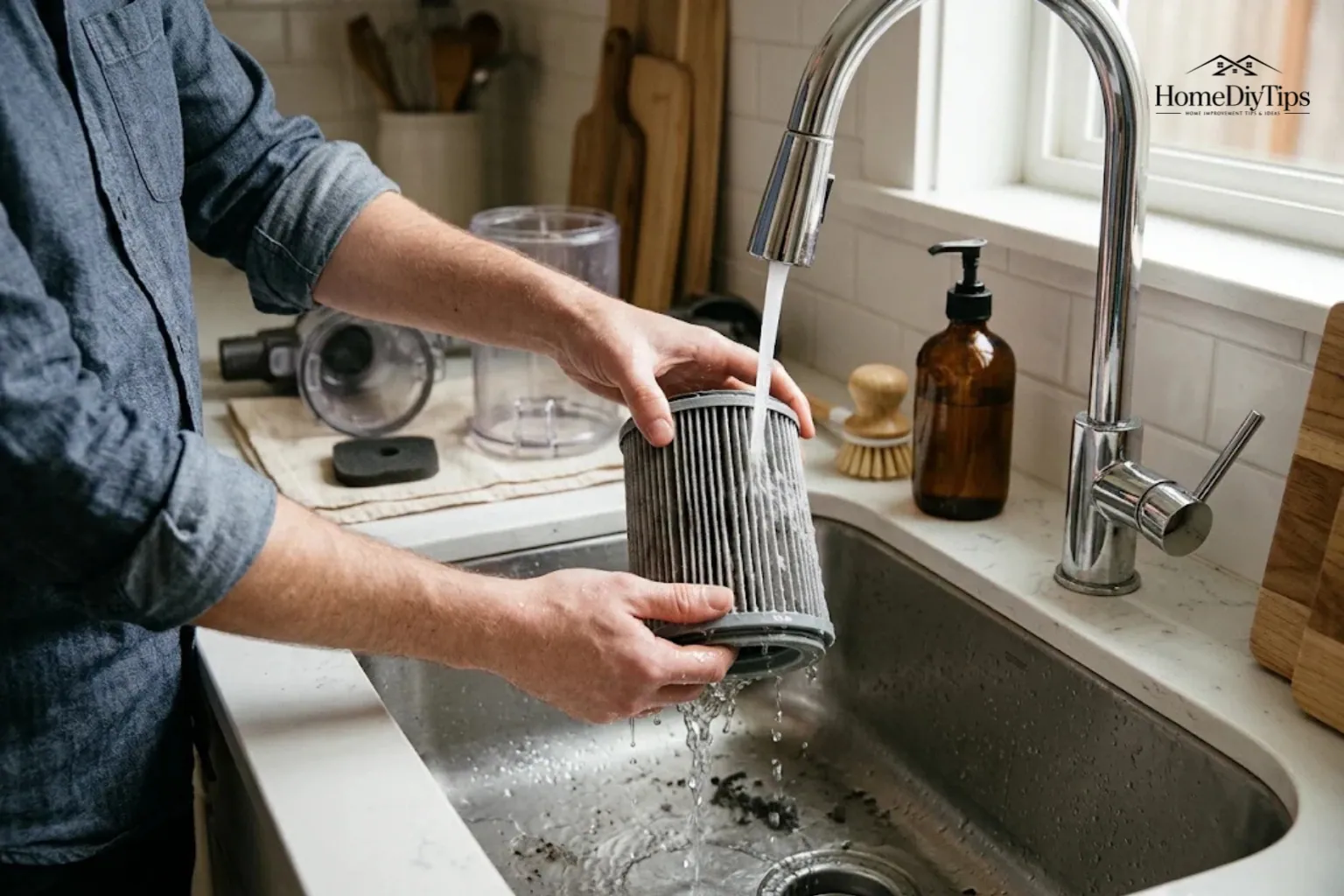
Step 4: Rinse it with the approved water
Use the water temperature stated in the manual. Rinse slowly. If it is a washable foam filter, gently press and release it under the water only if the maker allows this. Do not twist, stretch, or tear the material. Follow any instructions about which side to rinse, and continue until the water runs clear or the manual’s cleaning step is complete.
Use soap only when the manual permits it. BISSELL allows mild detergent for the foam pre-motor filter in the referenced CleanView/PowerClean instructions. Shark’s IX140/IZ140 manual says to use water only and not to use soap. That difference is why a general dish-soap tip is not safe for every vacuum. (BISSELL; Shark IX140/IZ140 owner’s guide)
Step 5: Remove excess water gently
Let water drain, then shake the filter lightly. Press foam gently only if the manual allows it. Do not wring or twist the filter.
Step 6: Let the filter dry completely
Place the filter in a clean, well-ventilated spot. Let air move around it. Do not put it back while it feels damp, even if the outside looks dry. Water trapped inside the filter can be drawn into the vacuum’s electrical or motor area.
Many manufacturers specify at least 24 hours for certain washable filters. Shark’s IX140/IZ140 guide requires at least 24 hours, and Dyson gives a minimum of 24 hours for the filter in its referenced instructions. Actual drying time can be longer if the filter is thick, the room is humid, or airflow is poor. Follow the model’s stated time and wait longer if any moisture remains. (Shark owner’s guide; Dyson filter instructions)
Do not use a hair dryer, oven, microwave, tumble dryer, radiator, or open flame to speed up drying. Heat can damage filter materials. Do not place the filter in direct heat just to save time. A spare compatible filter can be useful if you need to use the vacuum while the washed one dries.
Step 7: Reinstall the filter
Check that the filter is completely dry and has no tears or loose sections. Fit the filter in the correct direction and make sure it sits flat. Close the cover or dust cup until it locks. Never run the vacuum without its required filters.
4. How Do You Clean a Non-Washable Vacuum Filter?
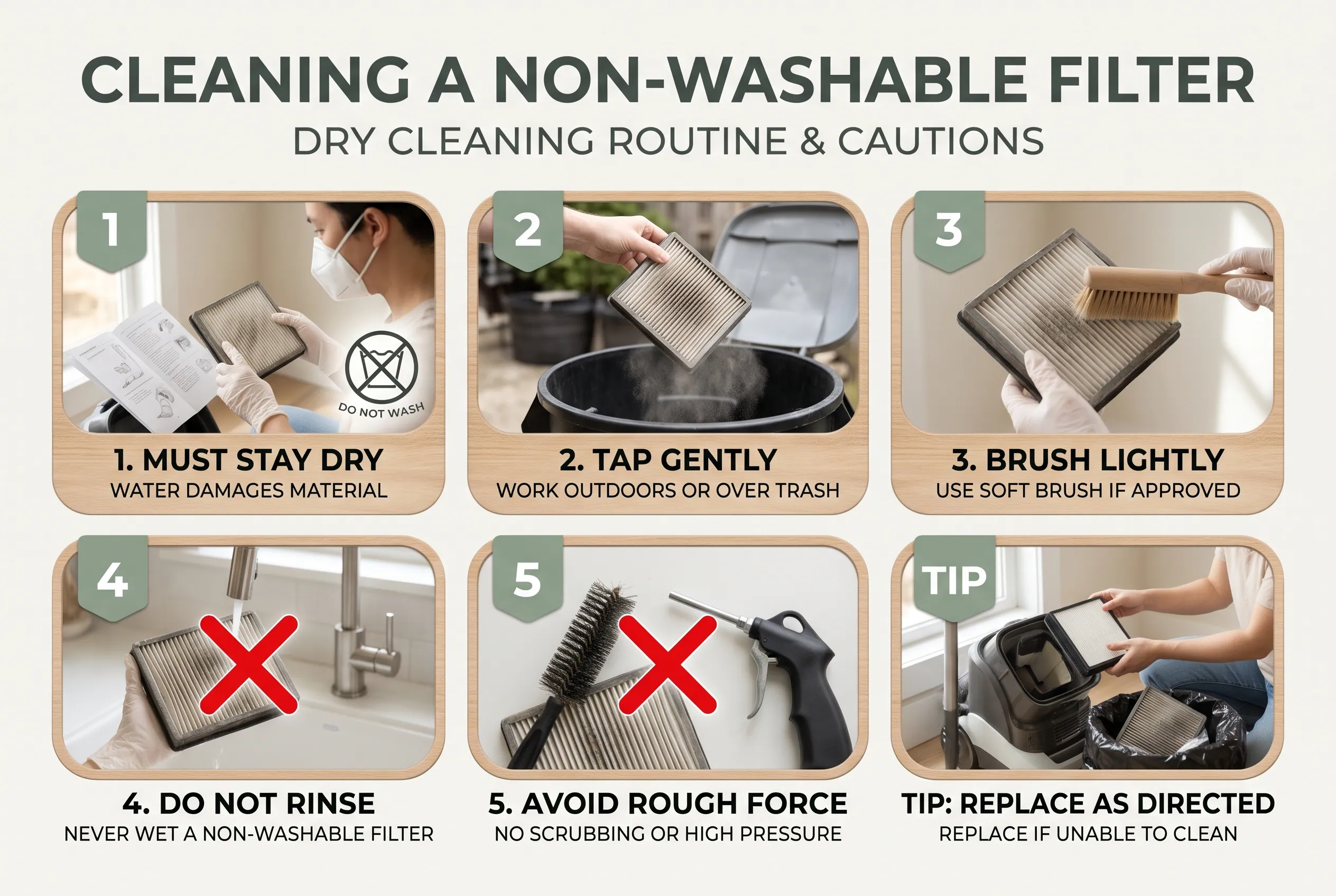
A non-washable filter must stay dry. Water can damage some pleated or paper-like media, even if the filter looks normal afterward. A filter that can be tapped clean is not necessarily washable.
Check whether the manual allows tapping or brushing. If it does, work outdoors or over a trash can and tap gently. Use a soft brush only if approved, sweeping lightly without pushing dirt deeper into the folds.
Do not scrub, soak, use a stiff brush, or blow high-pressure air through the filter unless the manufacturer allows it. Replace filters that the manual says cannot be cleaned.
Philips gives a useful example for several listed bagless vacuum models: its pleated HEPA/EPA filter cannot be washed and can be tapped over a bin or brushed, while the foam part beside it can be washed and must dry fully. These directions apply to the models listed on that support page, not to every vacuum. (Philips filter instructions)
5. How to Clean Filters From Popular Vacuum Brands
Brand names alone do not tell you whether a filter can be washed. Use the model number and correct manual before following any example below.
How to clean a Shark vacuum filter
For Shark’s Rocket cordless IX140 and IZ140 series, the owner’s guide says to rinse filters with water only, never soap. It requires at least 24 hours of air drying. The guide says to clean the pre-motor filters at least monthly and the post-motor filter at least yearly; heavy use may require more frequent cleaning.
Remove the dust cup as shown in the manual. Take out the foam and felt pre-motor filters and rinse them with water only. The post-motor filter is removed separately. These directions apply to the named series, not every Shark vacuum. (Shark IX140/IZ140 owner’s guide)
How to clean a Dyson vacuum filter
Dyson instructions vary by machine. For the model in support reference 15426-01, Dyson says to wash the filter in cold water only, without detergent, a washing machine, or dishwasher. It must dry for 24 hours in a warm place. The instructions also prohibit a tumble dryer, oven, microwave, or open flame.
Other Dyson support pages give similar guidance for specific cordless models, but filter location and cleaning schedules vary. Find your model’s support page first. (Dyson model instructions; Dyson cordless filter guidance)
How to clean a BISSELL vacuum filter
BISSELL’s CleanView/PowerClean instructions show why each filter needs its own check. For the referenced models, hand-wash the foam pre-motor filter with warm water and mild detergent, then dry it completely. Do not wash the post-motor filter; tap it gently over a trash can instead.
BISSELL gives a three-to-six-month replacement interval for both filters in this example. Use the schedule for your own model rather than applying this interval to every BISSELL vacuum. (BISSELL CleanView/PowerClean filter instructions)
How to clean a BLACK+DECKER Dustbuster cordless filter
The BLACK+DECKER CHV1410L manual describes a reusable filter and dust bowl. It allows the bowl and filters to be washed in warm, soapy water, but they must be dry before refitting. It recommends replacing filters every six to nine months, depending on use, and whenever they are worn or damaged.
For this model, remove the dust bowl, take out the filter, and separate the pre-filter from its housing for a deeper clean. Wash only the removable parts. Keep water away from the vacuum body and charging base. Other Dustbuster models may use different filters, so check their manuals. (BLACK+DECKER CHV1410L owner’s manual)
6. How Often Should You Clean a Vacuum Filter?
Follow the schedule in your vacuum’s manual. Cleaning frequency depends on the model and how much dust passes through it. Pets, heavy foot traffic, renovation dust, and frequent use may call for more frequent checks.
The Shark IX140/IZ140 guide recommends cleaning pre-motor filters monthly and the post-motor filter yearly. BISSELL’s CleanView/PowerClean instructions say to clean both filters every few uses. These are model-specific examples, not universal schedules.
Check the filter when you empty the dust cup or notice weaker suction. Look for visible dust, hair, or debris, and clean it only by the approved method. Inspect it sooner after vacuuming fine dust or large amounts of pet hair.
7. Common Vacuum Filter Cleaning Mistakes to Avoid
Washing every filter: Some filters are designed to stay dry. Confirm washability first.
Using the wrong water temperature: Follow the manual. Some makers specify cold water; others allow warm water for certain foam filters.
Adding dish soap automatically: Soap is not a universal filter cleaner. It may leave residue or damage a filter that is meant for water only. Use it only when the model’s instructions approve it.
Using baking soda: Do not sprinkle baking soda on a filter or soak a filter in a baking-soda mixture unless the manufacturer specifically recommends it. The instructions reviewed for the Shark, Dyson, BISSELL, Philips, and BLACK+DECKER examples do not provide a general baking-soda method. Stick to the method stated for your machine.
Scrubbing or squeezing too hard: Delicate pleats, seams, and foam can tear or change shape. Use gentle pressure only when the maker permits it.
Using heat to dry the filter: A hair dryer, heater, oven, or tumble dryer can damage filter materials. Air-dry it as directed.
Putting a damp filter back: This can allow moisture to enter the machine. Wait until the filter is fully dry, not just dry on the surface.
Running the vacuum without its filter: The filter is part of the machine’s dust-control system. Reinstall all required filters before use.
Forgetting other blockages: A clean filter may not fix weak suction if hair or debris is blocking the hose, wand, brush roll, or air path.
8. When Should You Replace a Vacuum Filter Instead of Cleaning It?
Cleaning removes dirt; it does not repair damaged filter material. Replace the filter if you see a tear, hole, split seam, crushed pleat, or a frame that no longer fits securely. Also follow the maker’s replacement schedule, even if the filter still looks fairly clean.
A filter may also need replacement if it stays clogged after the approved cleaning method, has an odor that remains after it is fully dry, or no longer fits tightly in its housing. Do not keep washing a filter that the manufacturer says is disposable or due for replacement.
If suction remains weak after you clean or replace the filter, check the dust cup, hose, wand, brush roll, and other air passages for blockages. Make sure the dust cup is seated and every filter door is closed. If the vacuum still overheats, shuts off, smells like burning, or has an electrical problem, stop using it and follow the manufacturer’s service guidance instead of taking the motor apart.
Frequently Asked Questions About Vacuum Filter Cleaning
Can a vacuum cleaner filter be washed?
Some can, but not all. Foam and sponge filters are often washable on certain models. Some pleated, paper, felt, and HEPA filters must stay dry. Check the exact model’s manual before using water.
Can you clean and reuse a vacuum filter?
Yes, when the filter is designed to be reusable and the manual allows cleaning. Wash or dry-clean it as directed, let washable filters dry fully, and replace the filter when it is damaged or reaches its replacement interval.
Can I soak my vacuum filter in water?
Only if the manufacturer says soaking is allowed. Some instructions say to rinse under running water; others describe soaking a washable filter. Never soak a filter simply because it looks like foam or sponge.
How often should a vacuum filter be cleaned?
Follow the schedule for your model. Some filters need attention every few uses, while others are checked monthly or less often. Heavy use, pets, and fine dust may mean you need to inspect the filter more often.
Can you clean a HEPA vacuum filter with water?
Sometimes, but never assume so from the HEPA label alone. Some vacuum HEPA filters are washable; others can only be tapped or brushed gently, or must be replaced. Check the manual for the exact filter.
Final Thoughts on Cleaning Your Vacuum Filter
The safest way to clean a vacuum filter is to identify it before you start. Wash only filters the manufacturer says are washable, keep non-washable filters dry, and let every washed filter dry completely before reinstalling it. When the filter is torn, misshapen, or still blocked after approved cleaning, replace it. A few minutes checking the manual can prevent damage and help your vacuum keep working as intended.
Disclaimer
Cleaning methods vary by vacuum model, filter type, and household conditions. Follow the owner’s manual for washing, drying, and replacement instructions. Contact the manufacturer or a qualified repair professional if your vacuum has electrical, motor, or overheating problems.