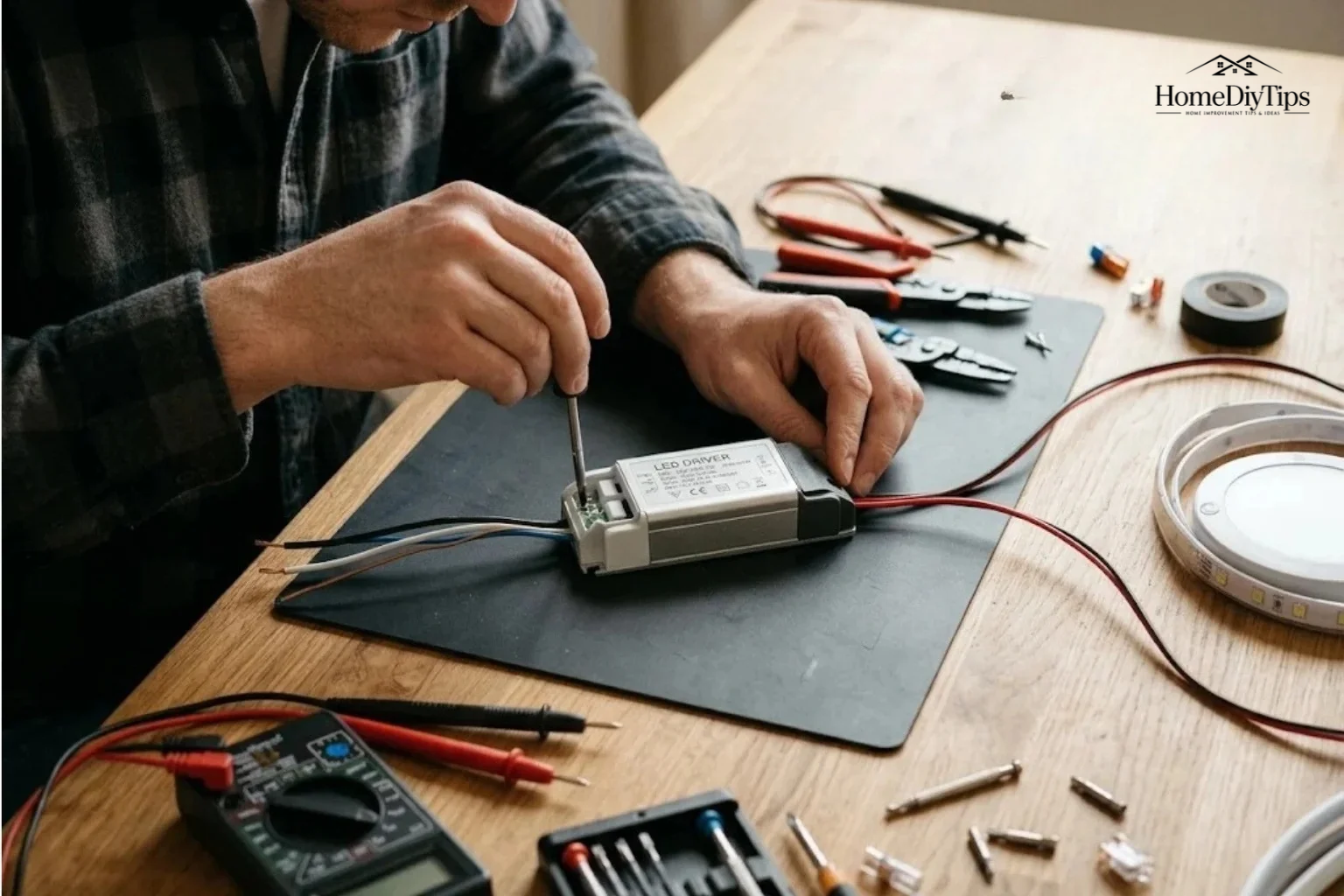
An LED driver is an electrical device that controls the power supplied to an LED light. It helps the light receive the correct current or voltage so it can work as designed. You may find a driver built inside an LED bulb or installed as a separate box in a ceiling light, outdoor fixture, or LED strip system.
LED drivers matter because LEDs cannot safely use just any power source. The correct driver depends on the lighting system’s electrical requirements. Some LEDs need a constant-current driver, while others use a constant-voltage driver, such as a compatible 12V or 24V model.
Understanding these differences can help you choose the right replacement, investigate a flickering light, and avoid buying a driver that does not match your fixture.
Direct Answer
An LED driver is an electrical device that regulates power for LED lights. Depending on the lighting system, it controls current or voltage and may convert AC power to DC.
Practical Home Tip
Before replacing an LED driver, check the original label for its output voltage or current, wattage, and dimming requirements. A similar-looking driver may not be electrically compatible, and hardwired replacements may require a qualified electrician.
What Is an LED Driver?
An LED driver is a specialized power supply designed to deliver suitable electrical power to an LED or a group of LEDs. It may convert alternating current (AC) from a household electrical supply into direct current (DC), regulate current, control voltage, or perform several of these functions.
The exact job depends on the driver’s design and the LEDs it powers.
For example, a standard household LED bulb usually contains a small driver inside its base. You can screw the bulb into a compatible socket without buying a separate driver. By contrast, some under-cabinet LED strips use an external power supply that connects to the lighting through separate wires or connectors.
Why do LED lights need a driver?
LEDs are sensitive to electrical conditions. They need power within specific limits to produce light reliably.
A driver helps by:
- Supplying the type of electrical power the LEDs require.
- Controlling current or voltage, depending on the design.
- Supporting steady light output under suitable operating conditions.
- Helping prevent electrical conditions that could damage the LEDs.
- Supporting features such as dimming when the driver and controls are compatible.
Some drivers also include protection against problems such as overloads, short circuits, or excessive temperature. However, not every driver has every protection feature, so check the manufacturer’s specifications.
Without suitable power control, an LED system may flicker, operate poorly, overheat, or fail early.
What is the difference between a built-in driver and an external driver?
A built-in driver is part of the light itself. An external driver is a separate component connected to the light.
Built-in drivers are common in household LED bulbs and many integrated LED fixtures. They save space and make installation simpler because you do not need to select a separate driver.
External drivers are common in LED strip systems, some recessed lights, commercial fixtures, and outdoor lighting. They can make a driver easier to identify or replace, provided the fixture is designed for that type of service.
An external driver is not automatically replaceable by a homeowner. Some are installed inside hardwired fixtures or electrical enclosures and require qualified electrical work.
How Does an LED Driver Work?
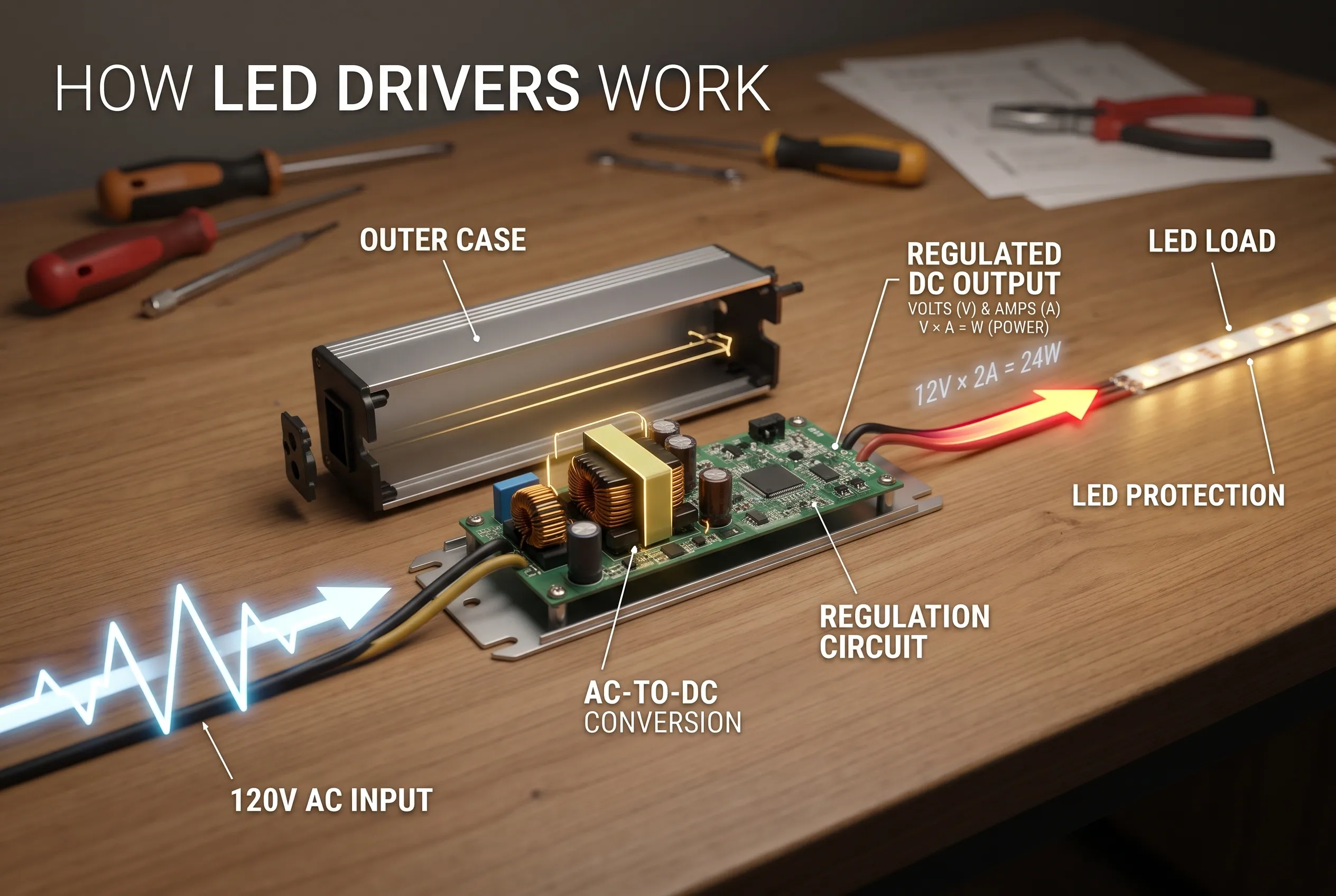
An LED driver takes the electrical input available to it and supplies power suited to the connected LED system. The process depends on the design, but many drivers convert AC input into regulated DC output.
A simplified example is a household lighting system that receives 120V AC and uses a driver to produce a much lower DC output for its LEDs. The actual output might be a fixed voltage, a controlled current, or a voltage that changes within a specified range.
Not every driver produces 12V or 24V. The label and manufacturer’s instructions determine what a particular model supplies.
What do volts, amps, and watts mean?
Three electrical terms are especially useful when choosing an LED driver.
- Volts (V): Measure electrical pressure, or the force that pushes electrical charge through a circuit.
- Amps (A): Measure the amount of electrical current flowing through a circuit.
- Watts (W): Measure electrical power, or how quickly electrical energy is being used.
For a simple DC circuit, watts equal volts multiplied by amps.
For example, a 12V LED strip drawing 2A uses 24W of electrical power under those conditions.
This calculation helps explain a product label, but it does not prove that any 24W driver will work with that strip. The output type, voltage, current requirements, operating limits, and manufacturer’s instructions must also match.
How does a driver help protect LEDs?
LEDs can draw excessive current if their electrical supply is not properly controlled. Excess current creates additional heat, which can damage the LED and reduce its useful life.
A suitable driver helps keep the electrical conditions within the LED’s specified operating range. Its performance also depends on factors such as ambient temperature, cooling, and the total connected load.
The driver cannot correct every problem. Poor ventilation, a damaged fixture, loose connections, incompatible controls, or an unsuitable LED module can still cause trouble.
What Are the Main Types of LED Drivers?
The most important distinction is between constant-current and constant-voltage drivers. These types regulate electrical power differently, so they are not interchangeable in every application.
1. Constant-current LED drivers
A constant-current driver supplies a set current while adjusting its output voltage within a specified range.
For example, a driver may be rated for 700 milliamps (mA) with an output voltage range of 20–36V. It is designed to maintain the specified current while the connected LED load operates within that range.
Constant-current drivers are common in:
- High-power LED modules.
- Some recessed and downlight fixtures.
- Commercial lighting.
- LED arrays designed for a specified operating current.
When replacing one, check the required current and the driver’s supported output-voltage range. The total LED load must also fall within the manufacturer’s limits.
A driver with a higher current rating is not automatically a suitable upgrade. Excess current can damage LEDs that are not designed to handle it.
2. Constant-voltage LED drivers
A constant-voltage driver supplies a fixed output voltage, such as 12V DC or 24V DC, within its rated operating conditions.
These drivers are common in LED strip systems and other lighting products designed for a fixed voltage. Such systems often include current-limiting components as part of the LED assembly.
For example, a 12V LED strip generally needs a compatible 12V supply. Using a 24V supply could damage the strip unless the product specifically supports that input.
When choosing a constant-voltage driver, check:
- The required output voltage.
- The total power needed by the connected lights.
- The driver’s maximum rated output.
- Any minimum-load or other operating restrictions.
- Whether the driver is suitable for the installation environment.
A higher wattage rating may be acceptable if the voltage and other requirements match and the manufacturer permits the load. The driver does not automatically force its maximum rated wattage into the LEDs.
3. Built-in and external LED drivers
These terms describe where the driver is located rather than how it regulates power.
A built-in driver is integrated into a bulb or fixture. An external driver is installed separately, often inside a housing or electrical enclosure.
The location affects maintenance. A failed driver in a sealed integrated fixture may require replacing the complete fixture, while an external driver may be replaceable if the manufacturer supports that repair.
4. Dimmable LED drivers
A dimmable LED driver supports reducing light output when paired with a compatible dimmer or control system.
Not all LED drivers are dimmable, and not all dimmers work with every dimmable driver. Compatibility depends on the control method and the specifications of both components.
If an LED light flickers, buzzes, or fails to dim smoothly, check the manufacturer’s compatibility information before assuming the driver is defective.
5. Emergency LED drivers
An emergency LED driver is designed to support emergency lighting when the normal power supply fails. Depending on the model, it may work with a battery or another specified backup arrangement.
These systems are different from ordinary LED drivers because they must support an emergency operating mode. Compatibility with the fixture, LED load, battery, and required emergency-lighting function is essential.
Do not substitute an ordinary driver for an emergency driver unless the lighting system’s manufacturer explicitly approves the arrangement.
Where Are LED Drivers Used?
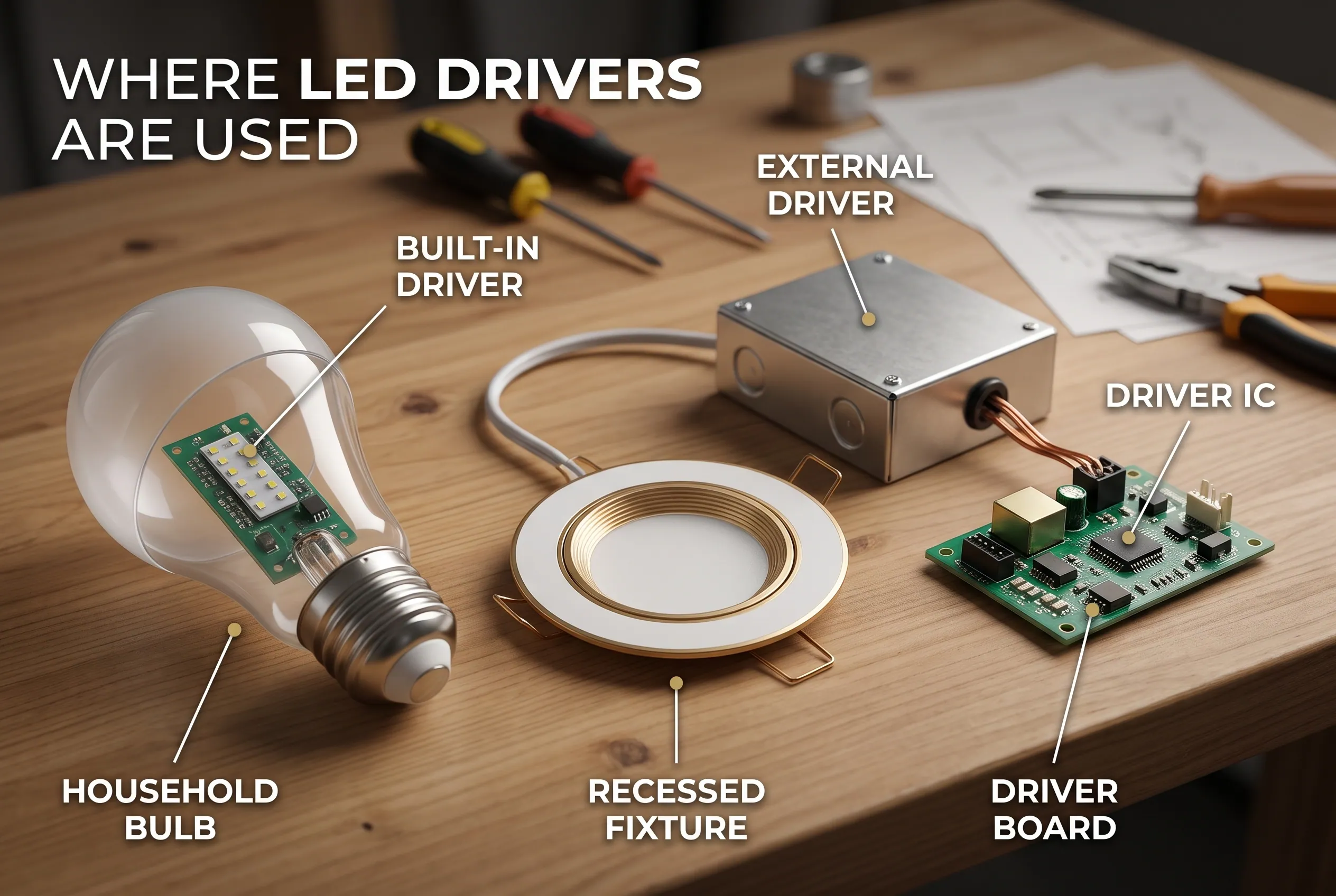
LED drivers are used in many types of lighting, but their design and location vary.
| Lighting application | Typical driver arrangement |
| Household LED bulbs | Built-in driver |
| Under-cabinet LED strips | Often an external constant-voltage supply |
| LED panels | Driver integrated into or supplied separately from the panel |
| Recessed LED fixtures | Built-in or external driver, depending on the model |
| Outdoor LED fixtures | Integrated or external driver designed for the fixture and environment |
| Commercial high-bay lights | Often an integrated or replaceable constant-current driver |
These are common arrangements, not universal rules. Always check the individual product’s requirements.
What is an LED driver board?
An LED driver board is a circuit board containing the electronic components that control power for an LED system. It may include components for rectification, voltage conversion, current regulation, filtering, and protection.
The exact components depend on the design. Some boards are built into LED bulbs, while others are part of larger fixtures.
A damaged driver board may cause the light to flicker or stop working, but the symptom alone does not identify the failed component.
What is an LED driver IC?
An LED driver IC is an integrated circuit used to control aspects of the LED power supply. IC stands for integrated circuit, a small electronic device that performs specific control functions.
The IC is only one part of the driver. Other components may be needed to convert power, manage current, filter electrical noise, and support protection features.
For most homeowners, the practical point is simple: a driver IC is an internal electronic component, not a complete replacement power supply.
LED Driver vs. Power Supply vs. Transformer
These terms are related, but they do not mean exactly the same thing.
| Component | Main function | Important consideration |
| LED driver | Supplies and regulates power for an LED system | Must match the LED’s electrical requirements |
| General DC power supply | Converts available input power into a specified DC output | May not provide the current regulation an LED system needs |
| Transformer | Transfers AC electrical energy between circuits and can change voltage | A basic transformer does not necessarily provide regulated DC or suitable LED current control |
Is an LED driver just a transformer?
No. A traditional transformer changes AC voltage through electromagnetic induction. It does not, by itself, provide all the power conversion and regulation that many LED systems need.
An LED driver may contain a transformer as one part of its internal circuit, but it can also contain rectifiers, switching components, control circuits, and other parts.
Some LED fixtures can work with a specified electronic transformer, but only when the LED and transformer are designed to operate together. Do not assume that a transformer with the correct-looking voltage label can replace an LED driver.
Can you use a regular power supply instead of an LED driver?
Sometimes, but only when the supply is suitable for the LED system.
For example, a compatible regulated 12V DC power supply may work with a 12V LED strip designed for constant-voltage operation. It must still have adequate capacity and meet the strip’s other requirements.
A constant-current LED module may need a driver that maintains a specific current over its operating-voltage range. A general-purpose power supply may not provide that function.
The safest rule is to match the power source to the lighting manufacturer’s specifications rather than relying on the product name alone.
How to Choose the Right LED Driver
The right LED driver is the one that matches the lighting system’s electrical requirements, control features, and installation conditions. A similar shape or higher wattage rating does not guarantee compatibility.
Step 1: Check the input voltage and frequency
Look for the driver’s input rating. A label might show:
Input: 120V AC, 60Hz
Another model might list a wider input range, such as 100–240V AC, 50/60Hz.
A label showing 220–240V AC, 50/60Hz describes a different input range from a model rated only for 120V AC. Do not assume that every driver accepts both.
For a replacement, confirm that the input rating is suitable for the electrical supply where the fixture will be installed.
Step 2: Match the output type and rating
Read the output section of the label.
For a constant-voltage driver, check the specified voltage, such as 12V DC or 24V DC.
For a constant-current driver, check the rated current and the permitted output-voltage range.
Also confirm the polarity and connection requirements for low-voltage DC systems. Never assume that a connector or wire arrangement is universal.
Step 3: Check the wattage and load range
The driver’s rated output must support the connected LEDs without exceeding its limits.
For a simple constant-voltage system, add the power requirements of the connected LED products. The result should stay within the driver’s permitted load, with any additional margin chosen according to the manufacturer’s guidance.
For example, imagine a compatible 12V LED strip that requires 24W in total. A 12V driver rated for 30W may be suitable if its other specifications and load restrictions match the strip.
That example is not a universal sizing rule. Constant-current systems require the correct current and operating-voltage range, not just a wattage comparison.
Step 4: Check dimming and installation requirements
If the light uses a dimmer, smart control, or emergency backup, confirm that the replacement supports the same required function.
Also check the driver’s enclosure, temperature rating, mounting requirements, and suitability for the installation location. An indoor driver is not automatically suitable for a damp or outdoor environment.
Example: Choosing a driver for a 12V LED strip
Imagine you want to replace the supply for a kitchen cabinet light.
- Read the strip’s label or installation instructions.
- Confirm that it requires 12V DC constant-voltage power.
- Find the total wattage of the connected strip.
- Choose a driver whose output voltage and capacity meet the strip’s requirements.
- Check connector polarity, dimming compatibility, and the intended installation environment.
If the original label is missing, use the product’s model number and manufacturer’s documentation where available. Do not guess the voltage from the connector’s appearance.
How to Tell If an LED Driver Is Bad
A faulty LED driver can cause flickering, dimming, intermittent operation, or a light that will not turn on. However, these symptoms can also result from a bad LED module, incompatible dimmer, loose connection, failed switch, or another electrical problem.
Start with safe checks before deciding to replace the driver.
Common warning signs
Flickering: The driver may be failing or incompatible with the dimmer. A loose connection or problem elsewhere in the circuit can produce similar symptoms.
Unexpected dimming: The driver may not be supplying the required power, but the LED module or control system could also be responsible.
Failure to turn on: The cause might be the bulb, driver, switch, circuit, or power supply.
Intermittent operation: A failing component or connection may cause the light to stop and restart. Do not assume the driver is responsible without further diagnosis.
Unusual heat, burning smells, or visible damage: These signs deserve prompt attention. A hot or damaged driver may indicate a fault rather than normal operation.
Safe checks to make before replacing anything
- Check the controls. Confirm that the wall switch is on and the dimmer is set correctly. If the light is designed for a particular dimmer, check compatibility using the manufacturer’s documentation.
- Check other lights on the same circuit. If several lights have stopped working, the problem may involve the electrical supply or circuit rather than one driver.
- Look for visible damage from a safe position. Do not remove covers or touch wiring to investigate. Look for external damage, discoloration, or a damaged enclosure.
- Check the product documentation. Follow any manufacturer-approved troubleshooting steps for the exact fixture.
- Consider other causes. If the controls and supply appear normal, a qualified technician can determine whether the driver, LED module, or another component has failed.
Stop using the light if you notice smoke, a burning smell, sparks, or signs of overheating. Switch off the circuit only if you can do so safely, and arrange qualified electrical help.
Do not open an energized driver or attempt live electrical testing without the required training and equipment.
How to Replace an LED Driver Safely
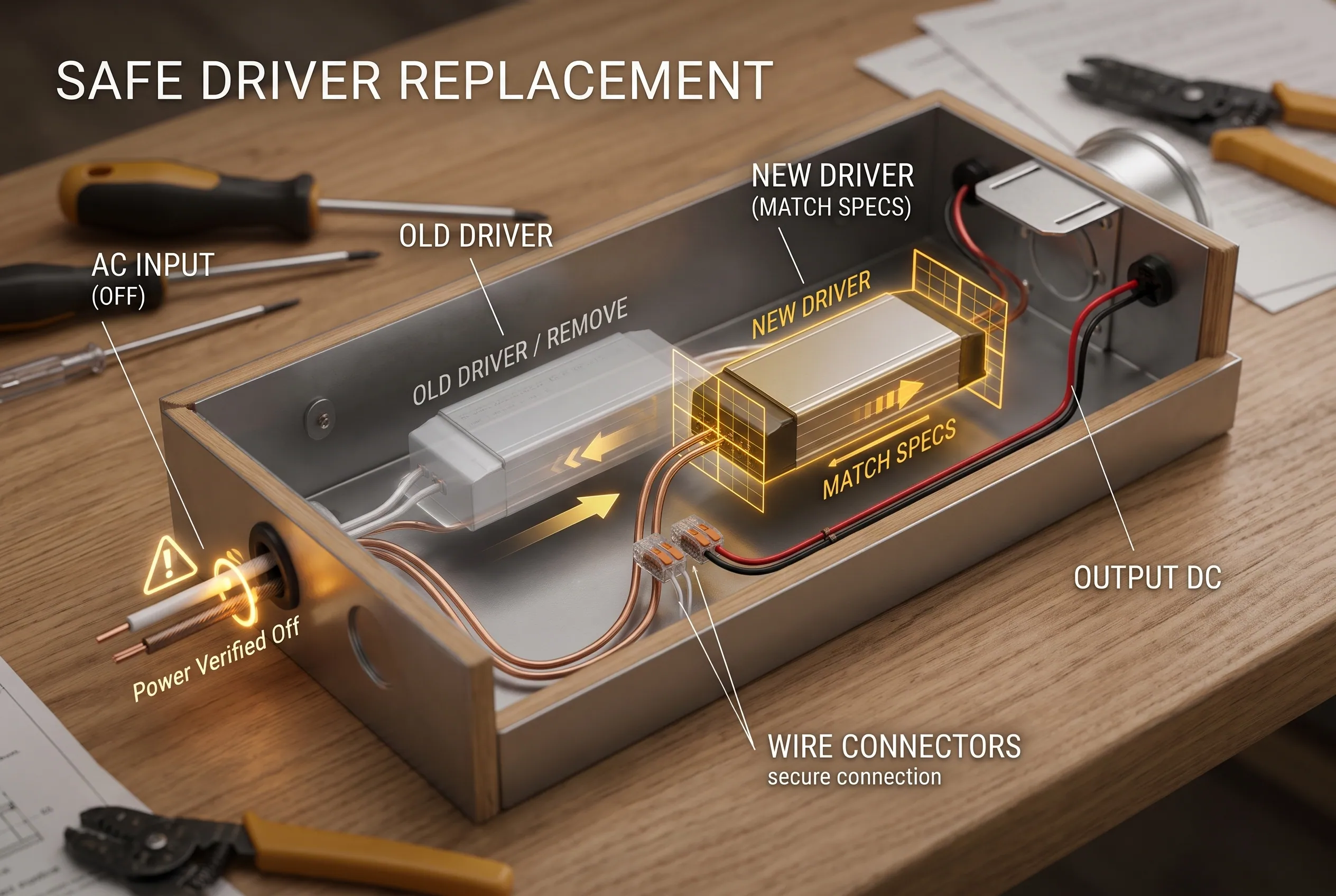
Replacing an LED driver may be possible when the fixture is designed for servicing and an exact compatible replacement is available. Other fixtures have sealed or integrated components, making complete fixture replacement the more appropriate option.
When is a replacement driver suitable?
Before buying a replacement, confirm:
- The input voltage and frequency are suitable.
- The output type and electrical ratings match the LED system.
- The output voltage or current range meets the manufacturer’s requirements.
- The wattage and load limits are appropriate.
- Dimming, emergency functions, connectors, and mounting requirements are compatible.
- The manufacturer permits the proposed replacement.
A driver that looks identical to the original may have different electrical specifications. Matching the model number and checking the manufacturer’s replacement guidance are often more reliable than comparing appearance alone.
How do you connect an LED driver to power?
The correct connection method depends on the exact driver and fixture. Some systems use plug-in low-voltage connectors, while others require hardwiring to the building’s electrical supply.
For a plug-in system, follow the manufacturer’s instructions and use only the specified connectors and supply. Confirm the correct voltage and polarity before connecting compatible low-voltage equipment.
Important safety limit: Hardwired drivers may have terminals connected to dangerous mains voltage. Turn off the appropriate circuit and have a qualified electrician perform wiring work if you are not trained to do it safely. Turning off a wall switch alone may not isolate every conductor in a fixture.
Do not rely on generic wire colors or a diagram from a different driver model. Follow the exact manufacturer’s instructions and applicable local electrical requirements.
How much does it cost to replace an LED driver?
The cost depends on the driver model, fixture design, availability of a compatible part, and whether professional labor is needed.
A standard external driver may be simpler to replace than a driver inside a sealed or difficult-to-access fixture. Specialized dimmable or emergency drivers may have additional compatibility requirements.
Before comparing prices, confirm the exact replacement part and whether the quoted cost includes installation. A low-cost driver is not a good value if it is incompatible or unsuitable for the fixture.
No single price applies to every LED driver replacement, and a reliable estimate requires the fixture details and current local pricing. If a fixture is sealed, damaged, or expensive to service, compare the cost of an approved repair with replacing the complete fixture.
Common LED Driver Mistakes to Avoid
A few simple checks can prevent unnecessary purchases and electrical problems.
- Matching only the wattage: Voltage, current regulation, and load requirements matter too.
- Confusing constant current with constant voltage: These drivers serve different types of LED systems.
- Assuming every driver outputs 12V or 24V: Some constant-current drivers operate across a voltage range.
- Ignoring dimmer compatibility: A driver and dimmer must support compatible control methods.
- Replacing the driver without checking other causes: A faulty LED module or control can produce similar symptoms.
- Using an indoor driver in an unsuitable location: Check environmental and temperature ratings.
- Assuming a higher-rated driver is always better: Its output must still match the connected lighting system.
- Opening a hardwired fixture without proper training: Electrical repair can expose you to dangerous voltage.
The original driver label and the lighting manufacturer’s instructions are the best starting points when choosing a replacement.
Frequently Asked Questions
Do all LED lights need a driver?
LEDs need suitable power control, but not every light requires a separate driver box. Many household LED bulbs and integrated fixtures contain a built-in driver. Others use an external driver or compatible power supply.
What happens if you use the wrong LED driver?
The light may flicker, fail to operate correctly, overheat, or become damaged. An incorrect output voltage or current can cause serious problems, depending on the LED design. Always check the required electrical specifications before connecting a replacement.
Is an LED driver the same as a transformer?
No. A transformer changes AC voltage, while an LED driver supplies and regulates power for the LED system. Some drivers contain transformers, but a basic transformer does not necessarily provide the conversion or current regulation that LEDs require.
Can you use a 12V power supply for LED lights?
Yes, when the LED system is designed for compatible 12V constant-voltage power and the supply meets its other requirements. A 12V supply is not automatically suitable for a constant-current LED module or a light designed for another voltage.
How much does it cost to replace an LED driver?
There is no single price for every replacement. The cost depends on the driver specifications, fixture design, part availability, and installation labor. Identify the exact compatible part before comparing product prices and repair estimates.
Final Advice
An LED driver helps your lighting system receive the electrical power it needs. The most important step when choosing or replacing one is to match the driver’s output requirements to the connected LEDs.
If a light flickers or stops working, check the accessible controls and product documentation before assuming the driver has failed. When replacement involves hardwired electrical connections or an unfamiliar fixture, use a qualified electrician rather than guessing.
A few minutes spent checking the original specifications can help you avoid an incompatible purchase and choose a safer, more practical repair.
Disclaimer
This article provides general educational information. Electrical systems, fixture designs, budgets, and repair needs vary, so check the manufacturer’s instructions for your specific product. For hardwired electrical work or uncertain repairs, consult a qualified electrician.