Wallpaper can cost a few dozen dollars for a small DIY project or several thousand dollars for a professionally decorated room. The total depends on the wallpaper you choose, the amount of wall space you cover, and whether your walls need repairs before installation.
In the United States, Angi’s October 2026 cost guide reports that professional wallpaper installation for a standard room typically costs $325 to $825, including materials and labor. It gives a national average of $600. Larger rooms, premium wallpaper, and extra preparation can push the price much higher.
The easiest way to plan your budget is to separate material costs, installation labor, and extra expenses. Here’s how to estimate each one before you buy wallpaper or hire an installer.
Direct Answer
Wallpaper installation in the US typically costs 325–825 for a standard room, according to Angi’s October 2026 guide. Your total depends on wallpaper type, room size, labor, and wall preparation.
Practical
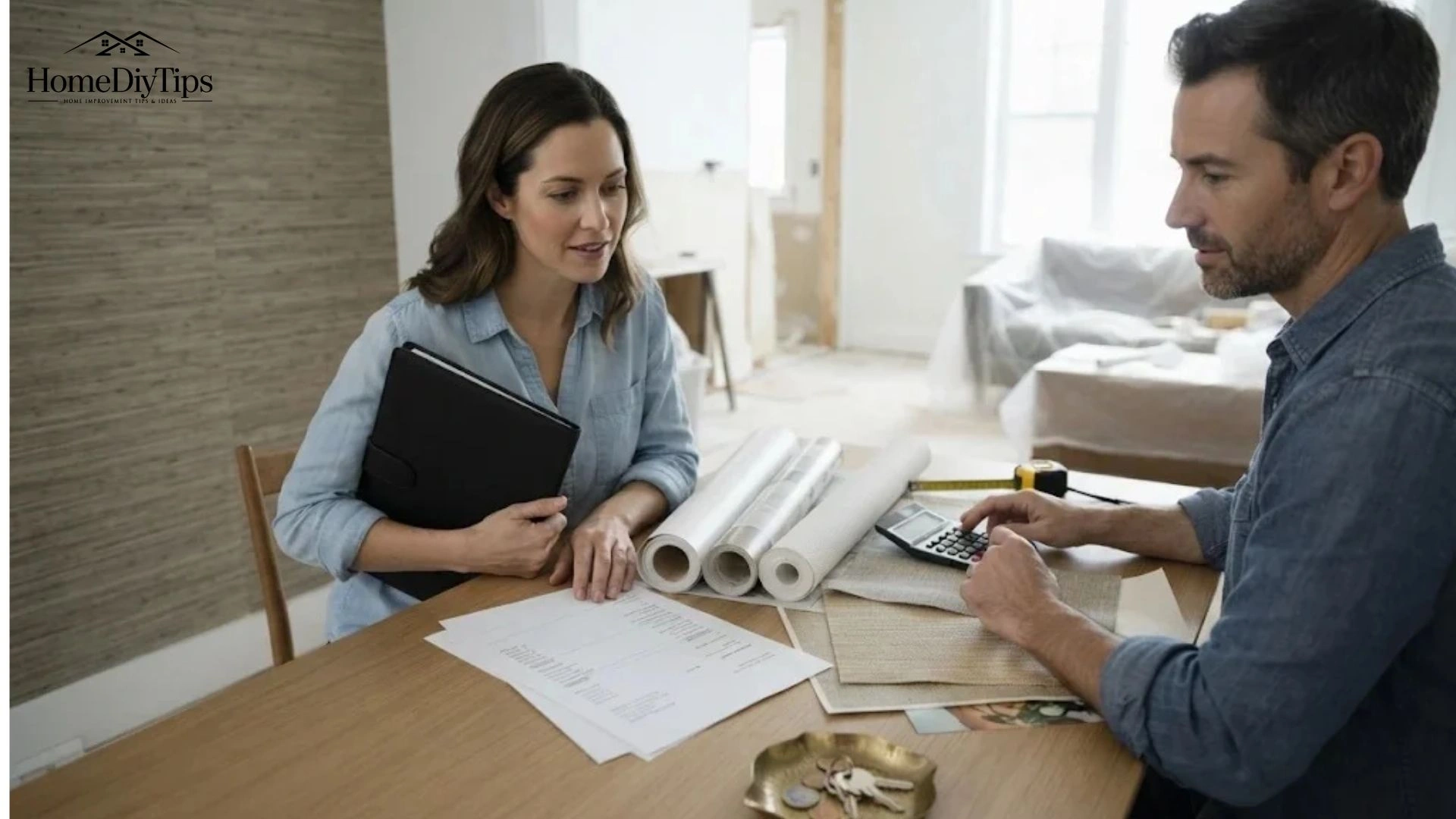
Measure every wall before buying wallpaper, and check the product’s usable coverage and pattern repeat to estimate how many rolls you need. Request a written installation quote that separates materials, labor, wall preparation, and wallpaper removal.
Wallpaper Cost by Type
The wallpaper material you choose affects both the purchase price and the cost of installation. Some products are easy to apply yourself, while others need careful handling and professional skill.
The following material prices are estimates from Angi’s October 2026 guide. They are not guaranteed retail prices, and the cost of installation may be separate.
| Wallpaper type | Estimated material cost per sq. ft. | Best suited for |
| Standard paper | 0.50–2 | Budget-friendly bedrooms and living spaces |
| Peel-and-stick | 1–6 | Accent walls and suitable rental spaces |
| Vinyl | 2–5 | Busy areas that need regular cleaning |
| Fabric wallpaper | 4–10 | Decorative spaces with a textured finish |
| Grasscloth | 5–12 | Rooms where natural texture is important |
| Custom murals | 10–50 | Feature walls and personalized designs |
Standard Paper and Vinyl Wallpaper
Standard paper wallpaper is often one of the cheapest choices. It comes in many colors and patterns, making it suitable for bedrooms, dining rooms, and other spaces where heavy cleaning is not a major concern.
However, basic paper wallpaper can tear more easily than some alternatives. It may also be harder to clean, so check the manufacturer’s care instructions before using it in a busy hallway or family room.
Vinyl wallpaper generally costs more, but many products are more durable and easier to wipe clean. This can make it a practical option for high-traffic areas.
Do not assume every vinyl product is suitable for a bathroom or kitchen. Moisture, ventilation, wall condition, and the manufacturer’s installation instructions all matter.
Peel-and-Stick Wallpaper
Peel-and-stick wallpaper has an adhesive backing. You remove the backing paper and press the wallpaper onto the prepared wall instead of applying separate wallpaper paste.
It can be a useful choice for renters, DIY beginners, and people who want to decorate a single wall without committing to traditional wallpaper.
For example, a Home Depot catalog listing showed RoomMates grasscloth-style peel-and-stick wallpaper at $39.99 per roll during a promotion running through October 25, 2026. That is a specific product example, not a current guaranteed price for all peel-and-stick wallpaper.
Before buying, check the coverage, recommended surface, and removal instructions. Peel-and-stick wallpaper may not adhere well to rough, dusty, freshly painted, or textured walls. It can also reveal small bumps that would be less noticeable on a textured surface.
Renters should check their lease and obtain permission when necessary. A product marketed as removable does not guarantee that every wall finish will remain undamaged.
Non-Woven and Fabric Wallpaper
Non-woven wallpaper is made from a blend of fibers designed to provide a stable wall covering. Some products are easier to install and remove than traditional paper, but the exact process depends on the product.
Fabric wallpaper offers a richer, more textured appearance. It can work well in formal living rooms, bedrooms, and decorative spaces.
Both options can cost more than basic paper. Fabric products may also need more careful cleaning and installation. Check whether the wallpaper requires adhesive on the wall, adhesive on the paper, or another method.
Grasscloth and Custom Murals
Grasscloth wallpaper uses natural fibers to create a woven appearance. It adds texture and visual depth, but the fibers can stain, and seams may remain visible.
Because grasscloth is often delicate, a low material price should not be your only consideration. Professional installation may be worthwhile if the material is expensive or the wall layout is complicated.
Custom murals are printed to fit a particular design or wall. They can create a dramatic feature behind a bed, sofa, or dining table. However, large murals can cost considerably more than standard wallpaper, especially when they use premium materials or custom artwork.
For a limited budget, consider using a mural or expensive wallpaper on one wall rather than throughout the room.
Wallpaper Cost Per Square Foot and Per Roll
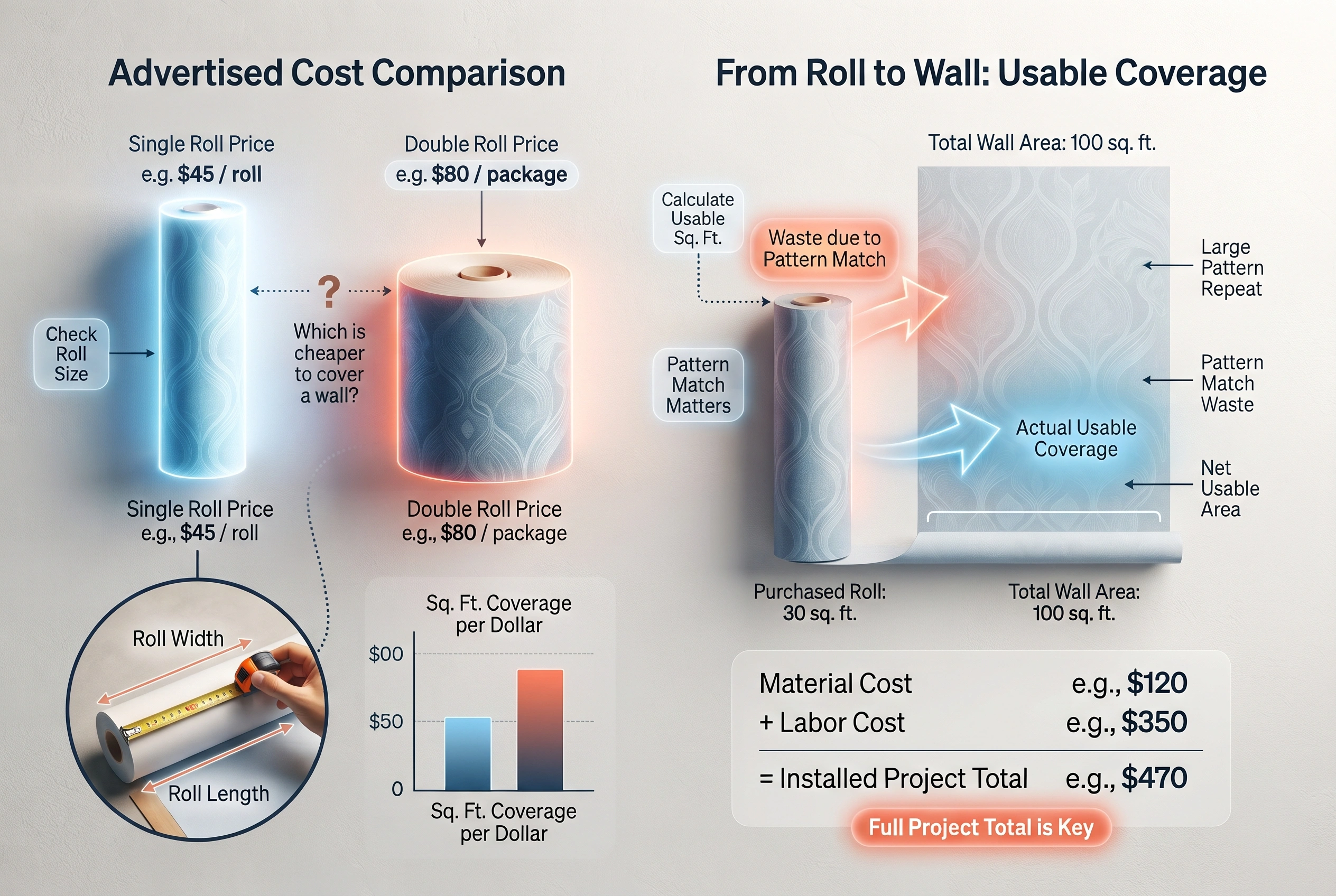
Wallpaper prices are commonly advertised per roll or per square foot. Installation companies may quote labor per square foot, per roll, or by the hour.
These figures are not interchangeable.
- Material cost: What you pay for the wallpaper itself.
- Labor cost: What an installer charges to hang it.
- Installed cost: The combined cost of materials and installation, sometimes with preparation included.
- Project total: The full amount after adding any extra services, supplies, delivery, or applicable taxes.
HomeAdvisor’s June 2026 guide reports professional labor estimates of approximately $1 to $7 per square foot, excluding wallpaper materials. Angi’s October 2026 guide reports approximately $3 to $8 per square foot for combined materials and labor. The ranges differ because cost guides use different assumptions and project scopes.
How much does wallpaper cost per roll?
There is no single standard price per roll. Basic products may cost relatively little, while designer patterns, textured materials, and custom prints can cost much more.
A roll’s size also matters. Two rolls with the same price may cover different amounts of wall space.
Before comparing products, check:
- The roll’s width and length.
- The stated coverage.
- Whether the listed price refers to a single roll, double roll, or another package.
- Whether the wallpaper requires separate adhesive.
- Whether pattern matching reduces the usable coverage.
A wallpaper with a large repeating pattern may leave more unused material than a plain design. This means the cheapest roll is not always the cheapest option for covering your wall.
How Much Does Wallpaper Cost for One Wall or One Room?
The best estimate starts with the wall area you plan to cover. Room dimensions alone do not tell you exactly how much wallpaper you need because doors, windows, ceiling height, and pattern matching affect the calculation.
Cost to wallpaper one accent wall
An accent wall is often the simplest way to try wallpaper without paying to cover an entire room.
Suppose you have a wall that is 10 feet wide and 8 feet high.
The wall area is:
10 × 8 = 80 square feet.
If you use a broad planning range of $3 to $8 per square foot for installed wallpaper, the estimate would be $240 to $640.
This is a calculation example, not a quote. It assumes the selected price applies to the full project area and does not include separate preparation charges or a minimum service fee.
A small project may cost more per square foot if an installer charges a minimum amount for each visit. Angi’s published 2026 estimate for an accent wall measuring approximately 30 to 60 square feet is $120 to $500, illustrating how project size and pricing assumptions affect the total.
Cost to wallpaper a 10 × 10-foot room
Imagine a square room measuring 10 feet by 10 feet, with an 8-foot ceiling.
First, calculate the wall area:
- Room perimeter: 10 + 10 + 10 + 10 = 40 feet.
- Total wall area: 40 × 8 = 320 square feet.
- Assume doors and windows account for 30 square feet.
- Estimated wall area to cover: 320 − 30 = 290 square feet.
Using the illustrative installed rate of $3 to $8 per square foot gives a preliminary estimate of $870 to $2,320.
This estimate excludes any separately charged preparation work. The actual amount will also depend on whether the installer prices the job by wall area, roll count, or a fixed project fee.
Cost to wallpaper a 12 × 12-foot room
Now imagine a 12 × 12-foot room with the same 8-foot ceiling.
- Room perimeter: 12 + 12 + 12 + 12 = 48 feet.
- Total wall area: 48 × 8 = 384 square feet.
- Assume doors and windows account for 40 square feet.
- Estimated wall area to cover: 384 − 40 = 344 square feet.
At the same illustrative installed rate of $3 to $8 per square foot, the estimate is $1,032 to $2,752 before separate preparation charges.
These calculations explain why a price guide’s average room cost may differ from an area-based estimate. Published averages can reflect different room sizes, material allowances, labor arrangements, and project scopes. Do not treat a national average as a firm quote for your room.
For a reliable estimate, give installers your room dimensions, ceiling height, wallpaper choice, and wall condition. Ask them to explain what their price includes.
DIY vs. Professional Wallpaper Installation
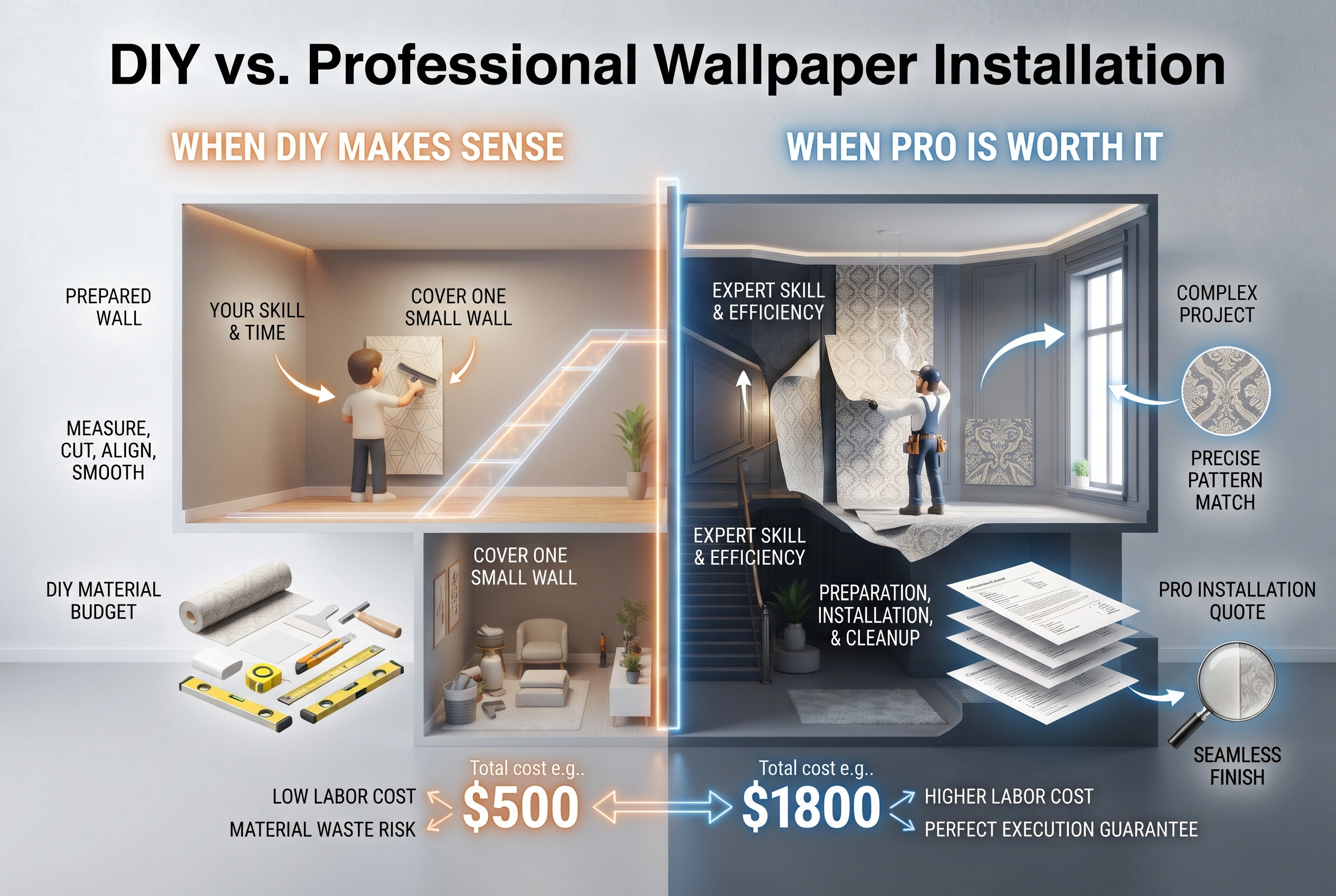
Installing wallpaper yourself can reduce labor costs, but you will need to consider your skill level, the material, and the amount of preparation required.
When DIY makes sense
DIY installation may be a reasonable option when:
- You are covering one small, simple wall.
- You have selected an easy-to-handle product.
- The wall is smooth, clean, and properly prepared.
- You have enough time to measure, cut, align, and smooth each strip.
- You can afford some extra material in case you make a mistake.
Your material budget should include wallpaper, any required adhesive, a smoothing tool, a sharp utility knife, a measuring tape, a level, and suitable surface-preparation supplies.
Some of these tools may already be available at home. If not, their cost should be included in your estimate.
When professional installation is worth considering
Hiring a wallpaper installer may make more sense for:
- Large rooms with many walls.
- Expensive or delicate wallpaper.
- Patterns that need precise alignment.
- Walls with significant damage or old wallpaper.
- Tall ceilings, stairways, or awkward corners.
- Projects where visible seams would be especially noticeable.
A professional may complete the work more efficiently and reduce the chance of wasting expensive material. However, a higher price does not automatically guarantee good workmanship.
Ask whether the installer has experience with your specific wallpaper type. Request a written quote that explains the preparation, installation, and cleanup included in the price.
Which option is cheaper?
DIY is usually cheaper when you can complete the work correctly without buying many tools or wasting material.
Professional installation costs more because you pay for labor and skill. But the difference may be worthwhile if the wallpaper is expensive or the project is difficult.
Compare the full DIY budget with the complete professional quote. Comparing a roll price with an installed project price will give you a misleading result.
Extra Costs That Can Increase Your Wallpaper Budget
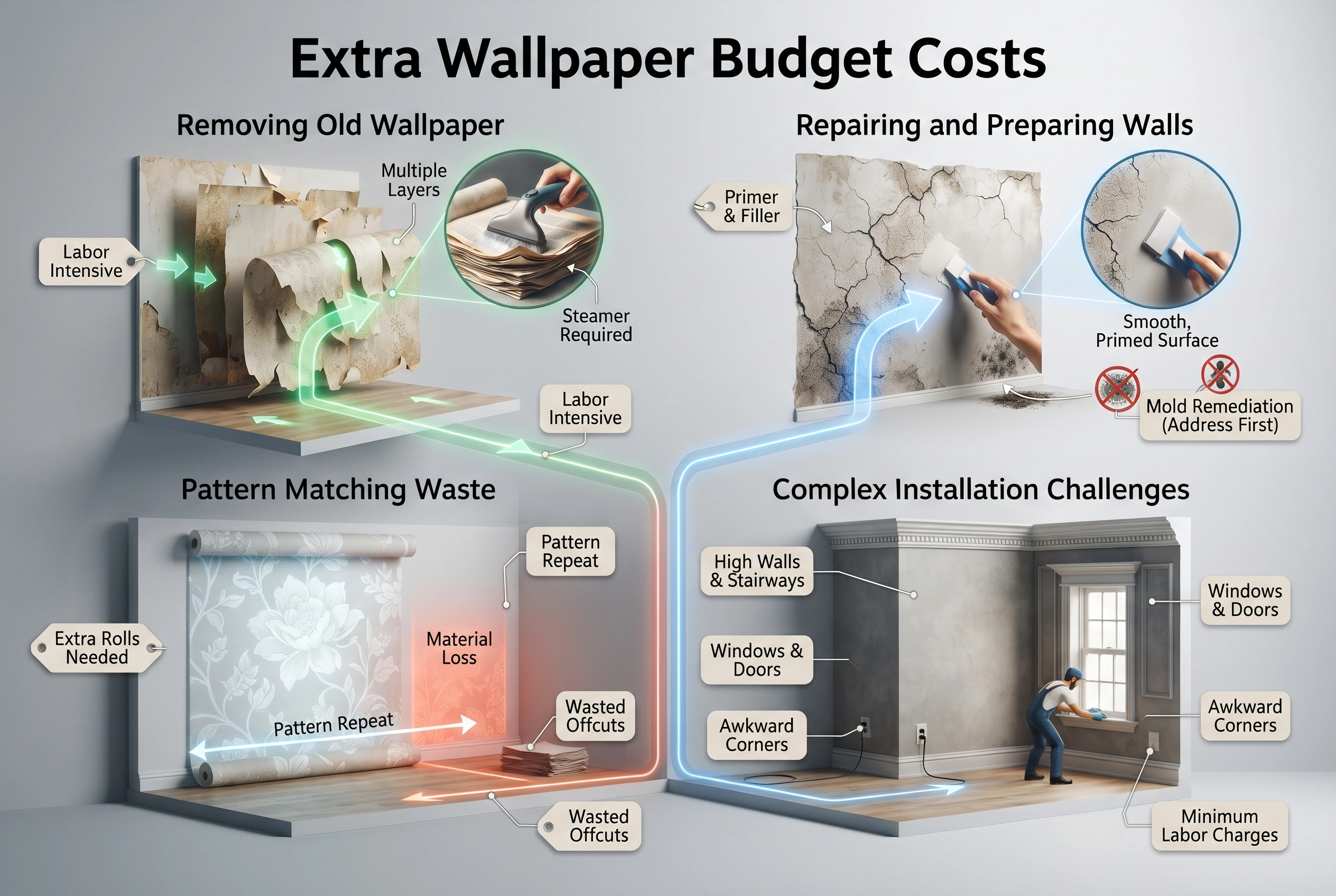
The wallpaper itself may not be the only major expense. Preparation and installation conditions can add substantially to the final bill.
Removing old wallpaper
Old wallpaper may need to come off before new material can be installed. Removal can take longer if the existing paper is difficult to strip or has several layers.
Ask whether removal is included in your installation quote. If it is separate, make sure the estimate accounts for the condition of the wall underneath.
Repairing and preparing walls
Wallpaper usually needs a smooth, clean surface to look good and adhere properly.
Holes, cracks, peeling paint, and uneven patches may require repair. Some surfaces also need a suitable primer before installation.
Angi reports preparation and repair costs of approximately $50 to $300 per wall in its 2026 installation guide. Your actual cost will depend on the amount of work required.
Do not cover serious moisture damage or active mold with wallpaper. The underlying problem needs to be addressed first, or the new covering may fail.
Pattern matching and wasted material
Pattern matching means aligning the design across neighboring strips. A small geometric print may be relatively easy to align, while a large floral or decorative pattern can require more careful cutting.
Some material is lost when you match the design. This can increase the number of rolls you need.
Check the pattern repeat on the product label and ask the retailer or installer to calculate the required quantity. Do not simply divide the wall area by the advertised roll coverage and assume the result will be enough.
Other possible expenses
Depending on the project, your quote may include or exclude:
- Moving furniture.
- Repairing drywall.
- Applying primer.
- Working around many windows, doors, or built-in shelves.
- Installing wallpaper on high walls or stairways.
- Delivery and disposal.
- Minimum labor charges for small projects.
Ask for a breakdown before agreeing to the work. It is easier to compare two estimates when both cover the same tasks.
How to Calculate Your Wallpaper Budget
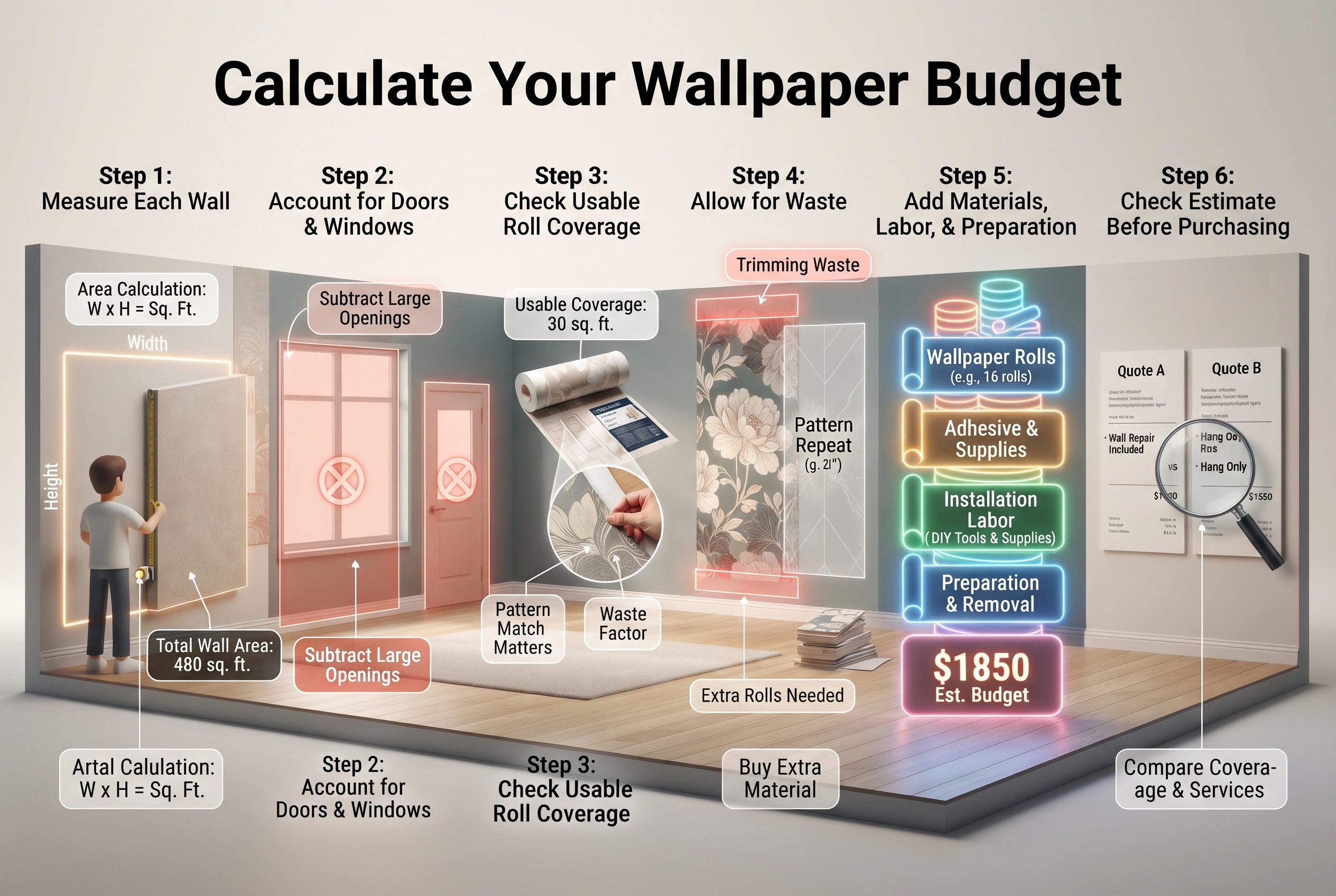
You can create a useful preliminary budget with a tape measure, a calculator, and the wallpaper’s product details.
Step 1: Measure each wall
Measure the width and height of every wall you want to cover. Multiply each wall’s width by its height to find its area.
For example, a wall that is 12 feet wide and 8 feet high covers 96 square feet.
Add the areas of all the walls.
Step 2: Account for doors and windows
Subtract large openings that will not receive wallpaper. For a simple room estimate, this gives you a more realistic area to cover.
You do not need to calculate every tiny opening precisely during the first budget check. However, unusual layouts and large built-in features should be included when requesting a final quote.
Step 3: Check usable roll coverage
Look at the coverage information for the exact wallpaper product you want to buy.
Do not assume that a roll will cover a fixed area simply because another brand uses the same roll name. Pattern matching can also reduce the amount of usable material.
Step 4: Allow for waste
You will need some extra material for trimming, pattern matching, and possible mistakes.
The amount depends on the design and room layout. Follow the manufacturer’s measuring guidance and ask for help calculating rolls when the pattern has a large repeat.
Buy enough wallpaper for the full project, ideally from compatible production batches. Different batches can have slight color variations that become visible when the strips are placed side by side.
Step 5: Add materials, labor, and preparation
Your preliminary project total is:
Wallpaper + adhesive and supplies + installation labor + preparation and removal + other quoted charges.
If you are installing the wallpaper yourself, replace professional labor with your tool and supply costs. You should also allow for the possibility of replacing material if a strip is damaged.
Step 6: Check the estimate before purchasing
Compare your calculations with the retailer’s coverage guidance and at least two written installation quotes when hiring a professional.
If the estimates differ substantially, ask why. One installer may have included wall repairs or removal, while another may have priced only the hanging work.
A clear explanation is more useful than choosing the lowest number without knowing what it covers.
How to Keep Wallpaper Costs Under Control
You do not need to choose the cheapest wallpaper to manage your budget. The goal is to avoid paying for material or work that does not suit your room.
Start with one wall. If you are unsure about a bold design, an accent wall lets you use less material while still creating a noticeable change.
Order a sample. Check the color, texture, and pattern in your actual lighting. This can help prevent an expensive purchase that looks different from the product photograph.
Compare coverage, not just roll prices. A cheaper roll may cover less usable wall area or require more pattern matching. Calculate the cost of the quantity you actually need.
Prepare the walls properly. Correct preparation can reduce adhesion problems and help the wallpaper look smoother. Do not skip repairs simply to lower the initial quote.
Compare installation quotes carefully. Ask each installer to list removal, repairs, primer, hanging, cleanup, and any minimum charge.
Choose materials for the room. A delicate, expensive wallpaper may not be practical in an area that needs frequent cleaning. A more suitable product may offer better value over time.
Buy the correct quantity. Running short halfway through installation can create delays and color-matching problems. Keep the batch information and follow the manufacturer’s recommendations for spare material.
Common Wallpaper Budgeting Mistakes
A few avoidable mistakes can make a wallpaper project more expensive than expected.
- Buying too little wallpaper: Advertised coverage may not account for pattern matching and trimming.
- Comparing different types of prices: A material-only price is not comparable to a quote that includes installation.
- Ignoring wall preparation: Damaged or unsuitable surfaces can require additional work before hanging begins.
- Choosing by appearance alone: The wallpaper also needs to suit the room’s cleaning needs, moisture conditions, and surface.
- Accepting an unclear quote: A low starting price may exclude removal, repairs, or other necessary work.
- Assuming DIY always saves money: Wasted material, extra tools, and rework can reduce the savings.
- Forgetting future repairs: Keeping compatible spare material can make it easier to repair a damaged section later.
Before buying, check the wall measurements, product coverage, installation instructions, and full project cost. These checks take less time than correcting an expensive ordering mistake.
Frequently Asked Questions About Wallpaper Costs
How much should I expect to pay for wallpaper?
For a standard professionally installed room, Angi reports a typical US range of $325 to $825 in October 2026. Your project may cost more or less depending on the room size, material, labor, and wall preparation.
How much does wallpaper cost per square foot?
Material prices vary by type. Angi’s 2026 estimates range from $0.50 to $2 per square foot for standard paper to $10 to $50 for custom murals. Professional installation is an additional cost unless the quote specifically includes materials and labor.
Is it cheaper to paint or wallpaper?
Painting is often cheaper for a straightforward room because basic paint and supplies can cost less than wallpaper materials and installation. However, the result depends on wall preparation, the finish you choose, and whether you do the work yourself. Compare the complete costs for your room rather than material prices alone.
How many wallpaper rolls do I need?
Measure the total wall area, check the usable coverage of your chosen product, and account for doors, windows, and pattern matching. Divide the area by usable roll coverage to get a preliminary quantity, then follow the manufacturer’s guidance. Some products are sold in double or triple rolls, so check the package details before ordering.
Is peel-and-stick wallpaper cheaper to install?
It can be cheaper for a simple DIY project because it does not require separate wallpaper paste and may be easier to reposition during installation. However, product prices vary, and the material may not suit every wall. Professional installation, surface preparation, or replacing poorly applied strips can add to the total.
Choose a Wallpaper Budget That Fits Your Home
Start by measuring the walls you want to cover and deciding which wallpaper suits the room. Check the usable coverage, calculate the number of rolls, and separate material costs from labor and preparation.
If you plan to hire an installer, request a written quote that covers the entire job. A realistic budget should account for the work your walls need, not just the price printed on the wallpaper roll.
Disclaimer
Wallpaper prices are estimates and may vary by location, product, labor rates, and wall condition. Confirm current material prices, product coverage, and installation charges before purchasing or hiring a contractor.