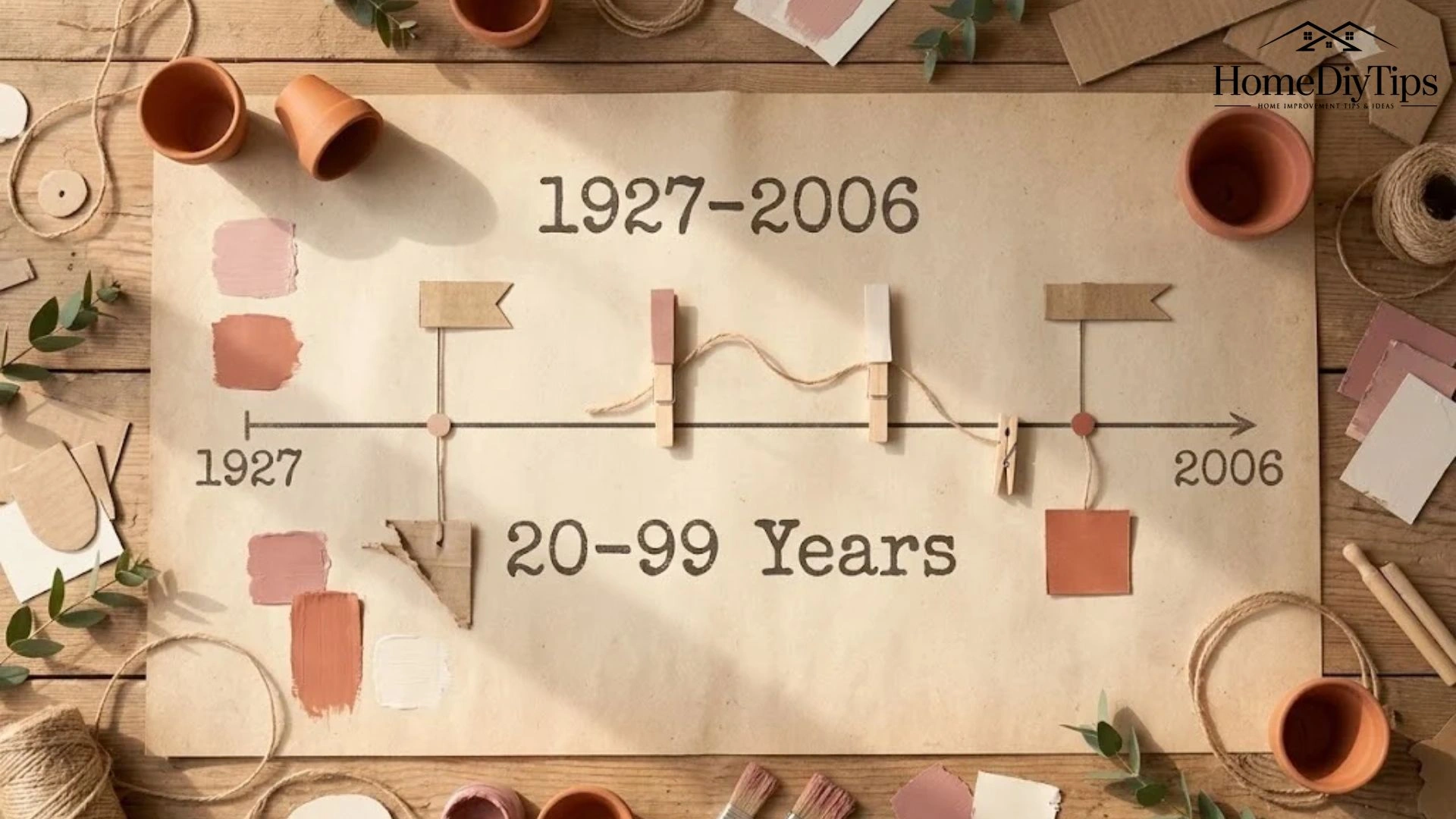
If you’re wondering what year is vintage, the answer depends on the item’s age and the category it belongs to. In 2026, items made from roughly 1927 through 2006 fall within the commonly used vintage age range of 20 to 99 years.
However, this is a general guideline, not a universal rule. Furniture collectors, clothing sellers, and other specialists may use different definitions. A new chair with a 1970s-inspired design can look vintage without being an original vintage piece.
Understanding these differences can help you shop for furniture, decorate your home, identify older belongings, and avoid paying extra for an item simply because a seller calls it vintage.
Direct Answer
In 2026, vintage commonly describes items made about 20–99 years ago—roughly 1927–2006. Definitions vary by category, and age alone does not prove authenticity or value.
Experience
Before buying vintage furniture or decor, ask for the production date and inspect labels, construction, and condition. A vintage appearance alone cannot confirm an item’s age, so seek specialist advice for expensive or potentially rare pieces.
What Year Is Vintage in 2026?
The common definition of vintage covers items that are at least 20 years old but less than 100 years old. Using 2026 as the reference year, that gives an approximate range of 1927 through 2006.
The exact cutoff can vary. An item made in late 2006, for example, may not have reached its 20th anniversary until later in 2026. Its actual production date matters more than the year alone.
Here is a simple guide to the years.
| Production year | Age during 2026 | General classification |
| 1920 | About 106 years | Usually antique by age |
| 1930 | About 96 years | Vintage |
| 1940 | About 86 years | Vintage |
| 1950 | About 76 years | Vintage |
| 1960 | About 66 years | Vintage |
| 1970 | About 56 years | Vintage |
| 1980 | About 46 years | Vintage |
| 1990 | About 36 years | Vintage |
| 2000 | About 26 years | Vintage |
| 2006 | About 20 years | Vintage under the common convention |
| 2010 | About 16 years | Usually too recent under the common convention |
| 2020 | About 6 years | Modern, not vintage by age |
These categories describe common usage. A particular collecting market may use a narrower definition, especially for clothing, cars, watches, and other specialized items.
Practical example: Suppose you find a wooden dresser made in 1985. It is about 41 years old in 2026, so it fits the common vintage age range. Whether it is valuable depends on its maker, materials, condition, design, and buyer demand.
How Old Does Something Have to Be to Be Vintage?
In everyday use, an item generally needs to be around 20 years old to qualify as vintage. Many collectors also look for a connection to a recognizable period, such as mid-century design or the styles of the 1980s and 1990s.
The word does not have one fixed meaning across every market. Some sellers use narrower age limits, while others focus more on an item’s design history and cultural importance.
What does “true vintage” mean?
You may see sellers use the phrase true vintage for items that are considerably older than 20 years. In some fashion and collecting markets, that can mean 40 or 50 years old, or older.
In 2026, that narrower interpretation might include items from the 1970s or earlier. However, it is not a universal standard.
When buying an older item, ask what the seller means by vintage. A clear production date and supporting evidence are more useful than an undefined label.
Does the vintage year range change every year?
Yes. If you use the common 20-year threshold, the earliest qualifying production year moves forward as time passes.
For example, an item made in 2007 reaches its 20th anniversary in 2027. Under the common convention, it may then qualify as vintage by age.
The same principle applies to older items approaching the 100-year mark. An item made in 1927 reaches its 100th anniversary in 2027. It may then be considered an antique under the common age convention, although its exact production date and the definition used still matter.
Vintage vs. Antique vs. Retro vs. Secondhand
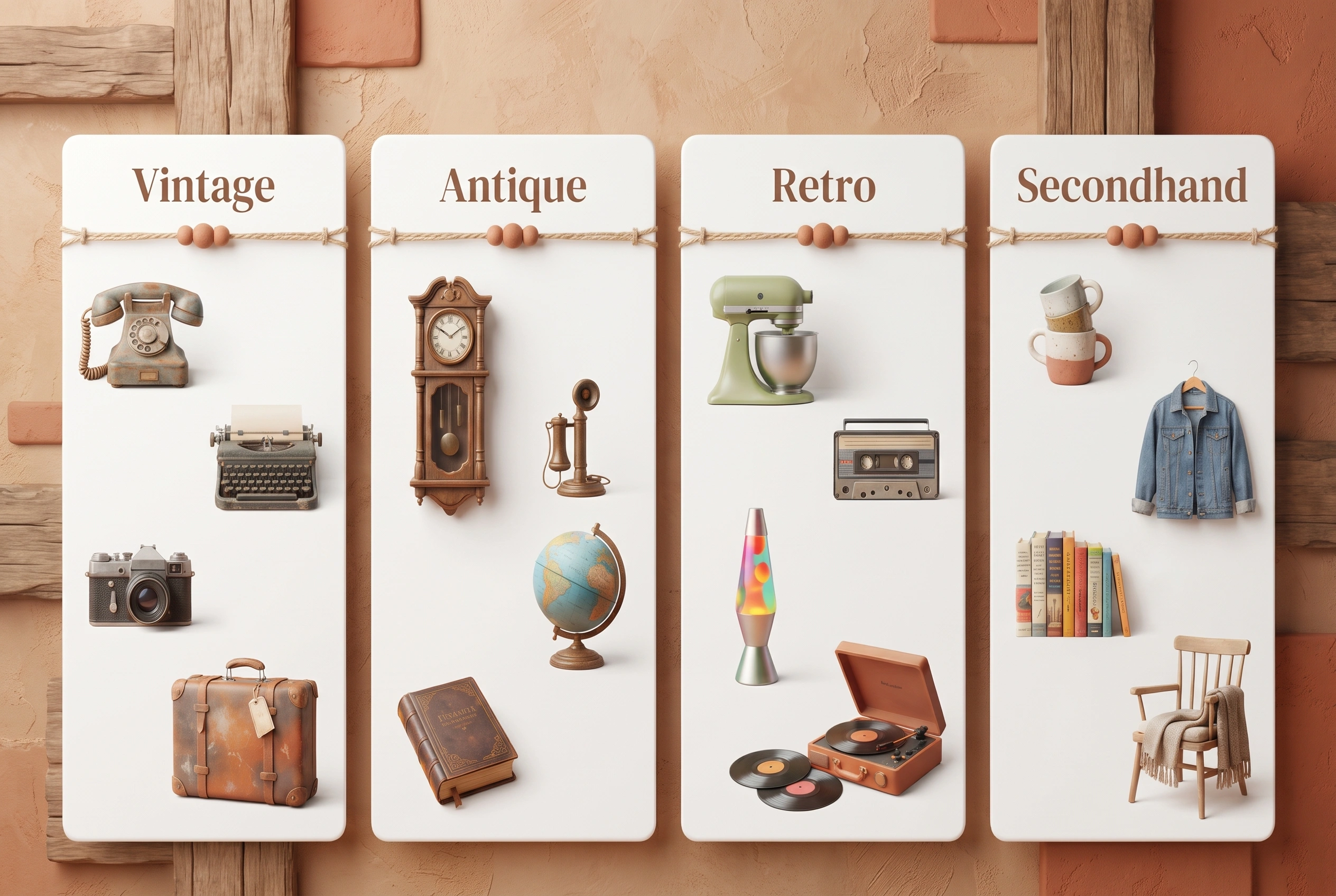
These four terms describe different things. Understanding the difference helps you choose furniture and decor that match your taste, budget, and expectations.
| Term | Common meaning | Example |
| Vintage | An older item, commonly 20–99 years old | A dresser made in 1985 |
| Antique | An item generally at least 100 years old | A table made in 1910 |
| Retro | A newer item that copies or recalls an older style | A new lamp with a 1970s-inspired design |
| Secondhand | An item previously owned or used by someone else | A five-year-old sofa sold by its first owner |
These definitions are general conventions rather than universal rules. The age, design, and market in which an item is sold can affect how people describe it. The Homes and Antiques guide to vintage and antique items explains the commonly used age distinction and why retro products are different.
Vintage vs. antique
The main difference is age. Vintage usually describes items from a more recent period, while antique generally refers to items that are at least 100 years old.
For example, a dresser made in 1970 is vintage in 2026. A dresser made in 1910 generally qualifies as an antique.
Neither term automatically tells you how much an item is worth. A vintage chair from a well-known designer may sell for more than an antique chair that is common, damaged, or difficult to use.
Vintage vs. retro
Vintage usually refers to an older item from the period it represents. Retro describes a style inspired by the past and often appears in newly manufactured products.
Imagine you want a living room with a 1960s look. You could buy an original vintage coffee table from that decade or a new table designed to resemble 1960s furniture.
The original may have more historical character, but it could need repairs or special care. The new version may be easier to maintain and fit your budget better.
Vintage vs. secondhand
Secondhand means an item has had a previous owner. It does not tell you how old the item is.
A used sofa purchased three years ago is secondhand, but it would not normally qualify as vintage by the common age rule. An original chair from 1980 can be both vintage and secondhand.
This distinction matters when shopping online. Check the production date separately from the item’s ownership history.
What Counts as Vintage Furniture and Home Decor?
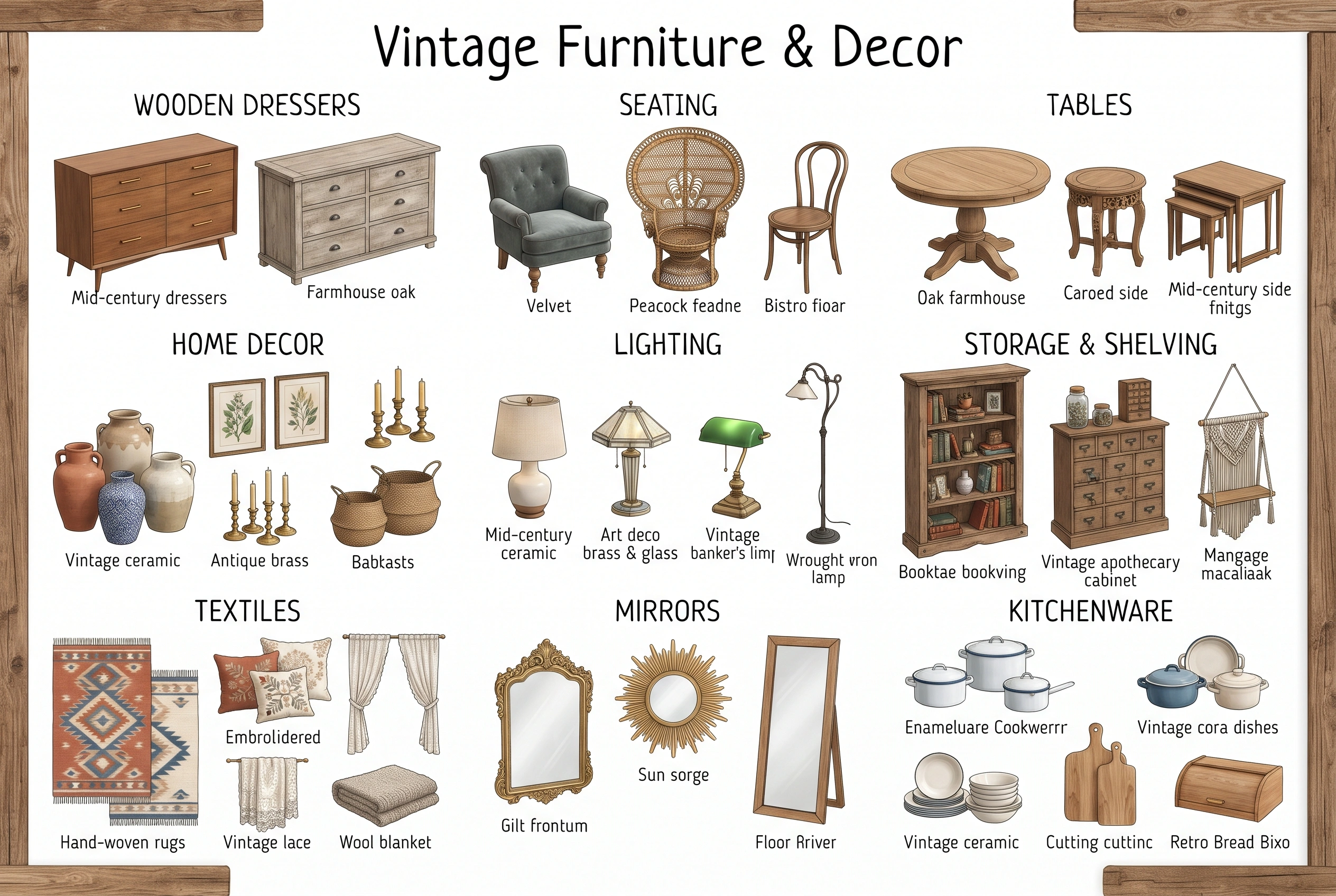
Vintage furniture and decor generally include older pieces that reflect the materials, shapes, and design choices of their time. They can add character to a home without requiring every room to follow one historical style.
The important point is that a vintage look does not prove an item’s age. Furniture styles can remain popular for decades, and manufacturers often produce modern versions of older designs.
Vintage furniture
Common examples of vintage furniture include:
- Wooden dressers and sideboards from the 1960s through the 1990s.
- Mid-century-style tables and chairs made during their original production period.
- Older cabinets, desks, bookshelves, and bedside tables.
- Original furniture with distinctive hardware, finishes, or construction details from its era.
When choosing vintage furniture, consider how you will use it. A dresser for everyday clothing storage needs sturdy drawers and smooth movement. A vintage dining chair needs a stable frame and secure joints, especially if people will use it daily.
Also measure the piece before buying. An older cabinet may have a different depth or height from modern furniture, so check that it fits your room and can pass through doorways and stairwells.
Vintage home decor
Vintage home decor can include:
- Table lamps and decorative lighting.
- Framed artwork and mirrors.
- Ceramic vases, bowls, and serving dishes.
- Rugs, curtains, and decorative textiles.
- Clocks, picture frames, and small decorative objects.
These pieces can help a room feel collected rather than purchased all at once. For example, a modern living room can include an original vintage mirror, a secondhand wooden table, and a new sofa.
Before buying, check the item’s condition and intended use. Inspect mirrors for damage, rugs for wear and odors, and ceramics for cracks or repairs. For an older lamp, check the cord, plug, and other electrical parts before using it. Have questionable wiring assessed by a qualified electrician.
A decorative object does not need to be expensive or rare to suit your home. Choose pieces that fit your space, work with your existing furniture, and are practical to care for.
What Year Is Vintage Clothing?
Vintage clothing is commonly associated with garments made at least 20 years ago. Under that broad convention, clothing from the 1990s and early 2000s can qualify as vintage in 2026.
However, fashion sellers and collectors sometimes use narrower definitions. Some focus on garments from earlier decades, while others emphasize designer history, cultural importance, or distinctive construction.
To estimate a garment’s age, check several details together:
- Labels: Brand names, logo designs, and label formats can help narrow down the production period.
- Zippers and fasteners: Their design and construction may offer useful clues.
- Stitching and fabric: Materials, seams, and finishing methods can help identify an era.
- Care labels: Label formats and wording may help establish a date range.
- Provenance: This means the item’s documented history, such as receipts, original packaging, or information from a previous owner.
No single detail proves that a garment is vintage. Manufacturers sometimes reuse designs, and modern reproductions can imitate older labels and construction methods.
How to Tell Whether an Item Is Truly Vintage
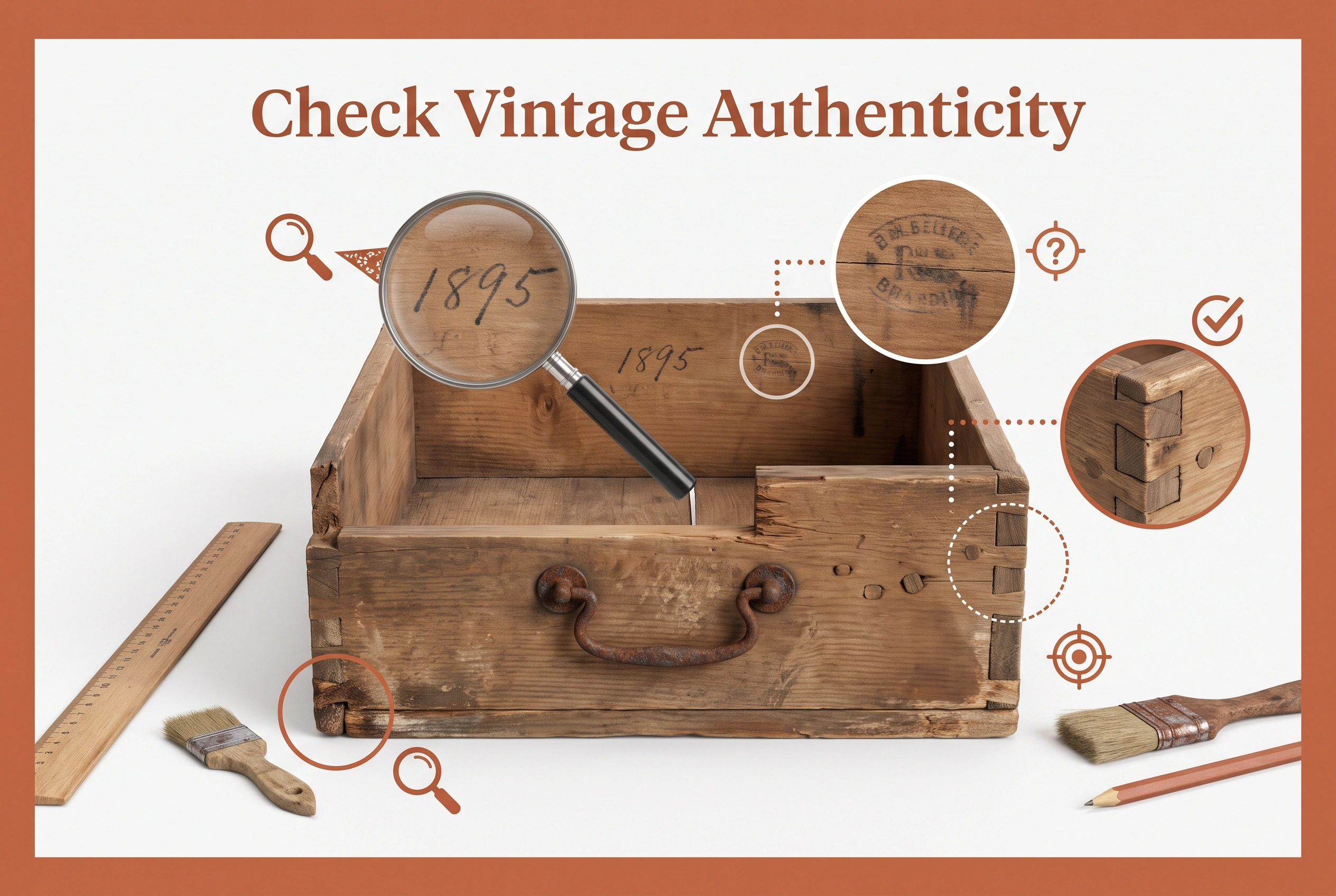
You do not need to be an antiques expert to make a useful first assessment. Start with information that is easy to check, then investigate further if the item is expensive or described as a rare collectible.
1. Ask for the production date
Ask the seller when the item was made and how they know.
A specific year is more useful than a description such as “very old” or “classic vintage.” If the seller has an original receipt, dated catalog, or reliable manufacturer information, those details may help support the claim.
Remember that a brand’s founding date is not the same as an item’s production date. A company established in 1950 may still manufacture products today.
2. Look for maker’s marks and labels
A maker’s mark is a name, symbol, stamp, or label that identifies a manufacturer or craftsman.
For furniture, check the underside, the back panel, inside drawers, or the bottom of the piece. For ceramics, inspect the base. For textiles, look for labels or tags.
Record the name and any model or serial number. Compare these details with reliable manufacturer records, museum collections, or specialist references.
A mark can help narrow down an item’s age, but it is not conclusive proof. Some marks have been copied, and many genuine older objects have no identifying mark at all.
3. Examine the construction
Materials and construction methods can provide additional clues.
For example, a wooden dresser may have drawer joints, hardware, and finishes associated with a particular production period. But older designs are often copied, so one feature should not determine your conclusion.
4. Check wear and repairs
Look at areas that would naturally receive use. On a frequently used chair, the seat and armrests may show more wear than the underside. A drawer may have wear along its runners.
Be cautious if an item appears heavily worn everywhere but has unusually new-looking details in other places. Such differences can have innocent explanations, including restoration or replacement parts, but they deserve a closer look.
Do not assume that damage proves age. Modern products can be distressed to look old, and genuine vintage items may have been carefully restored.
5. Decide whether expert help is worthwhile
For an inexpensive decorative item, your own research may be enough to decide whether you like it and whether the price seems reasonable.
For a costly piece advertised as rare, signed, or historically important, consider a qualified appraiser or specialist dealer. Ask what evidence supports the identification and whether the assessment covers both authenticity and value.
The goal is not to prove the exact year of every object. It is to gather enough reliable information to make a sensible buying decision.
Does Vintage Mean Valuable?
No. Vintage describes an item’s age or place in a design period; it does not guarantee a high resale price.
Some vintage furniture is desirable because of its maker, distinctive design, materials, or limited availability. Other pieces are common, heavily damaged, difficult to transport, or expensive to restore.
Several factors can affect value:
- Authenticity: Is the item original, or is it a later reproduction?
- Condition: Does it work as intended? Are there cracks, missing parts, or major repairs?
- Rarity: Are comparable pieces difficult to find?
- Maker and design: Does the item have a recognized maker or a sought-after design?
- Demand: Are buyers currently interested in this type of item?
- Practical costs: Will transportation, restoration, or specialist care add substantial expense?
Suppose you find a vintage dining table at a local sale. The table fits your room, but its finish is damaged and one leg is unstable. Its age may make it interesting, but the repair work could make it a poor purchase for your budget.
Before buying, compare similar items that have actually sold, rather than relying only on sellers’ asking prices. If you want the table for your own home, consider its usefulness and appearance as well as its possible resale value.
Common Mistakes When Identifying Vintage Items
A few simple mistakes can lead to confusion or unnecessary spending.
Assuming every item over 20 years old is automatically vintage. The age rule is a useful starting point, but category-specific conventions and the item’s historical context also matter.
Confusing retro style with original vintage. A new lamp inspired by the 1970s may suit your decor perfectly, but its design does not make it an original item from that decade.
Treating secondhand as a synonym for vintage. An item can be used and relatively new. Check its production date separately.
Assuming old means valuable. Age alone does not establish rarity, quality, or demand. Look at condition and comparable sales.
Trusting appearance without checking evidence. Distressed paint, faded labels, and aged finishes can be created deliberately. Look for several clues that agree with one another.
Ignoring the item’s intended use. A vintage chair may look attractive but need repairs before it is safe for everyday use. A vintage lamp may need electrical inspection before use. Factor those needs into your decision.
Frequently Asked Questions About Vintage Years
Is 20 years considered vintage?
Generally, yes. The common convention treats items at least 20 years old but less than 100 years old as vintage. However, definitions differ among fashion, furniture, and collectible markets, so age alone may not settle every classification.
Is the 2000s considered vintage now?
Yes, some items made in the early 2000s qualify under the common 20-year convention in 2026. Items made in 2006 reach their 20th anniversary during 2026, depending on their production date. Items from later years may not qualify yet.
How old is vintage versus retro?
Vintage commonly describes an older item, often 20–99 years old. Retro usually describes a product that recalls an earlier style and is often newly made. An original 1980s chair can be vintage, while a new chair inspired by the 1980s can be retro.
Is something from the 1960s vintage or antique?
An item made in the 1960s is generally vintage in 2026 because it is roughly 57–66 years old. It would not normally be considered an antique under the common 100-year rule.
How can you tell whether vintage furniture is genuinely old?
Start with the production date, maker’s marks, labels, hardware, and construction. Compare several clues with reliable references rather than trusting appearance alone. For an expensive or rare piece, a qualified specialist can help assess its authenticity and value.
How to Use the Vintage Definition When Shopping
When shopping for vintage furniture or home decor, start with the item’s approximate age, but do not stop there. Check its condition, look for evidence of its history, and decide whether it suits your home and budget.
The common 20-to-99-year range is a helpful starting point in 2026, not a guarantee of authenticity or value. Once you understand the difference between vintage, antique, retro, and secondhand, you can compare items more confidently and choose pieces for the reasons that matter to you.
Disclaimer
This article provides general information; definitions, home conditions, budgets, and individual needs vary. For concerns involving structural safety, electrical systems, or significant repairs, consult a qualified professional when appropriate.