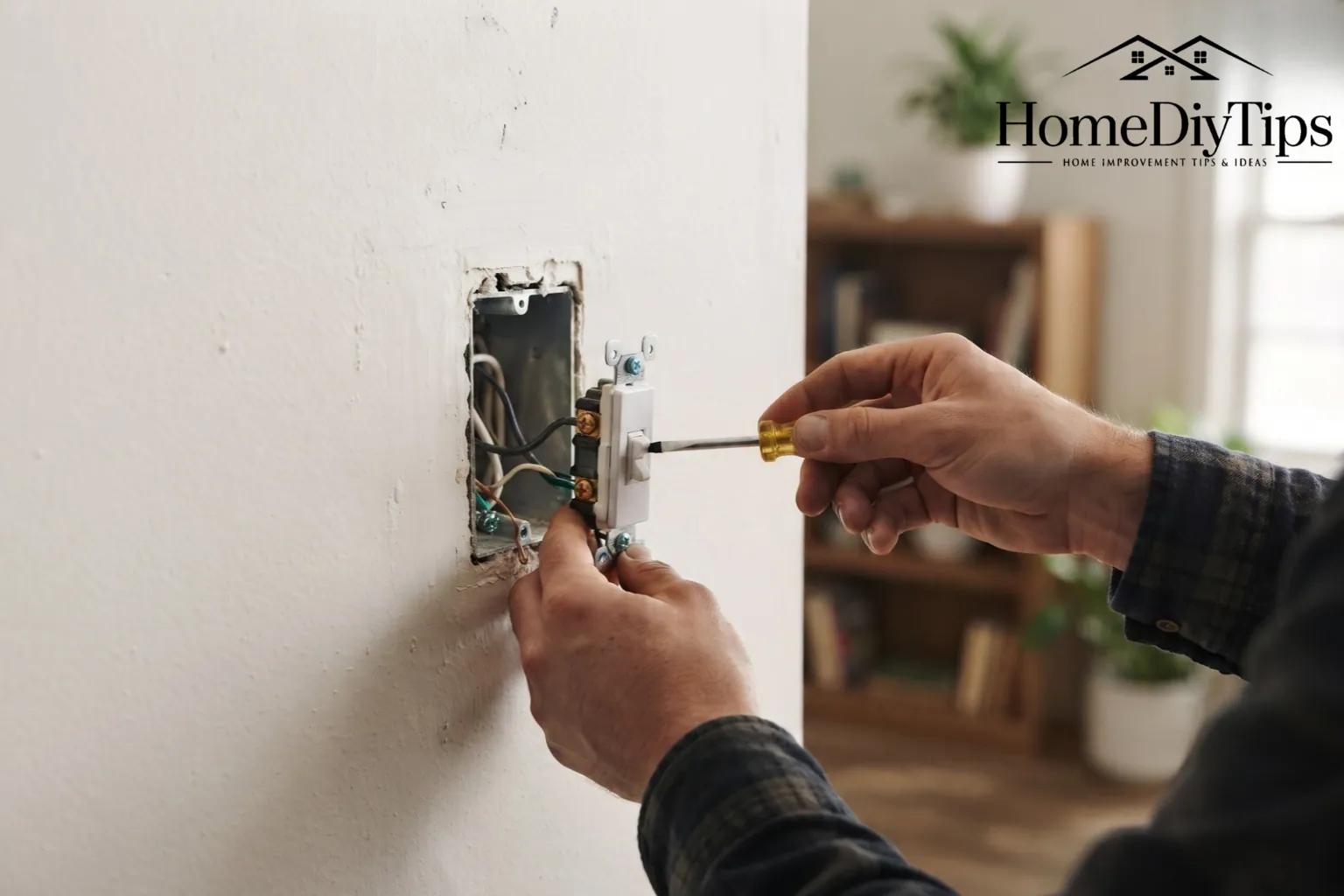
A single pole light switch is a common household switch that turns a light or another compatible electrical load on and off from one location. You will often find one beside a bedroom door, near a bathroom entrance, or next to a kitchen light.
The main difference between a single pole switch and other switch types is how the light is controlled. A single pole switch controls the load from one location, while a standard 3-way arrangement lets you control the same light from two locations. A double pole switch controls two electrical paths together, which serves a different purpose.
Understanding these differences can help you identify the right switch, understand a basic wiring diagram, and avoid buying an incompatible replacement. Before touching any wiring, turn off the correct circuit breaker and verify that the power is off with a suitable tester. If the wiring is unfamiliar or you cannot safely identify it, contact a qualified electrician.
Direct Answer
A single pole light switch turns a light or compatible electrical load on and off from one location by opening or closing one switched electrical path. It differs from 3-way and double pole switches.
Practical Home Tip
Before choosing a replacement switch, check how many locations control the light and read the new switch’s wiring instructions. If the existing wires do not match the diagram, stop and contact a qualified electrician rather than guessing.
What Is a Single Pole Light Switch?
A single pole light switch is a mechanical electrical switch that opens or closes one switched electrical path. In a typical US home, it controls a light fixture from a single wall-switch location.
For example, suppose you have a ceiling light in your bedroom with one wall switch beside the entrance. If that switch is the only control for the light, the arrangement is usually a single pole setup.
According to Leviton’s single pole switch guide, this type of switch controls lights or other loads from one location.
Common single pole switch styles include:
- Toggle switches: Traditional switches with a small lever that moves up or down.
- Rocker switches: Wider switches that you press on one side or the other.
- Decorator-style switches: Flat, rectangular switches with a larger paddle.
- Some dimmer switches: Models designed to adjust brightness from one location rather than simply turn the light on and off.
These styles can look different while serving the same basic switching function.
A single pole switch does not necessarily control just one bulb. One switch can control a fixture containing several bulbs or a group of lights wired to operate together, provided the circuit and switch are properly rated.
It can also control other compatible loads, such as a ceiling fan’s on/off function. A fan that needs speed control may require a suitable fan control instead of an ordinary light switch.
How Does a Single Pole Light Switch Work?
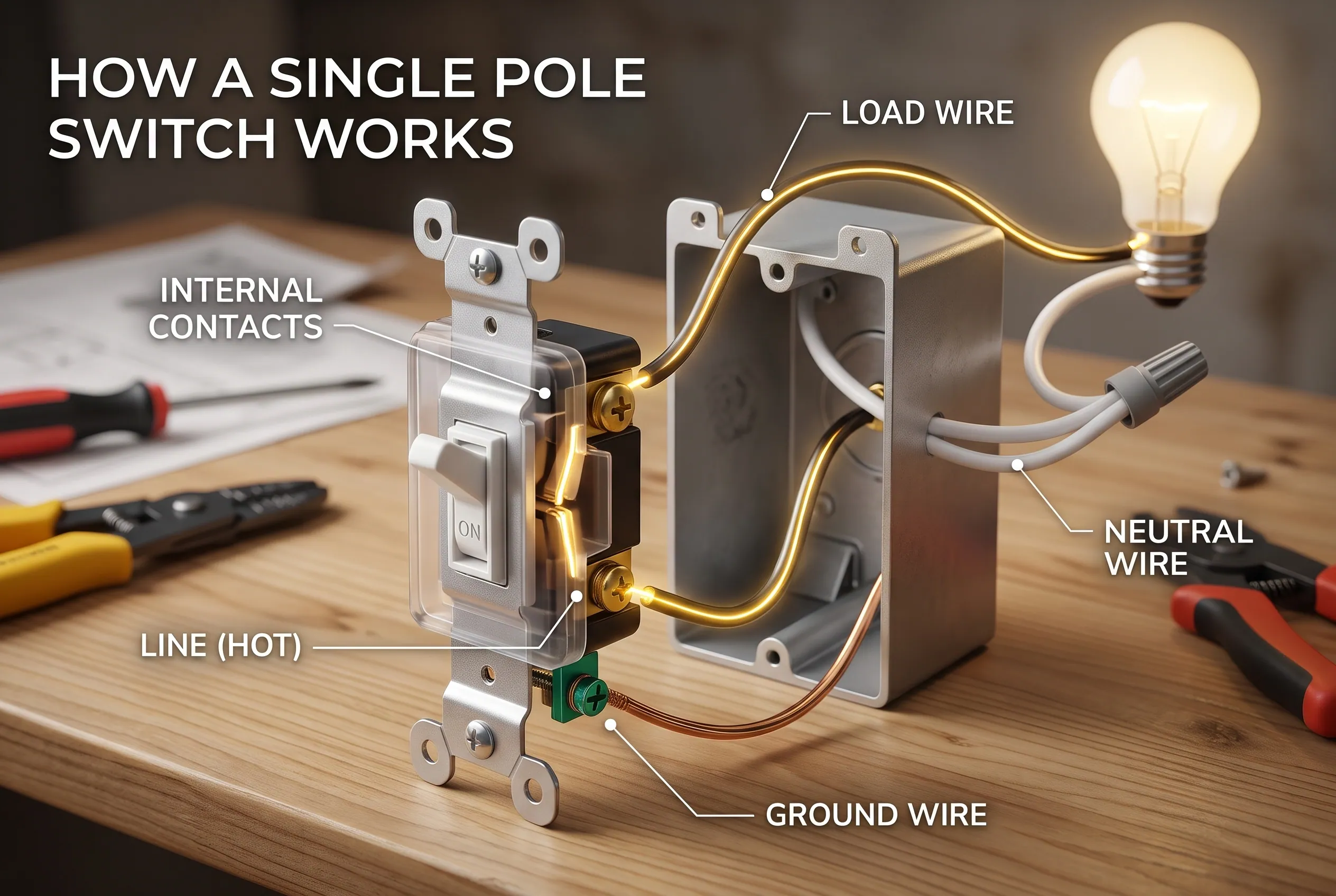
A single pole switch controls electricity by opening or closing a circuit. A circuit is the complete path that allows electric current to flow through a device and return to its source.
When the switch is on, its internal contacts close. Current can flow through the switched path to the light, allowing it to operate.
When the switch is off, its contacts open. This interrupts the switched path, and the light turns off.
Here are four electrical terms that help explain the process.
- Hot or line wire: Carries power from the electrical supply toward the switch. Line is a common term for the incoming supply conductor.
- Load or switched-hot wire: Carries power from the switch toward the light or other controlled device when the switch is on.
- Neutral wire: Provides the normal return path for current in a typical US household lighting circuit.
- Ground wire: Provides a protective path for fault current under applicable conditions. It is not intended to carry normal operating current.
The hot wire is the conductor interrupted by a conventional single pole lighting switch. The neutral normally connects to the light rather than to a basic mechanical switch, although the wiring inside the electrical box can vary.
Grounding is equally important. It helps protect people if a fault makes an exposed metal part energized.
One key point is that turning a wall switch off does not make every wire inside its electrical box safe to touch. Other conductors in the box may still carry power, and incorrect wiring can create unexpected conditions.
Where Are Single Pole Light Switches Commonly Used?
Single pole switches work well wherever you need to control a compatible light or load from one location.
Bedroom and living room lights
A wall switch beside the entrance can control a ceiling light or a group of lights that operate together. This is a typical use because you can turn the lights on as you enter and off as you leave.
Bathroom lights
A bathroom light controlled by one wall switch is another common example. Some bathrooms have separate switches for the main light, exhaust fan, or vanity lighting. Each may serve an individual load or function.
Hallway and utility room lights
A short hallway, laundry room, pantry, or utility room may have one switch at its entrance. If the same light is not controlled from another location, a single pole switch may be appropriate.
Longer hallways with switches at both ends usually need a different switching arrangement.
Outdoor lights
A porch light or other outdoor fixture may use a single pole switch inside the home. The switch and associated equipment must be suitable for the electrical load and installation.
Switched outlets
In some rooms, a switch controls a compatible electrical outlet rather than a hardwired light fixture. For example, it may control a lamp plugged into the outlet.
This arrangement is different from an outlet that remains powered at all times. The correct switch type depends on how the outlet circuit was designed.
For each application, check the device’s voltage and current ratings, the type of load, and the manufacturer’s instructions. Do not assume that every wall switch can safely control every light, fan, or outlet.
How Can You Identify a Single Pole Light Switch?
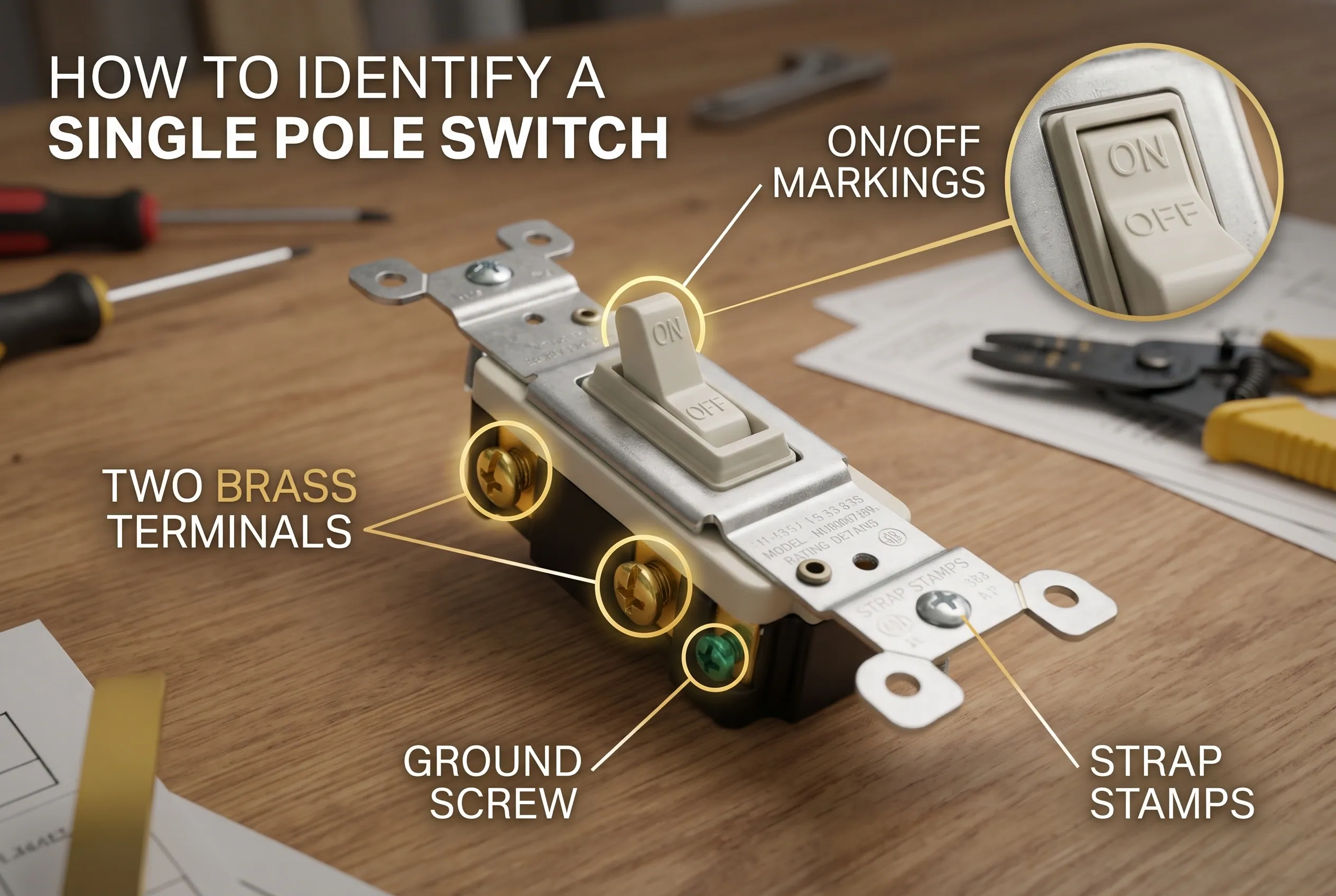
You can often identify a single pole switch by checking how the light operates and looking at the switch’s markings. However, the appearance of the wall plate or toggle alone is not enough to confirm the type.
Use these clues together.
1. Check how many locations control the light
This is the most useful everyday clue.
If one wall switch is the only control for a particular light, it is likely a single pole setup. If two switches in different locations control the same light, the arrangement is usually a 3-way circuit in US residential wiring.
Do not count only the switches in a room. The important question is whether another switch controls the same light.
2. Look at the switch type and markings
A conventional mechanical single pole switch commonly has two main switching terminals, often brass screw terminals, plus a green grounding screw or another grounding connection.
Some models use push-in wire connections or a different terminal layout. Dimmers and electronic switches can have additional connections.
Look for the model number, wiring diagram, and any labels such as line, load, or ground. These details are more useful than the switch’s exterior style.
3. Understand what terminal counts can and cannot tell you
A conventional single pole switch commonly has two switching terminals. A traditional 3-way switch usually has three main switching terminals: one common terminal and two traveler terminals, as well as a grounding connection.
However, counting terminals is only a clue. An electronic switch, dimmer, illuminated switch, or combination device may have a different arrangement.
Never assume that a switch is a single pole just because it has two visible wires. A proper identification also considers the circuit’s function and the manufacturer’s markings.
4. Check the replacement instructions
If you plan to replace the switch, identify the exact replacement model and read its instructions before doing any work.
A replacement must match the intended switching arrangement, load, and electrical ratings. Smart switches and some dimmers also have specific wiring requirements.
If the existing wiring does not match the new product’s diagram, stop rather than guessing.
What Is a Single Pole Light Switch Wiring Diagram?
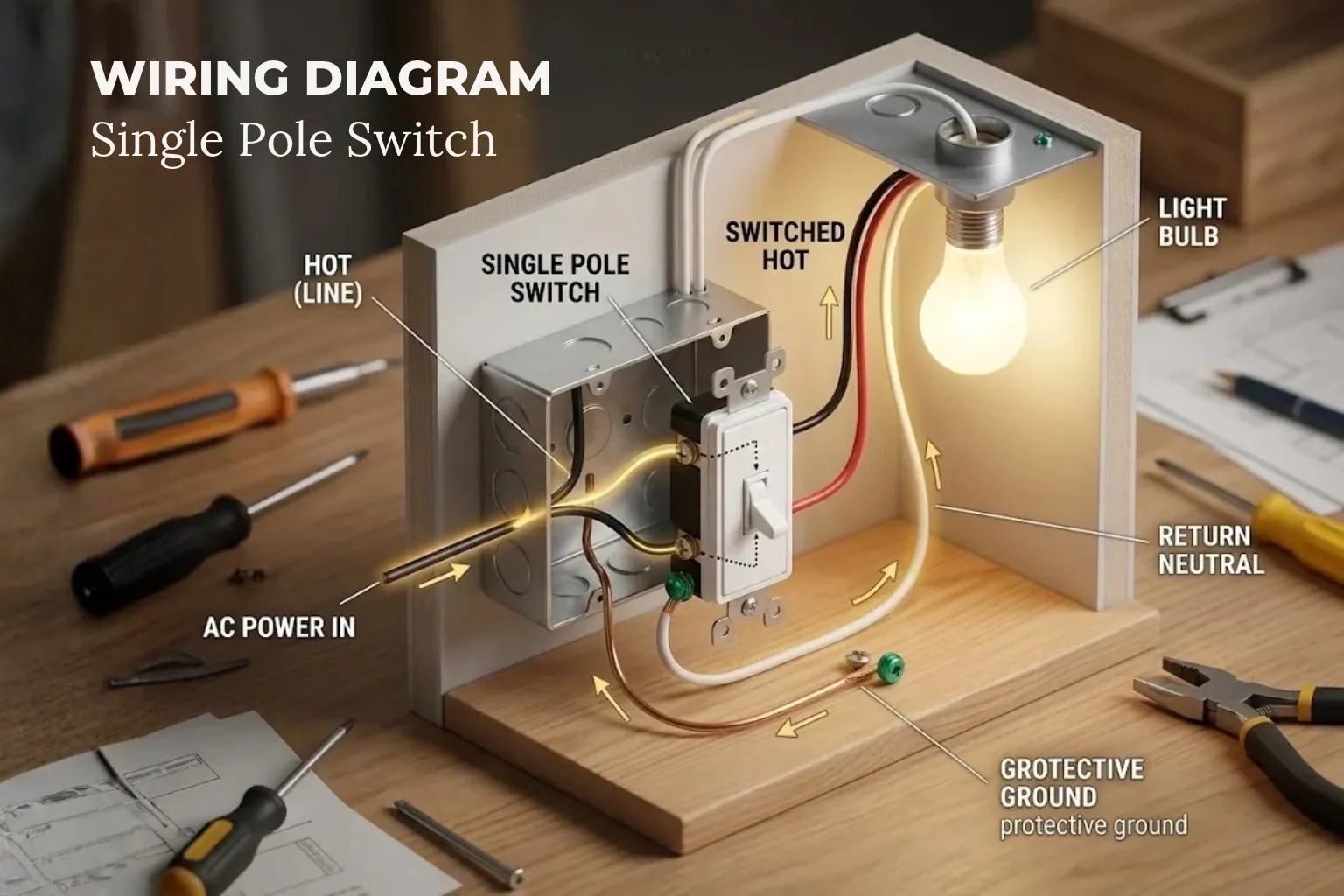
A single pole light switch wiring diagram shows how a conventional switch interrupts the hot conductor supplying a light. A simple conceptual diagram looks like this:
SIMPLIFIED LIGHTING CIRCUIT
Supply hot (line)
|
v
[Single pole switch]
|
| Switched hot
v
[Light fixture]
|
v
Supply neutral
Grounding conductors connect to the
required grounding points and equipment.
This is a functional illustration, not a universal installation diagram. It shows the basic path, but it does not show every connection inside a real electrical box.
In a typical arrangement, the incoming hot conductor connects through the switch to the switched-hot conductor going to the light. The neutral returns from the light to the supply neutral. Grounding connections provide the required electrical protection.
The diagram helps explain why the switch does not usually need a neutral connection for its basic mechanical operation. It opens or closes the hot path rather than switching the neutral.
What happens when the switch is on?
The switch contacts close, allowing current to flow through the switched-hot conductor to the light. The current returns through the circuit’s neutral path, and the light operates.
What happens when the switch is off?
The switch contacts open, interrupting the hot path to the light. Under normal conditions, the light turns off.
Why should you not copy a generic diagram blindly?
Actual household wiring may differ based on the circuit layout, age of the installation, previous repairs, and device type. Some boxes contain several circuits or additional connections. Smart switches and dimmers may also use different terminal labels.
Wire colors alone cannot reliably establish a conductor’s function, especially in older or altered wiring.
Before any wiring work, The Home Depot’s light-switch guide provides a useful overview of the importance of turning off power and testing conductors. This general information does not replace the exact instructions for your switch.
Single Pole vs. 3-Way Switch: What Is the Difference?
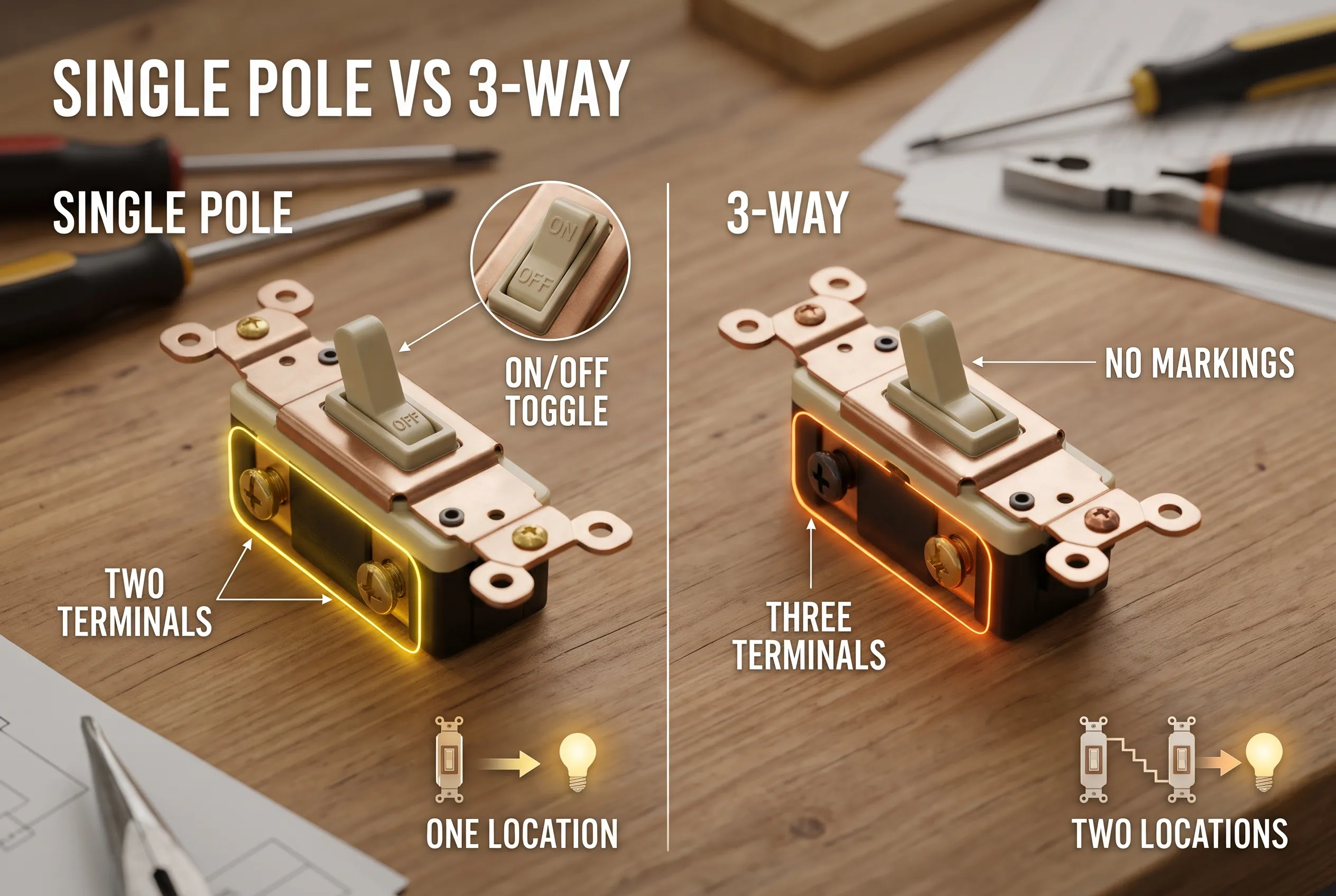
The main difference between a single pole and a 3-way switch is the number of locations that can control the same light.
| Feature | Single pole switch | 3-way switch |
| Typical control locations | One | Two, using a pair of 3-way switches |
| Common use | Bedroom light controlled from one entrance | Staircase light controlled from both ends |
| Typical switching terminals | Two main switching terminals | One common terminal and two traveler terminals |
| Typical markings | Often marked ON and OFF | Usually no fixed ON/OFF position |
| Main purpose | Simple on/off control from one location | Control the same light from two locations |
According to Leviton’s 3-way switch explanation, a standard US 3-way arrangement uses two 3-way switches to control a light from separate locations.
Imagine a staircase with a switch at the bottom and another at the top. You can turn on the light at the bottom, climb the stairs, and turn it off at the top. Either switch can change the light’s state.
A single pole switch is suitable when only one location controls that light. If you want control from two locations, a standard single pole switch by itself will not provide the same function.
A 3-way arrangement also has different wiring connections. Its common and traveler terminals must be used according to the circuit design and device instructions.
The practical rule: Choose the switch configuration based on how many locations need to control the light, not simply on how the switch looks.
Single Pole vs. Double Pole Switch: What Is the Difference?
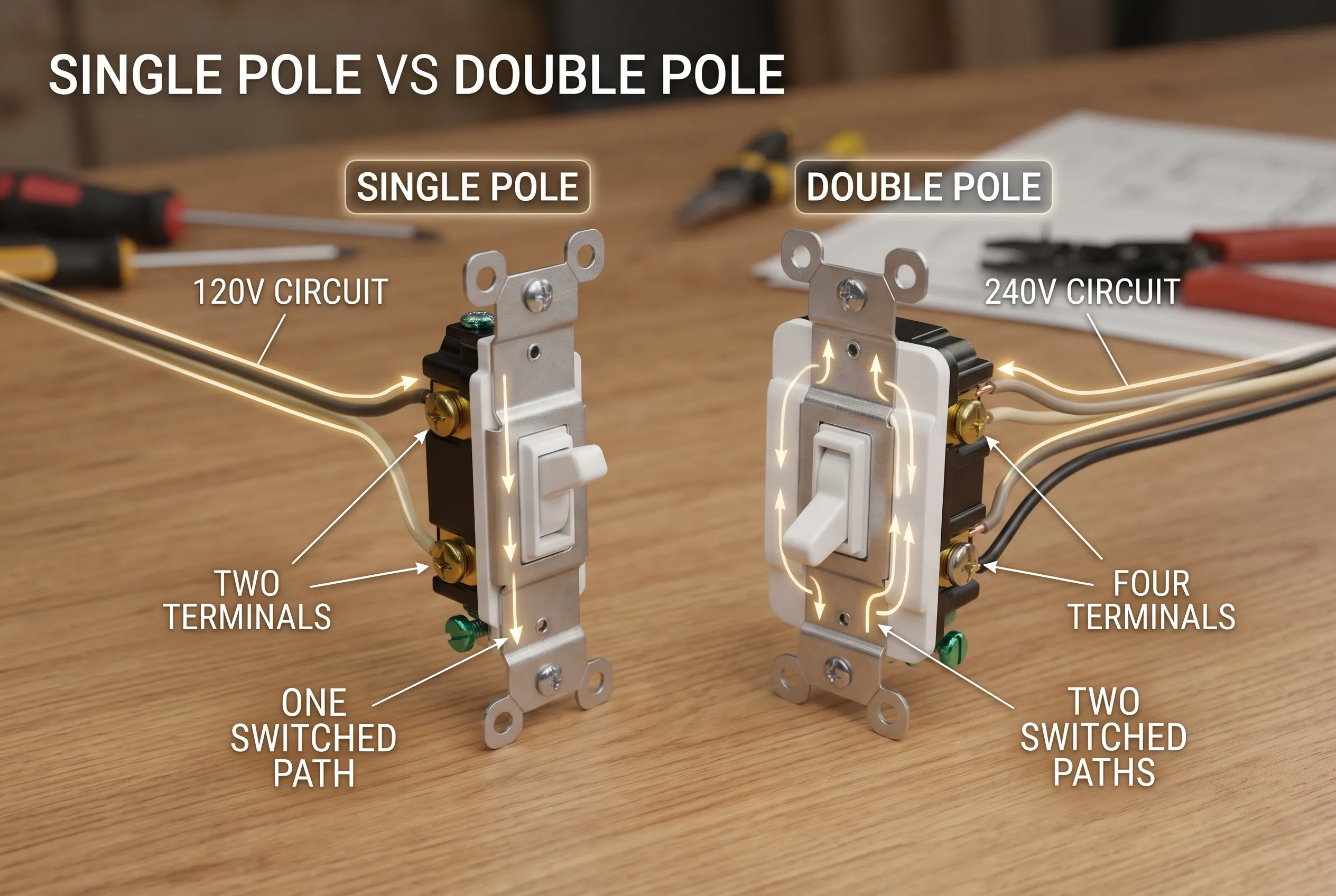
A single pole switch operates one switched electrical path, while a double pole switch operates two electrical paths or conductors together. They serve different purposes, so one is not automatically a replacement for the other.
| Feature | Single pole switch | Double pole switch |
| Switching function | Controls one switched path | Switches two conductors together |
| Common household role | Ordinary light controlled from one location | Certain applications that require two conductors to be switched |
| Typical light-switch use | Common for standard household lighting | Used when the circuit and device design call for double-pole switching |
| Selection factors | Load, voltage, current rating, and control arrangement | Load, voltage, current rating, and required switching or disconnect function |
In typical US homes, a single pole switch commonly controls a light on a 120-volt circuit by interrupting the hot conductor. Some residential equipment operates on 240 volts and uses a suitable double-pole device to switch both hot conductors.
The exact requirements depend on the equipment, circuit design, device rating, and applicable electrical rules. A double pole switch should not be chosen just because an appliance seems more powerful or has a different plug.
It is also important to distinguish a double pole switch from a 3-way switch. A double pole switch changes two electrical paths together. A 3-way switch is part of an arrangement that lets one light be controlled from two locations.
These descriptions refer to different features.
- Single pole versus double pole describes the switching paths or conductors the device operates.
- Single-location versus two-location control describes how many places can operate the same light.
A double pole switch does not automatically provide two-location lighting control, and a 3-way switch is not simply a double pole switch.
For general product selection, Leviton’s residential switch overview separates one-location, two-location, and multi-location lighting control. Always check the exact device specifications when selecting a replacement.
What Does Single Pole, Double Throw Mean?
“Single pole, double throw” describes a different type of switch, often shortened to SPDT.
To understand the name, think of the two parts separately:
- Pole: The electrical path or set of contacts the switch operates.
- Throw: The number of alternative connections that the pole can select.
A single pole, single throw switch, or SPST, is a common on/off switch. It connects or disconnects one switched path.
A single pole, double throw switch, or SPDT, can connect a common terminal to one of two alternative terminals. This gives it a different function from a basic on/off switch.
These terms appear in electronics, equipment controls, and product specifications. They are useful to recognize, but most homeowners do not need to learn the full range of switch designs to identify an ordinary wall light switch.
For a technical explanation, TE Connectivity’s switch terminology reference explains poles and throws and how they describe switch configurations.
Do Smart Light Switches Need a Neutral Wire?
Some smart light switches require a neutral wire, while other models are designed to work without one. The answer depends on the particular device, so do not assume that every smart switch has the same wiring requirements.
A traditional mechanical light switch generally opens or closes the hot conductor and does not need a neutral connection for that basic function. A smart switch contains electronic parts that may need a small amount of power even when the light is off.
Some products obtain that power through a neutral connection. Others use a different design. Their compatibility depends on the product’s instructions and the existing wiring.
For example, the Wyze Switch installation guide, updated in May 2026, states that the specified switch requires both a single pole setup and a neutral wire. That requirement applies to that product, not all smart switches.
Before buying a smart switch, check these points:
- Control arrangement: Does one switch control the light, or do multiple switches control it?
- Neutral requirement: Does the exact model require a neutral wire?
- Load compatibility: Is the switch rated for your light or other device?
- Product instructions: Does the manufacturer support your existing wiring arrangement?
Do not rely on the age of the house, the number of visible wires, or the switch’s appearance to confirm compatibility. If you cannot identify the wiring safely, ask a qualified electrician to assess it.
Common Mistakes and Safety Checks
Identifying a single pole switch is often simple. Working on electrical wiring is a different matter. These common mistakes are worth avoiding.
Assuming wire colors always identify their function
Wire colors provide useful clues, but they are not enough to confirm a conductor’s purpose in every existing installation. Older wiring, past repairs, and different circuit layouts can create exceptions.
Do not connect wires based only on color. Use the device instructions and appropriate testing methods, and seek qualified help when the wiring is unclear.
Confusing neutral and ground
Neutral and ground serve different roles. Neutral is part of the normal operating circuit, while ground provides a protective path under fault conditions.
They are not interchangeable. Do not use a grounding conductor as a substitute for a required neutral connection.
Assuming every switch has the same terminals
A conventional single pole switch commonly has two switching terminals. A dimmer, smart switch, illuminated switch, or combination device may have different connections.
Read the exact model’s instructions rather than applying a diagram for another product.
Forgetting to verify that power is off
Safety warning: Do not touch or disconnect conductors until the circuit has been de-energized and the absence of voltage verified.
If you are qualified and equipped to do electrical work, turn off the correct breaker and verify the wires with a suitable tester before touching them. Turning off the wall switch alone is not sufficient.
If you cannot identify the correct breaker, cannot test the conductors properly, or find unexpected wiring, stop and contact an electrician.
The Electrical Safety Foundation International’s DIY electrical safety guidance recommends switching off power at the circuit breaker, testing wires before touching them, and avoiding projects beyond your skill level.
Buying a replacement without checking its rating
A switch that fits the wall opening may still be unsuitable for the electrical load. Check its voltage rating, current rating, compatibility with the light or appliance, and required switching arrangement.
If you need a dimmer, confirm that it supports your bulbs. If you need a smart switch, confirm its neutral and multi-location requirements.
Frequently Asked Questions
What’s the difference between a single and double pole switch?
A single pole switch operates one switched electrical path, while a double pole switch operates two conductors together. A single pole switch is common for standard household lighting, while a double pole device is used where the circuit requires that type of switching. The correct choice depends on the circuit and device ratings.
How do I know if I have a single pole switch?
If one wall switch is the only control for a particular light, it is likely a single pole setup. A conventional mechanical switch often has two main switching terminals and a grounding connection. Check the device markings and circuit function because terminal counts alone are not conclusive.
What is the difference between a single pole and a three pole light switch?
In ordinary US residential lighting, a switch controlling the same light from two locations is usually called a 3-way switch, not a three-pole switch. A three-pole device describes a different switching configuration. Do not treat the terms as interchangeable when purchasing or replacing a switch.
Does it matter what wire goes where on a single pole switch?
Yes. Conductors must connect according to the circuit design and the switch manufacturer’s instructions. Some basic mechanical switches have interchangeable switching terminals, but electronic switches and other devices may have marked line, load, neutral, and ground connections. Never guess from wire color alone.
Can I replace a single pole switch with a smart switch?
Yes, when the smart switch is compatible with the existing control arrangement, wiring, load, and electrical ratings. Some models need a neutral wire, while others do not. Check the exact product instructions before buying, and contact an electrician if the wiring cannot be confidently identified.
Choosing the Right Switch for Your Home
For an ordinary light controlled from one location, a single pole switch is usually the appropriate choice. If the same light needs to be controlled from two locations, look at a compatible 3-way arrangement instead. A double pole switch serves a different electrical purpose and must match the circuit requirements.
Before selecting a replacement, check how many locations control the light, verify the device’s ratings, and read the manufacturer’s instructions. For smart switches, confirm neutral-wire requirements and multi-location compatibility.
The goal is not simply to find a switch that fits the wall. It is to choose one that performs the right function and suits the existing circuit. When the wiring is unfamiliar or something does not match the instructions, qualified electrical help is the safer next step.
Disclaimer
Electrical wiring, home conditions, and product requirements vary. Turn off the correct circuit breaker and verify that power is off before touching wiring. Contact a qualified electrician if the wiring is unfamiliar, damaged, or does not match the manufacturer’s instructions.