

Powder detergent can clean everyday laundry, muddy clothes, and ground-in dirt when you use the right amount and follow your washing machine’s instructions. The key is knowing where to put the powder, how much to use, and which wash settings suit your clothes.
To use powder detergent, measure the amount recommended on the package, then add it to your washer’s designated powder compartment or another location approved by the manufacturer. Some machines require you to remove a liquid-detergent cup before adding powder. Use a detergent suitable for your washer, especially if you have a high-efficiency (HE) model. For best results, match the water temperature to the garment-care label and detergent instructions.
You do not need to add extra powder just because your clothes look dirty. Too much detergent can leave residue, cause poor rinsing, and create buildup inside the machine. A correct dose and the right placement are more useful than simply adding more.
Short Definition
To use powder detergent, measure the amount listed on the package and add it to your washer’s approved powder compartment or another location allowed by the manual. Choose a suitable wash cycle and temperature.
Experience
If powder remains in the dispenser or leaves white marks on clothes, check the detergent amount and whether a liquid-only insert needs to be removed. Also make sure the powder has stayed dry and is suitable for your chosen wash temperature.
How to Use Powder Detergent Correctly
Before starting your next load, follow these steps. Your washer’s manual takes priority if its instructions differ from general laundry advice.
- Check the detergent label. Confirm that the powder is suitable for your machine and laundry. If you own an HE washer, choose detergent marked for HE use.
- Measure the correct amount. Follow the package directions for your load size and how dirty the clothes are. Use the supplied scoop or another suitable measuring tool.
- Find the correct compartment. Look for the main-wash detergent compartment. If your washer has a removable liquid-detergent cup, check whether it must be removed before adding powder.
- Add the powder in the approved location. Use the dispenser when the manufacturer specifies it. Some models allow or require powder to go into the empty drum before the clothes are loaded.
- Load your laundry. Avoid packing the drum so tightly that clothes cannot move freely. Follow the washer’s load recommendations.
- Choose the wash settings. Select a cycle and water temperature suitable for your clothes, soil level, detergent, and machine.
- Start the wash. When the cycle finishes, check for visible powder residue or detergent left in the dispenser. These signs may mean you need to adjust the amount, placement, or settings.
For general laundry guidance, the American Cleaning Institute’s laundry basics recommends following detergent labels and garment-care instructions rather than guessing at the amount.
How Much Powder Detergent Should You Use?
Use the amount stated on your detergent package for your specific laundry load. There is no single tablespoon measurement that works for every powder detergent, washing machine, and load.
Some powders are more concentrated than others. A scoop that is appropriate for one product may provide too much for another.
What affects the amount of detergent you need?
Consider these four factors before measuring.
- Load size: A small load usually needs less detergent than a full load, according to the product directions.
- Soil level: Clothes covered in mud or ground-in dirt may need a different dose from lightly worn shirts.
- Product concentration: Concentrated detergents can clean effectively with smaller amounts. Check the label rather than assuming all powders require the same quantity.
- Water conditions: Hard water can affect cleaning performance. Follow the detergent manufacturer’s directions for your water conditions instead of automatically adding more powder.
The American Cleaning Institute explains that using either too much or too little detergent can result in less effective cleaning.
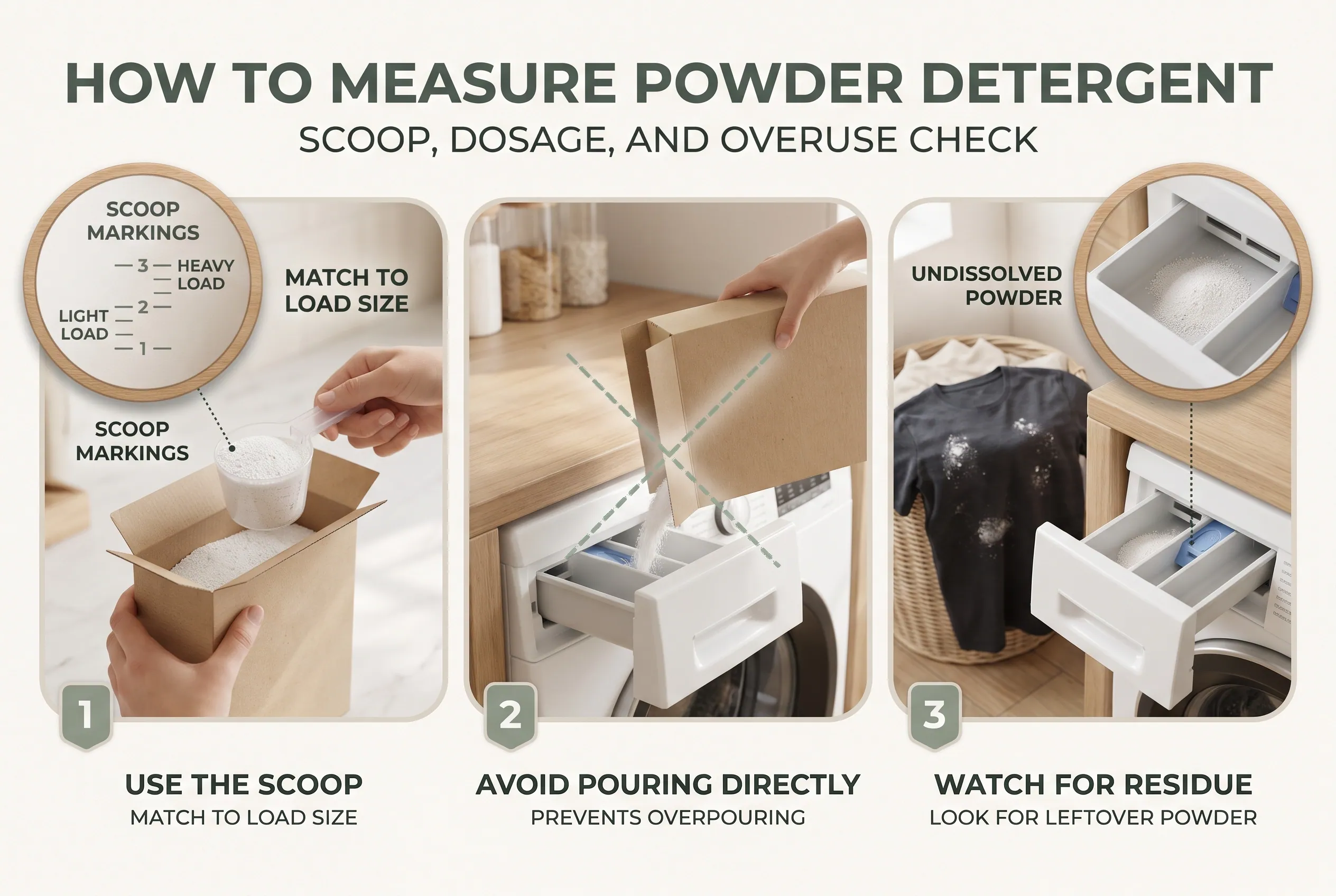
How to measure powder detergent
Use the scoop supplied with the product when available, and check its measurement markings. Do not automatically fill the scoop to the top unless the package tells you to do so.
For example, imagine you are washing a small load of lightly worn T-shirts. The package may recommend a smaller dose for that load than for a full load of heavily soiled work clothes. Follow those instructions rather than using the same amount every time.
Avoid pouring powder directly from the package without measuring. It becomes difficult to judge how much you have used, and repeated overpouring can waste detergent.
Practical check: If clothes come out with detergent marks or the washer leaves powder in the dispenser, check the dose before increasing it. Adding more detergent may make the problem worse.
Where to Put Powder Detergent in Your Washing Machine
The correct location depends on the washer design. Top-load and front-load machines may have different dispensers, and even two machines of the same brand can use different systems.
How to use powder detergent in a top-load washer
Open the lid and look for a detergent compartment or drawer. If it is designed for powder, measure the detergent and add it there according to the manual.
Some top-load models have a removable liquid-detergent cup inside the main detergent compartment. If the manufacturer says to remove this cup for powder, take it out before adding the detergent.
For other models, the approved method may be to add powder to the empty drum before loading clothes. Follow the instructions for your particular machine rather than assuming that every top-loader uses direct-drum placement.
Once the powder is in the correct location, load the clothes without overfilling the tub. Choose a suitable cycle and start the wash.
How to use powder laundry detergent in a front-load washer
Most front-load washers have a dispenser drawer at the front of the machine. It may contain separate sections for the main wash, prewash, fabric softener, and other laundry products.
- Pull out the dispenser drawer.
- Find the compartment marked for the main wash, often labeled II or 2.
- Check whether the compartment has a removable cup or insert intended for liquid detergent.
- If the manual instructs you to remove that insert for powder, remove it.
- Measure the detergent and put it into the approved powder compartment.
- Close the drawer gently and start the appropriate cycle.
Do not put powder into the fabric-softener compartment or another compartment intended for a different product.
Some Whirlpool washers have dispensers that accept either liquid or powdered HE detergent when a selector is placed in the correct position. Other Whirlpool bulk-dosing systems are designed for liquid detergent and require powder to be placed in the single-load dispenser or wash basket, as specified by the model manual.
See Whirlpool’s single-load dispenser instructions for an example of how the correct position changes between powdered and liquid detergent.
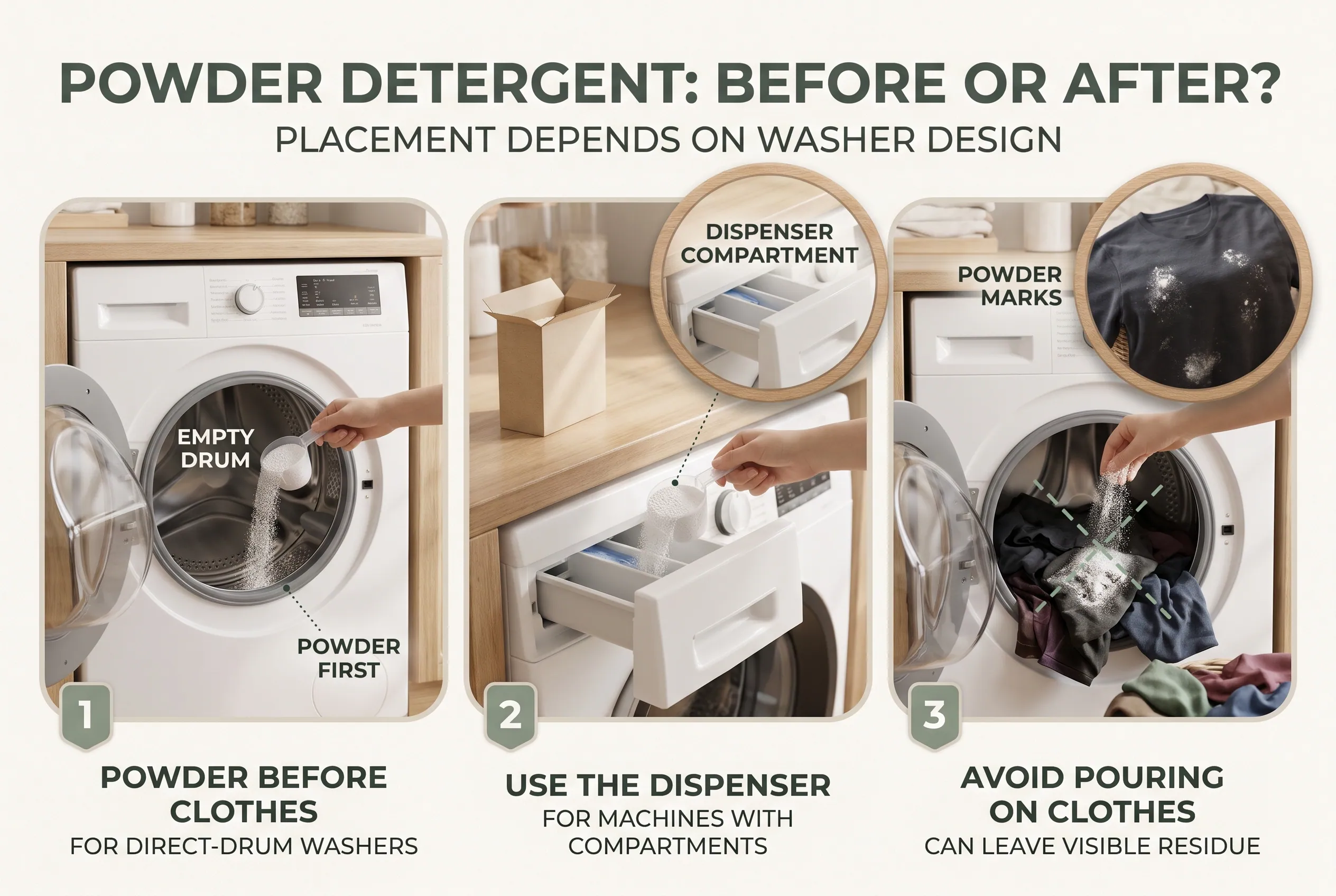
Should you add powder before or after clothes?
This depends on the machine’s design and approved washing method.
When a washer manual specifies direct-drum placement, adding the measured powder before the clothes can help prevent concentrated powder from sitting on dry fabric. When the washer has a dedicated powder dispenser, use that compartment if instructed.
Avoid sprinkling an unmeasured pile of powder over dry clothes. Powder that does not dissolve or rinse away fully can leave visible marks, particularly on dark fabrics.
If your manual provides a different sequence, follow it.
How to Use Powder Detergent in Samsung, LG, and Whirlpool Washers
The brand name alone does not tell you exactly where to put the detergent. Check the manual for your model, because dispenser designs can vary.
Samsung washing machines
Samsung’s official detergent instructions explain how to use the detergent drawer on its top-load and front-load machines.
For the models covered by its instructions, powder goes in the appropriate detergent compartment. If a liquid-detergent cup is installed, it may need to be removed before you add powder.
Samsung also instructs users to use HE detergent in its washing machines and warns that excess detergent can cause problems, including stains, leaks, or appliance damage.
What to check: Open your manual or dispenser diagram before removing an insert. Do not assume that every Samsung model uses an identical drawer.
LG washing machines
LG’s top-load washer instructions state that powder should go into the detergent dispenser. On models with a liquid-detergent cup, the cup must be removed before powder is added.
Putting powder into a liquid-only cup can prevent it from dispensing correctly. Detergent may remain in the compartment, and washing performance may suffer.
LG also advises using the recommended amount. Too much detergent can contribute to residue and buildup inside the machine.
What to check: Confirm that the liquid cup is removed when required, that the powder goes in the main-wash compartment, and that the detergent is suitable for the washer.
Whirlpool washing machines
Whirlpool has several dispenser designs. Some single-load drawers accept powdered HE detergent and use a selector that must be set for powder. Other bulk dispensers are intended for liquid detergent.
For certain bulk-dosing models, Whirlpool instructs users to put powder in the single-load dispenser or the wash basket rather than the bulk container. The exact procedure depends on the model.
Read Whirlpool’s bulk-dispenser guidance before adding powder to a machine with automatic detergent dosing.
What to check: Find out whether your machine uses a single-load compartment, a powder-and-liquid selector, or a bulk liquid dispenser. Never force powder into a compartment that is not designed for it.
Which Water Temperature and Wash Cycle Should You Choose?
Choose the temperature based on the fabric, detergent, and washer instructions. Warm or hot water is not automatically better for every load.
Powder detergents can sometimes be harder to dissolve in cold water, especially if the product is old, damp, or unsuitable for the selected cycle. However, many laundry products are designed for cold-water use.
Using powder detergent in cold water
Cold water can help you follow the care instructions for certain garments, and it can be suitable when your detergent is formulated for cold washing.
If you want to use powder in a cold-water cycle, check the product label for cold-water compatibility. Measure the correct amount and use the placement recommended for your machine.
If you notice white marks after washing, do not immediately assume that cold water is the only cause. The dosage, dispenser, powder condition, and rinse performance may also matter.
You may need to try another detergent specifically suitable for cold water if the problem continues.
Choosing warm or hot water
Warm water may help some powders dissolve, but you should only use it when the clothing and product instructions allow it.
Before changing the temperature, check the garment-care label. Hot water may shrink or damage certain fabrics, affect dyes, or set some stains.
Use the cycle recommended for the type of laundry, too. A quick cycle may be useful for lightly soiled clothes, but it may not provide enough time for heavily soiled laundry in every machine.
Practical rule: Choose the correct fabric setting first. Then select a compatible detergent and temperature instead of using hot water for every load.
How to Use Powder Detergent for Mud, Dirt, and Stains
Powder detergent can be useful for general laundry and clothes with clay or ground-in dirt. The American Cleaning Institute identifies powders as particularly suitable for removing these types of soil.
This can make powder a practical option for children’s play clothes, gardening clothes, and other items that collect dirt.
Washing muddy or heavily soiled clothes
Before washing muddy clothes, remove loose dirt when practical. Brushing away dried mud outside can prevent unnecessary soil from entering the washing machine.
Then check the garment-care label and follow these steps:
- Remove loose dirt without damaging the fabric.
- Measure powder according to the package directions for the load.
- Add it to the approved dispenser or drum location.
- Select a cycle suitable for the fabric and the amount of soil.
- Check the clothes after the wash. If dirt remains, use an appropriate stain-treatment method or wash again when the care label allows it.
Do not assume that heavily soiled clothing always needs a large amount of powder. The correct dose and a suitable cycle are more useful than uncontrolled extra detergent.

What about greasy stains?
Powder is not necessarily the most convenient choice for every stain. Liquid detergent can be easier to apply directly to greasy marks, such as cooking oil or makeup.
Tide’s powder-detergent guide distinguishes between powders for dirt and clay and liquids for greasy stains.
For a greasy mark, use a suitable pretreatment product according to its label, then wash the garment as directed. Check that the stain has improved before using a dryer, because heat can make some stains harder to remove.
Should you soak clothes first?
Soaking may help with some heavily soiled items, but it is not required for every load.
If you choose to soak clothes, follow the detergent and garment-care instructions. Do not leave delicate or color-sensitive fabrics in detergent water without checking whether soaking is suitable.
Only dissolve powder separately if the product instructions or washer manual recommend that method. Avoid pouring concentrated detergent directly onto fabric.
Powder Detergent vs. Liquid Detergent
Both powder and liquid detergents can clean machine-washable clothes effectively. Your choice should depend on the laundry, washing conditions, and product instructions.
| Feature | Powder detergent | Liquid detergent |
| Everyday laundry | Suitable for general loads | Suitable for general loads |
| Mud and clay | Often useful for ground-in dirt | Can also clean dirt, depending on the product |
| Greasy stains | May be less convenient for direct pretreatment | Easy to apply to suitable stains when the label allows |
| Cold-water washing | Some powders may dissolve less easily | Usually dissolves readily in water |
| Measuring | Requires a suitable scoop or measuring tool | Often measured with a cap or marked container |
| Storage | Needs to stay dry to avoid clumping | Needs to remain sealed and stored as directed |
Neither type is automatically better for every household. A household that frequently washes gardening clothes may find powder useful for dirt-heavy loads. Someone who often treats cooking-oil stains may prefer liquid detergent for pretreatment.
You can also use different detergent types for different loads, provided each product is suitable for your machine and clothes.
The main goal is to choose a product that works with your washing conditions, not to assume that the detergent type alone guarantees cleaner laundry.
Why Is Powder Detergent Leaving White Marks on Clothes?
White marks, visible granules, or powder left in the dispenser can indicate that the detergent has not been distributed or rinsed away properly. However, the exact cause can vary.
Start with simple checks before buying another detergent or changing your usual washing routine.
Check the detergent amount
Using too much powder may leave residue on clothes or inside the washing machine. Excess detergent can also contribute to poor rinsing and buildup.
For the next load, follow the product’s measurement instructions carefully. Do not use a full scoop by habit when a smaller dose is recommended for your load.
If the marks continue, consider whether the detergent is suitable for your machine and the type of wash you are running.
Check the dispenser and wash settings
Look at the dispenser after the cycle finishes. If powder remains inside, check whether you used the correct compartment and removed any liquid-only cup when required.
Also consider these possible causes:
- The powder has absorbed moisture and formed clumps.
- The detergent is not intended for the selected cold-water cycle.
- The dispenser is blocked or needs cleaning.
- The load is too large for the selected cycle.
- The machine is not rinsing as expected.
LG’s detergent-dispenser troubleshooting guidance explains that incorrect placement, detergent choice, and maintenance can affect dispensing.
What should you do before the next wash?
If white marks remain on clothing, check the garment-care label and try rinsing or rewashing the items using a suitable cycle without adding unnecessary extra detergent.
Next, reduce the detergent to the correct package-recommended amount if you previously used too much. Check the powder for damp clumps and replace it if it no longer dissolves properly.
Clean the dispenser according to the washer manual. If the washer has a dedicated cleaning cycle, follow the manufacturer’s maintenance instructions.
If residue continues despite correct dosing and placement, check the manual for further troubleshooting. Persistent dispensing or rinsing problems may need manufacturer support or a qualified appliance technician.
Common Powder Detergent Mistakes to Avoid
A few simple mistakes can affect both cleaning performance and the condition of your washer.
- Adding too much powder: Extra detergent does not guarantee cleaner clothes. Use the recommended amount.
- Using the wrong compartment: Powder in a liquid-only insert may not dispense correctly.
- Ignoring HE requirements: High-efficiency washers should use detergent marked for HE machines when required by the manufacturer.
- Assuming all washers work the same way: Follow the instructions for the specific model.
- Using hot water for every load: Check the care label before selecting a higher temperature.
- Pouring a pile of powder onto dry clothes: Follow the approved placement method to reduce the chance of residue.
- Using damp or clumped powder: Store detergent properly and replace product that no longer performs as directed.
- Ignoring dispenser buildup: Clean the drawer and washer as recommended in the manual.
Avoiding these mistakes is often easier and less expensive than repeatedly changing detergents or using additional laundry products to correct poor results.
How to Store Powder Detergent Safely
Powder detergent should be stored in a dry place, inside its original container with the lid or closure secured.
Moisture can cause powder to clump, which may make it harder to measure and dispense. Keep the container away from water splashes and damp laundry areas when possible.
Also keep detergent out of children’s reach. The Poison Control guide to laundry products recommends storing laundry products out of sight and reach of children and keeping them in their original containers.
Do not transfer powder into an unmarked food container. Clear labeling helps prevent confusion about what the substance is.
When handling detergent, follow the package safety directions and avoid getting powder into your eyes. If the product contacts your eyes or skin, follow the label’s first-aid instructions.
Frequently Asked Questions
Do you just put powder detergent in the washing machine?
Yes, but the correct location depends on your machine. Add the measured powder to the designated powder compartment or approved drum location. Follow your washer manual, and remove a liquid-only cup when the manufacturer instructs you to do so.
Where do you put detergent powder in the washing machine?
For many washers, the correct location is the main-wash compartment, often marked II or 2. Some models allow direct-drum placement. Check your machine’s instructions before adding powder, especially if it has removable inserts or automatic bulk dosing.
Can you put powder laundry detergent directly on clothes?
Avoid sprinkling an unmeasured pile of powder over dry clothes. Concentrated powder may leave marks if it does not dissolve or rinse away properly. Use the dispenser or drum placement approved by your washer’s manufacturer.
Can you use powder detergent in an HE washing machine?
Yes, when the detergent is suitable for HE use and the washer allows that product type. Follow the manual for detergent placement and measurement. Using non-HE detergent in a machine that requires HE detergent can cause excessive suds and poor rinsing.
Is powder or liquid detergent better for washing clothes?
Both can work well. Powder is often useful for general laundry and dirt-heavy clothes, while liquid is convenient for pretreating many greasy stains. Consider your laundry needs, water temperature, and machine instructions when choosing.
Final Check Before Starting Your Wash
Before pressing Start, confirm four things: you measured the correct amount, placed the powder in the approved location, selected a suitable wash cycle, and followed the clothing-care instructions.
If your clothes come out clean without visible powder residue and the dispenser empties properly, your method is likely working well. If problems continue, check the dosage, dispenser, powder condition, and machine settings before making bigger changes.
The simplest reliable approach is to use the correct detergent for your washer, measure it carefully, and follow the instructions for your particular model.
Disclaimer
Laundry results vary by washing-machine model, detergent formula, water conditions, load size, and fabric type. Follow product and garment-care instructions, and consult the manufacturer or a qualified appliance technician if persistent dispensing problems continue.